
I’ve been reading the comments under videos posted by South Indian bodybuilders on social media. Most of their “content” is what you’d expect: gym videos — leg days, shoulder days, ab days — muscle flexing at bodybuilding competitions, and the mandatory bicep-curl mirror selfies. What I wasn’t expecting were the reactions from younger star-struck men; their gaze is that of someone who would do anything to be the person they are watching on the screen.
“Super Chechi power,” says one of them (Chechi means older sister in Malayalam) under a video of Arathy Krishna, a prizewinning bodybuilder from Kerala, casually pushing weights on a leg-press machine. “A big salute to Arathy, Ma’am,” says another. And on and on it goes.
Photographer Keerthana Kunnath first saw Arathy Krishna on Instagram three years ago. Until then, she did not know of any woman from Kerala, her home state in southern India, who was into bodybuilding. She sent Krishna a message asking if they could talk. That long phone conversation pulled Kunnath into a scene that was then made up of around half a dozen women working out in different parts of Kerala. Still, Kunnath told me she could sense that they had the power to shake up a conservative society’s views about women.
India has long been obsessed with the muscular body. The country’s religious mythology as well as its pop culture reveal a deep interest in the toned human form. Today, signs of this enthusiasm can be found on wrestling grounds and in local gyms. Even the smallest towns host events and competitions. But women bodybuilders have rarely featured in the Indian imagination. Some of the factors that have stood between women and weightlifting are universal, such as the fear that a strong, chiselled body might make them look less feminine. In India, as in many other parts of the world, women also have limited access to resources such as gym memberships and, perhaps most significantly, free time to train. But one question nags women considering competing more than anything else: “What will people say?”

“People feel like they have a right to express opinions on their bodies because these women show their bodies as part of being a bodybuilder,” Kunnath told me. When she began travelling across Kerala to make this series, she noticed that men would often become aggressive if she asked them to leave because their presence was making her subjects uncomfortable. On one occasion, a man drove away on his scooter, only to return with a friend, both seemingly drunk.
Bodybuilding is about showing off the body — its size, strength and power — but not in ways that cater to the lurid glances of men. A bodybuilder wins a competition by displaying her flexed muscles — her biceps, calves, glutes — on a stage. And she often does so wearing very little, in front of a large crowd.
Performance is an integral part of their lives. “When they are on stage, every time the host says ‘cut’, they must strike a different pose,” said Kunnath, who has accompanied her subjects to several competitions over the past three years.
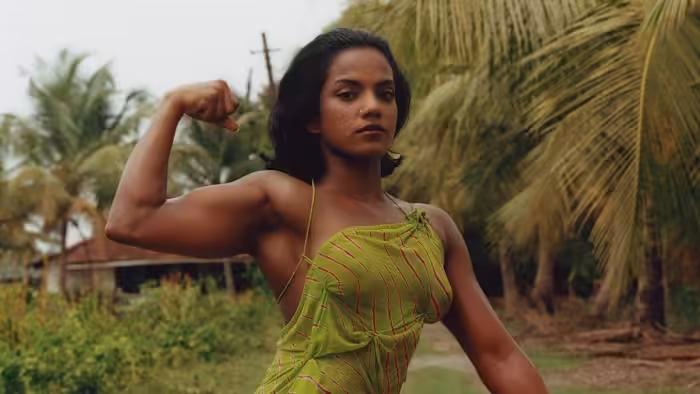
A big chunk of Not What You SawKunnath’s show at Foam 3h in Amsterdam, works within this pre-existing tradition of staging. She casts her subjects as majestic figures, inhabiting a realm shaped both by their reality and Kunnath’s imagination — although Kerala’s landscape of coconut groves, beaches and backwaters is never far from view.
The costumes add to the theatricality. A fashion stylist who calls himself Elton John, also from Kerala but based in Bengaluru, played with traditional handwoven silk Indian fabrics and other patterns local to the subcontinent to create distinctive silhouettes for each woman. The effect is spellbinding: a pleated skirt, dhoti-style shorts, a gauzy shift, a bow-tied blouse, a beaded crop top — loose fabric all fashioned into dazzling patterns that drape over the models. More than statement pieces, the fabrics give the impression that the women have pulled out heirlooms from family attics, clothes that might once have belonged to their mothers and aunts. “We didn’t really see it as a fashion editorial. We were just playing with whatever material was available,” Kunnath said.


John’s drapes are soft and glamorous but they also allow the women to flaunt the muscles in which they take the most pride. “When these girls flex, you can see these beautiful cuts. And I wanted to highlight the sculptural aspect of their usual poses,” Kunnath said.
On shoot days, she found she barely needed to direct them. The women knew exactly how they wanted to be photographed. “They would tell me, ‘Let’s try this pose because this muscle will come out really well.’” What they wanted to emphasise depended on what they were working on at the time. “Some would say, ‘Right now I’m focusing on the upper body, so let’s focus on pictures that would bring that out’.”
Typically, Kunnath spent months talking to the women over the phone before travelling to their towns to make the portraits. Many of those conversations revolved around family. The younger women in her series were living with their parents when they took up bodybuilding, usually after coming across a woman who had taken up the sport. Their first real challenge was breaking the news to their parents. Some hid their new hobby at the beginning, as one might a lover. They turned their rooms into gyms and appointed YouTube as their trainer.
Bhumika Senthilkumar was one of them. She grew up with overprotective parents and wasn’t even allowed to take part in sports at school. But secretly, she watched bodybuilders on social media. After graduating from high school, she decided to pursue her dream. Through Instagram, Senthilkumar found a fitness coach in Kochi, her hometown, and showed up at his gym asking to be coached. He took her on. Now she had to tell her parents. Their response wasn’t outrage but embarrassment. “They would never have wanted that life for me,” she told Kunnath. They had hoped she would follow her mother into the medical profession.
Senthilkumar kept pushing for their acceptance. But it didn’t come, not even after she began winning regional and national championships: Miss Ernakulam, then Miss Kerala, and eventually Miss India, twice in a row. “She wanted them to feel proud of her. She kept going,” Kunnath said.


In 2025, Senthilkumar won her first international title, clinching gold in the Women’s Wellness category at the 16th World Bodybuilding Championship in Indonesia. She accepted the medal — a chiselled woman sculpted in gold — wearing a pearl-studded off-white bikini and matching stilettos. To complete the world-champion look, she draped the Indian flag around her shoulders.
In Kerala, people woke up to the image on the front pages. “Her parents could see her being interviewed in the newspapers and on television. Everyone was talking about her, praising her,” Kunnath told me. The attention convinced them that “she was doing something right”. Now her parents are among her fiercest supporters, proudly defending her against the concerns of relatives.
The struggles of the women that Kunnath documents are as varied as their backgrounds. Sandra AS failed to convince her family to let her train as a bodybuilder. “They were worried about what people would say, how society would look at me,” she recalled to Kunnath. So she ran away from home. Kunnath pointed out that this is a well-established template for rebel girls in Kerala, one that often ends in a peaceful reunion. The same was true for Sandra, who returned home after her first competition and continued her training. Now a professional weightlifting athlete, the 25-year-old balances a busy competition schedule with her day job as a gym trainer.
For some, the biggest challenge has been convincing themselves, rather than their families, that they don’t need to have a certain kind of body to be bodybuilders. For Kunnath, one of the most rewarding aspects of making her series has been meeting women who started this journey in their mid-to-late thirties. Some were new mothers who took up lifting simply to lose weight, but with fitness came confidence. For some, having well-defined muscles made them feel more feminine. They kept lifting until their bodies resembled the photographs they had once saved on Instagram.


Kavitha P, a mother of two who started training in her late thirties, had the full support of her husband, a bodybuilder, who set up a gym for her in their back garden. But it wasn’t only her body that changed once she embraced bodybuilding. She says that her idea of what her days are meant to look like also changed.
Spending time with these women — at their homes, gyms and competitions — influenced how the series evolved. While the process initially involved arranging locations, costumes and staging, Kunnath’s more recent portraits feature them as women with complex lives, rather than just bodybuilders. “These women also have roles they play in their families, as friends, in society,” she said.
Some later portraits show subjects in what might appear to be more stereotypical roles, working in the kitchen or helping their children with homework. Kunnath is quick to clarify that this wasn’t to glorify domesticity. Rather, she wanted to reflect how her subjects navigated competing priorities. She found that their inner battles were no different from those faced by other working women: the guilt, for instance, of not being able to give more time to a child approaching an important exam.

As the series evolved, it also opened a path for 30-year-old Kunnath to talk to her own family about the strict cultural ideas of femininity that shaped her girlhood in Kozhikode, a coastal city in north Kerala. Sharing the photographs with her female relatives sometimes provoked laughter. But it also provided a springboard for discussions about women having autonomy over their bodies. Even her father, who had disapproved of her wearing jeans or sleeveless tops as a girl, now acknowledges that it is time to stop judging girls and women by what they wear.
It’s not just her family that is beginning to question cultural expectations of what women should look like. During her outdoor shoots with the bodybuilders, awkward comments from curious strangers could quickly morph into expressions of admiration. While many of these people may be responding to these women’s success, Kunnath believes that positive societal change has also shaped attitudes. “I sound really old when I say this, but I’m actually liking this new era.”
“Not What You Saw” is at Foam 3h in Amsterdam until November 27; foam.org
Find out about our latest stories first — follow FT Weekend Magazine on X and FT Weekend on Instagram
Source: www.ft.com