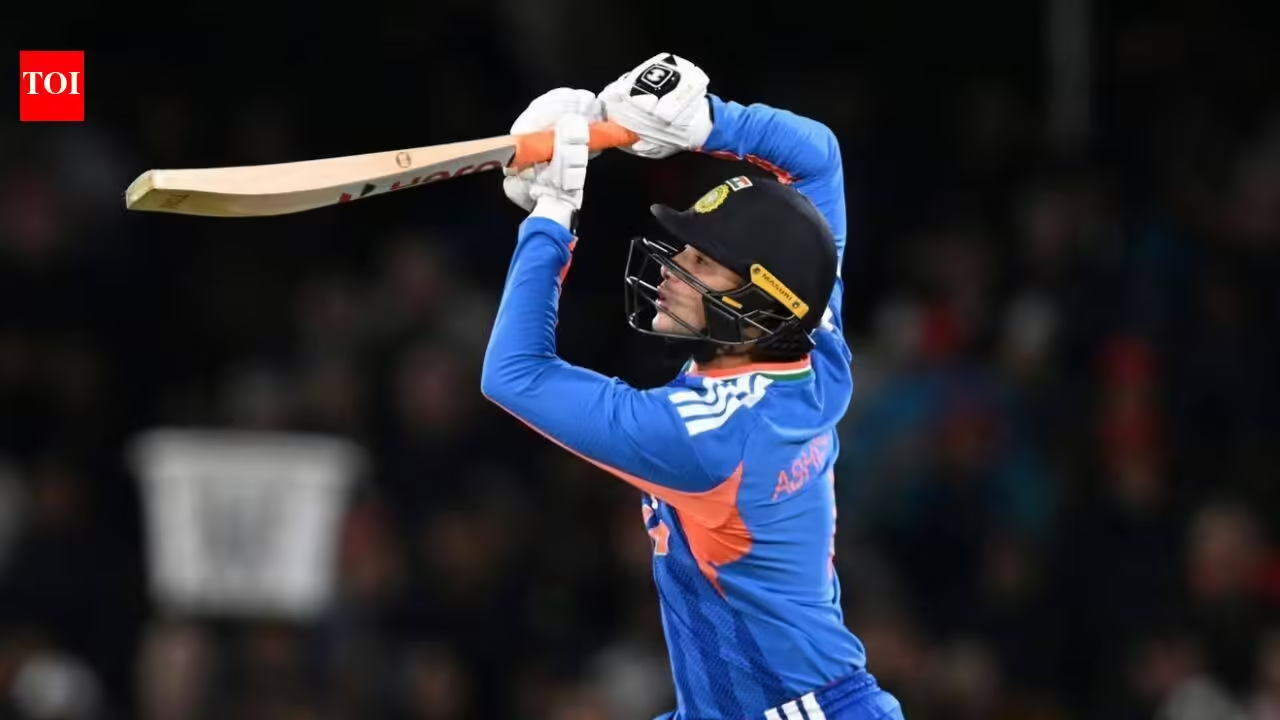

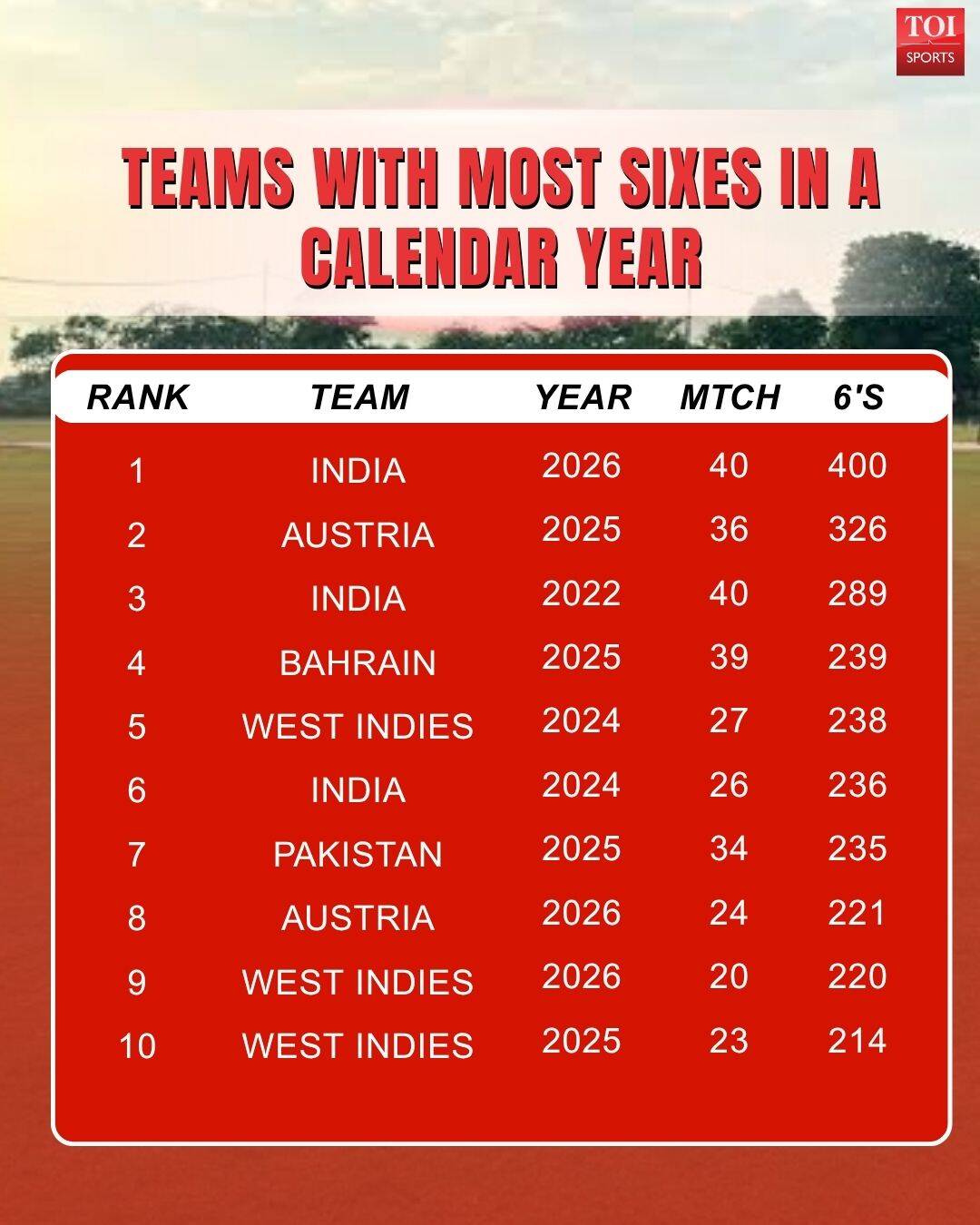
NEW DELHI: India hit 289 sixes in 40 T20Is in 2022. Four years later, they have smashed 400 in the same number of matches, a staggering 38.4 per cent increase. And the six-hitting spree is far from over. It has merely been put on hold for eight weeks, with Shreyas Iyer’s men set to resume their big-hitting exploits against Sri Lanka in a three-match T20I series in December.On the second ball of the 19th over against New Zealand, Naman Dhir’s top-edge sailed over fine leg and landed 15 rows back in the stands. It was India’s 400th six in 2026, making them the first team to reach this monumental milestone. Of those, 142 have come against New Zealand, the most India have hit against any opposition in a calendar year.India’s six-hitting prowess was also one of the reasons behind their 3-2 series win against New Zealand. Indian batters smashed 142 sixes, compared to New Zealand’s 61. In pure numbers, that is a difference of 486 runs.
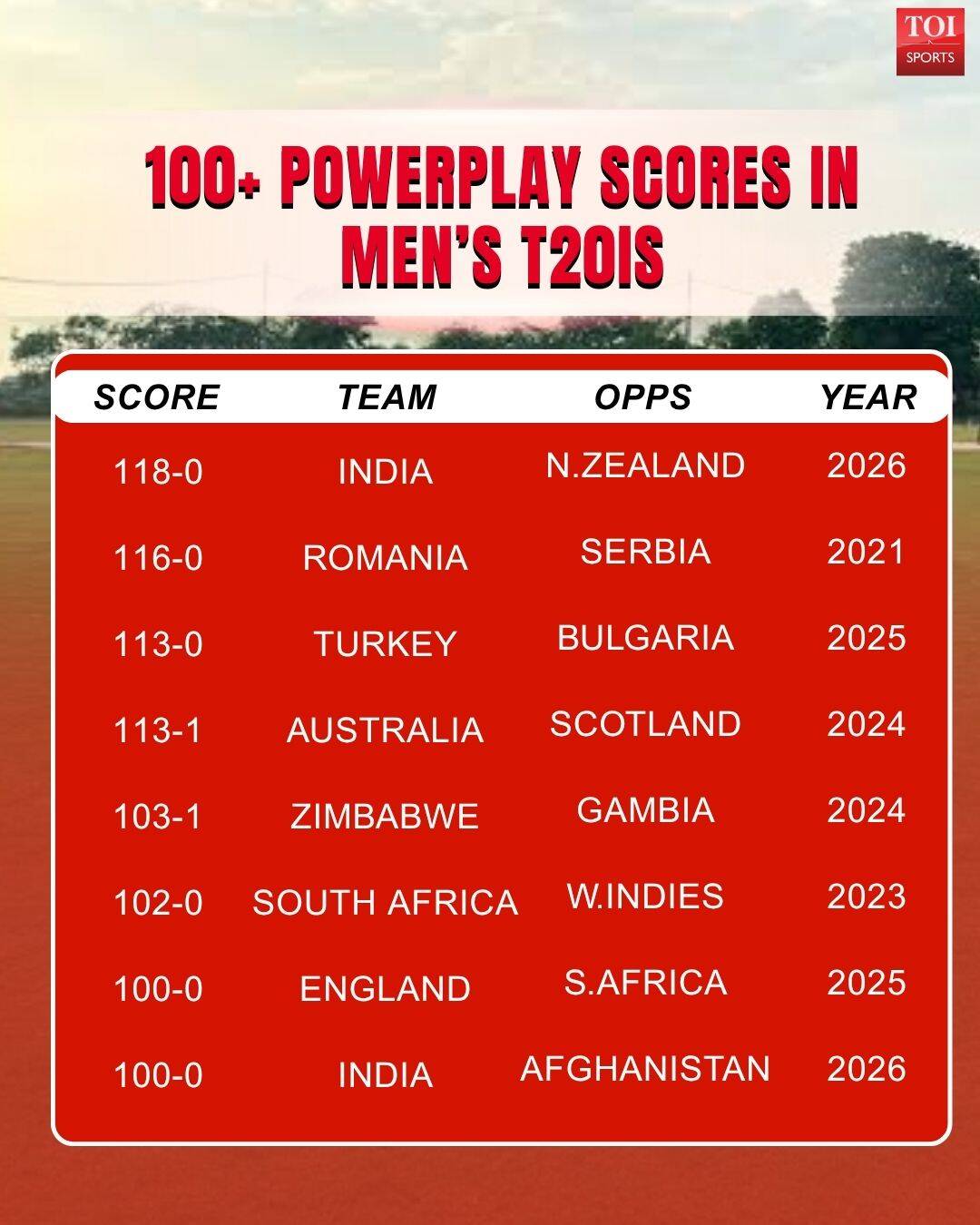
A majority of India’s six-hitting has come from the designated top three, with Abhishek Sharma leading the way with 86 sixes, followed by Ishan Kishan (60) and Sanju Samson (50). It also tells the story of why India are the only team to have crossed the 100-run mark in the Powerplay twice. India have smashed 145 sixes in the first six overs alone. Across their 40 matches, Indian batters have amassed 2,681 runs in 239 overs, at a blistering strike rate of 189.96 and a staggering run rate of 11.21.These numbers reflect India’s dominance in T20I cricket, having won back-to-back T20 World Cup titles. Renowned power-hitting coach Julian Wood believes India’s approach to batting is vastly different from that of other teams.

“I think India are approaching T20 cricket differently from other nations. They’re batting differently and not managing risk in the traditional sense. Instead of managing risk, you have to master the skill, and I think Indian batters are doing that very well,” Julian Wood, the power-hitting coach, tells TimesofIndia.com.“India probably have the largest pool of players playing T20 cricket in the world, which means they’re adapting to the evolution of the game quicker. The game has evolved massively and will continue to do so, but India are definitely ahead of the curve at the moment,” he adds.
Batting has evolved massively, and it continues to evolve very quickly. Batters are now hitting length balls. The only delivery you can’t really hit is a yorker.
Julian Wood | Power-hitting coach
While flatter pitches and smaller boundaries are often cited as reasons behind the surge in six-hitting, Wood believes the evolution of batting has left bowlers with very little margin for error.“Batting has evolved massively, and it continues to evolve very quickly. Batters are now hitting length balls. The only delivery you can’t really hit is a yorker,” he says.Citing Vaibhav Sooryavanshi’s ability to hit all around the ground, from mid-off to fine leg, Wood explains that bowlers have little margin for error against such aggressive batters. “If you’re going to bowl wide to him, you’d probably have to bowl wide and full. But you have to execute that delivery perfectly. The problem for bowlers is that when they miss, the ball doesn’t just go for four; it goes for six. That puts them under tremendous pressure.“
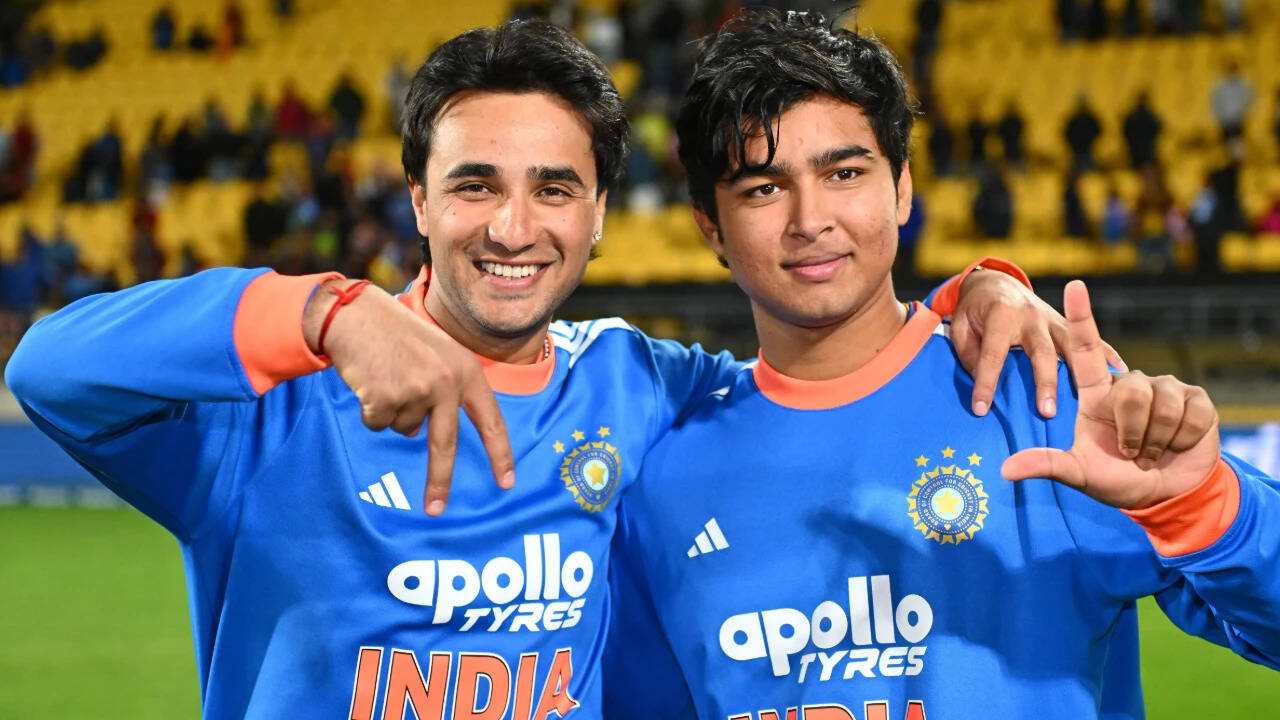
India’s Abhishek Sharma, left, and Vaibhav Sooryavanshi (AP/PTI)
Wood points to Sooryavanshi’s sixes off Jasprit Bumrah and Pat Cummins in the IPL as examples of this changing mindset. “It’s almost as if there’s a lack of respect, but he knows that if the bowler misses, he can hit him for six. The mindsets of both batters and bowlers have changed. Batters now think, ‘If he misses, I’m going to hit him for six.’“I’ve worked a lot with Liam Livingstone. When he was at his peak, his mindset was similar. He knew that if the bowler executed his skill perfectly, he might get him out. But if the bowler missed, he would hit him for six. That kind of mindset is very dangerous.”Sunrisers Hyderabad batting coach Hariesh Jaikumar echoes Wood’s sentiments, attributing the evolution of T20 batting primarily to the improvement in batting standards.
I think the quality of batting has improved significantly. Players have also started playing fearless cricket. They don’t have the inhibitions that batters may have had earlier.
Hariesh Jaikumar | Sunrisers Hyderabad batting coach
“You have to give credit to the batters. People say the pitches have become flatter, but even three or four years ago, similar pitches were being prepared,” he told this website.“I think the quality of batting has improved significantly. Players have also started playing fearless cricket. They don’t have the inhibitions that batters may have had earlier. The game itself has evolved completely,” he adds.One of the biggest changes in Indian batting since the defeat to England during the 2022 T20 World Cup has been the emphasis on occupying the crease and the shift away from relying on finishers to provide the big hits towards the end. Today, it is the openers who are dominating the Powerplay.
“I think a new breed of cricketer is emerging. Players who were traditionally finishers are now batting higher up the order. Instead of asking them to face just 10 to 15 balls, teams want them to face more deliveries,” explains Wood.“When those players move up the order, the batters coming in behind them are also hitters with the mindset to attack from ball one. That’s how I see the game evolving. In five years, teams could be full of this type of cricketer. The top eight batters could all be players who just want to smash the ball. We’re already beginning to see that,” he says.
Everybody knows that Test cricket and ODI cricket complement each other, but T20 cricket is now a different beast.
Julian Wood | Power-hitting coach
Wood believes the evolution of T20 cricket has also had a positive impact on the 50-over format and Test cricket, particularly by encouraging batters to adopt a more aggressive approach.“The game is phenomenal. T20 cricket will help 50-over cricket, as we’ve already seen. Sri Lanka, for instance, chased 430 against India and England. It’s great for the game. Everybody knows that Test cricket and ODI cricket complement each other, but T20 cricket is now a different beast,” he says.
Which factor do you think has contributed the most to India’s success in T20 cricket?
3k+ users shared opinion today
5k+ users already voted today
3k+ users shared opinion today
India’s 400 sixes are more than just a statistical milestone. They reflect a shift in batting philosophy, where power-hitting is no longer the preserve of finishers but a skill expected across the top order. As Wood points out, the next phase of T20 cricket could see teams packed with batters who attack from ball one. India, meanwhile, are already giving a glimpse of what that future looks like.
Source: timesofindia.indiatimes.com