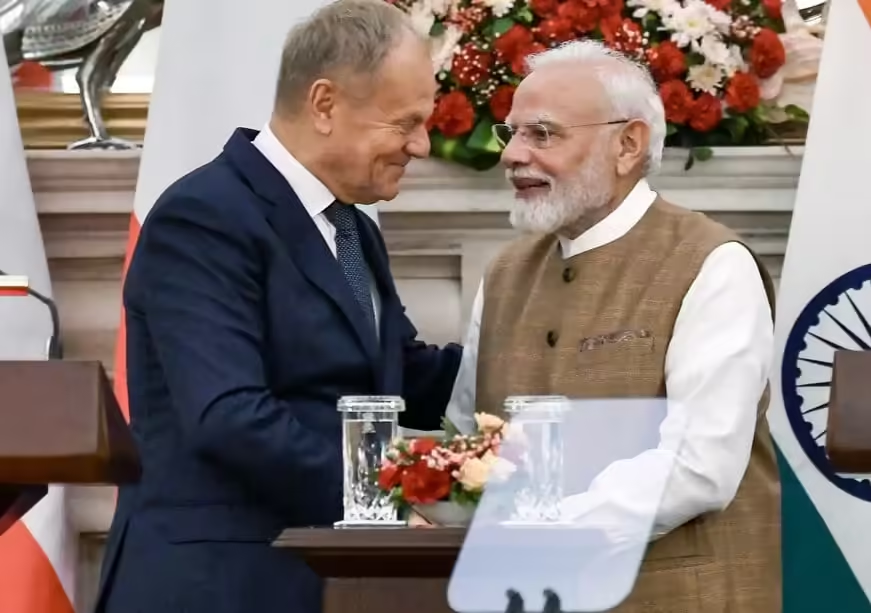

Polish Prime Minister Donald Tusk’s visit to India in October offered an opportunity to build on the strategic partnership established during Prime Minister Narendra Modi’s 2024 visit to Poland. Set against a markedly more challenging geopolitical backdrop than Tusk’s previous visit to India as prime minister in 2010, the engagement brought defence cooperation into sharper focus. Its prominence in both the Action Plan 2024-28 and the latest India-Poland joint statement underscores its growing importance within a bilateral agenda spanning economic ties, space, digital technology, and energy.
The Strategic Rationale
The India-Poland defence relationship rests on decades of practical cooperation. During the Cold War, Poland supplied military equipment to India and developed industrial links that extended into subsequent decades. Cooperation between Poland’s Bumar and India’s BEML on WZT-3 armoured recovery vehicles, which support the Indian Army’s T-72 tanks, offers an established foundation for further collaboration.
Russia’s invasion of Ukraine has sharpened Poland’s strategic importance, given its key role in Europe’s evolving security architecture as a frontline state on NATO’s eastern flank and a crucial logistical hub for support to Ukraine. Poland’s substantial defence expenditure, the highest among NATO countries at 4.8 percent of GDPand its plans to replace legacy Soviet-era equipment with “modern Western weapon systems” reflect both immediate security pressures and a long-term drive to strengthen military capabilities. Against the backdrop of strained transatlantic ties and the ongoing war in Ukraine, Poland placed security at the centre of its 2025 presidency of the Council of the European Union, during which the EU advanced major defence initiatives, including ReArm Europethe €150 billion SAFE instrumentand the Readiness 2030 White Paper.
As Europe rearms, India’s renewed engagement with Poland reflects this redistribution of strategic influence, as both New Delhi and Warsaw commit to defence modernisation. The complementarities and synergies are clear.
For New Delhi, closer engagement with Warsaw would diversify defence partnerships while supporting indigenous production and technological development. India’s manufacturing scale, engineering workforce, and growing private defence sector could complement Poland’s advanced technologies and defence industrial expertise. Despite a large national defence budget, the production capacity of Polish defence firms remains limited. Joint manufacturing and research into new technologies could help meet Indian capability requirements, while easing the production constraints facing Polish industry and more closely integrating the two countries’ defence industrial ecosystems.
The broader EU-India relationship, which has seen tremendous recent progress, adds momentum. The EU-India Security and Defence Partnership (SDP)signed in January 2026, provides a framework for cooperation across defence, cybersecurity, space, maritime security, and critical technologies, thereby reinforcing and supporting bilateral initiatives. The likely ratification of the EU-India Free Trade Agreement by the end of this year may also boost Indo-Polish bilateral defence trade, coupled with the recently announced target to double trade from the current €6 billion. Poland’s position within European manufacturing networks may serve as a gateway for Indian companies seeking to expand their presence across Central and Eastern Europe.
Key Areas for Defence Cooperation
Maintaining and upgrading Soviet-origin equipment remains a practical starting point for India-Poland defence cooperation. Polish expertise in armoured vehicles and military engineering could help India sustain and modernise its legacy platforms, such as T-72 tanks. The long-term opportunity, however, lies in deepening defence industrial collaboration and developing capabilities for contemporary warfare in areas such as unmanned systems, counter-drone systems, electronic warfare, and secure battlefield communications.
Cyber defence could encompass protecting critical networks and developing secure communications infrastructure, while naval cooperation could focus on sensors, radar integration, and specialised ship components. Space-based imaging and satellite-data applications provide further possibilities.
Polish company WB Group’s Indian presence, through its subsidiary WB Electronics India, offers an existing commercial foundation for cooperation in drones and military electronics, given Polish expertise in this area. Pitching India as a future drone manufacturing hub, WB’s proposed manufacturing facility in Jhansiwithin the Uttar Pradesh Defence Industrial Corridorwould deepen links with Indian suppliers and engineering talent.
India’s growing capabilities in electronics, ammunition, aerospace components, shipbuilding, and autonomous systems also offer opportunities for Polish manufacturers. Connecting established companies with startups and research institutions would help identify specialised projects with credible commercial prospects.
The goal should be an initial portfolio of achievable projects. Institutional mechanisms can help translate ambitions into tangible outcomes. The Joint Working Group on Defencewhose eighth meeting took place in Warsaw in September 2026, provides an established government channel. India’s reopened defence wing in Warsaw in 2024 and the newly launched Defence Industry Dialogue can help identify priorities by linking technology firms, defence manufacturers, and other stakeholders, and by encouraging direct business engagement and defence innovation. In this context, the India-Poland Business Forums in New Delhi and Bengaluru, which brought together almost 100 Polish companies, including defence firms, aimed to open doors to new industrial partnerships.
Bridging Differences
Yet the relationship is not without frictions, including differing threat perceptions that complicate deepening security and defence ties. Warsaw views Russia as its immediate and primary security threat and perceives New Delhi’s Russian oil purchases as financing Moscow’s war, while New Delhi’s relationship with Moscow reflects longstanding defence dependencies and concerns about China. India’s objections to Polish engagement with Pakistan further expose sensitivities, as was evident in the aftermath of Foreign Minister Radosław Sikorski’s visit to Pakistan in 2025a few months after Operation Sindoor, in which Polish drones were, incidentally, useful in dismantling Pakistani terror infrastructure. While Tusk’s assertion that both countries “have no conflicts of interest” is promising, sustained strategic trust will need to be consciously built, particularly to facilitate technology transfers.
Warsaw views Russia as its immediate and primary security threat and perceives New Delhi’s Russian oil purchases as financing Moscow’s war, while New Delhi’s relationship with Moscow reflects longstanding defence dependencies and concerns about China. India’s objections to Polish engagement with Pakistan further expose sensitivities, as was evident in the aftermath of Foreign Minister Radosław Sikorski’s visit to Pakistan in 2025
India’s defence imports have steadily diversified, with Russia’s share declining from 70 percent in 2011-15 to 40 percent in 2021-25. If European countries offer India better alternatives, including access to sensitive technologies, this trend may accelerate further. Meanwhile, Tusk has welcomed New Delhi’s recent constructive engagement with both Russia and Ukraine, and its proposed peace plan, which Kyiv has described as the most comprehensive put forth so far.
Finalising the unfinished agreement on the mutual protection and exchange of classified information is a prerequisite for deeper India-Poland defence and technology cooperation. Credible safeguards against unauthorised transfers and enforceable end-use conditions are needed to address sensitivities, particularly on technology sharing and access. Meanwhile, distinguishing projects that require additional protections from those that do not would prevent sensitive negotiations from delaying cooperation that is possible in the short term.
Aligning Intent, Ambition, and Trust
As a key pillar of bilateral engagement, defence cooperation can anchor a more strategic India-Poland partnership, supported by convergence on counterterrorism, multilateralism, and concerns about China, alongside expanding EU-India engagement. Warsaw’s willingness to decouple the Ukraine issue from wider security cooperation reflects a pragmatic recognition of India’s security constraints.
Poland and India increasingly see each other not just as markets but as partners whose security and industrial interests overlap. Translating political commitments into commercially viable joint ventures, and building the trust needed to support technology sharing, will give governments and businesses a lasting stake in the relationship and extend its value beyond ceremonial visits.
Tusk’s visit has supplied political momentum and a clear agenda; sustained progress now requires contracts, investment, and joint production. Combining Polish engineering and technological capabilities with India’s manufacturing capacity could strengthen defence supply chains and create enduring industrial links. Industrial ventures should support joint development and co-production, creating relationships that extend beyond equipment purchases and a traditional buyer-seller dynamic.
As two major, fast-growing economies, Poland and India increasingly see each other not just as markets but as partners whose security and industrial interests overlap. Translating political commitments into commercially viable joint ventures, and building the trust needed to support technology sharing, will give governments and businesses a lasting stake in the relationship and extend its value beyond ceremonial visits.
Shairee Malhotra is Deputy Director of the Strategic Studies Programme at the Observer Research Foundation.
The views expressed above belong to the author(s). ORF research and analyses now available on Telegram! Click here to access our curated content — blogs, longforms and interviews.
Source: www.orfonline.org