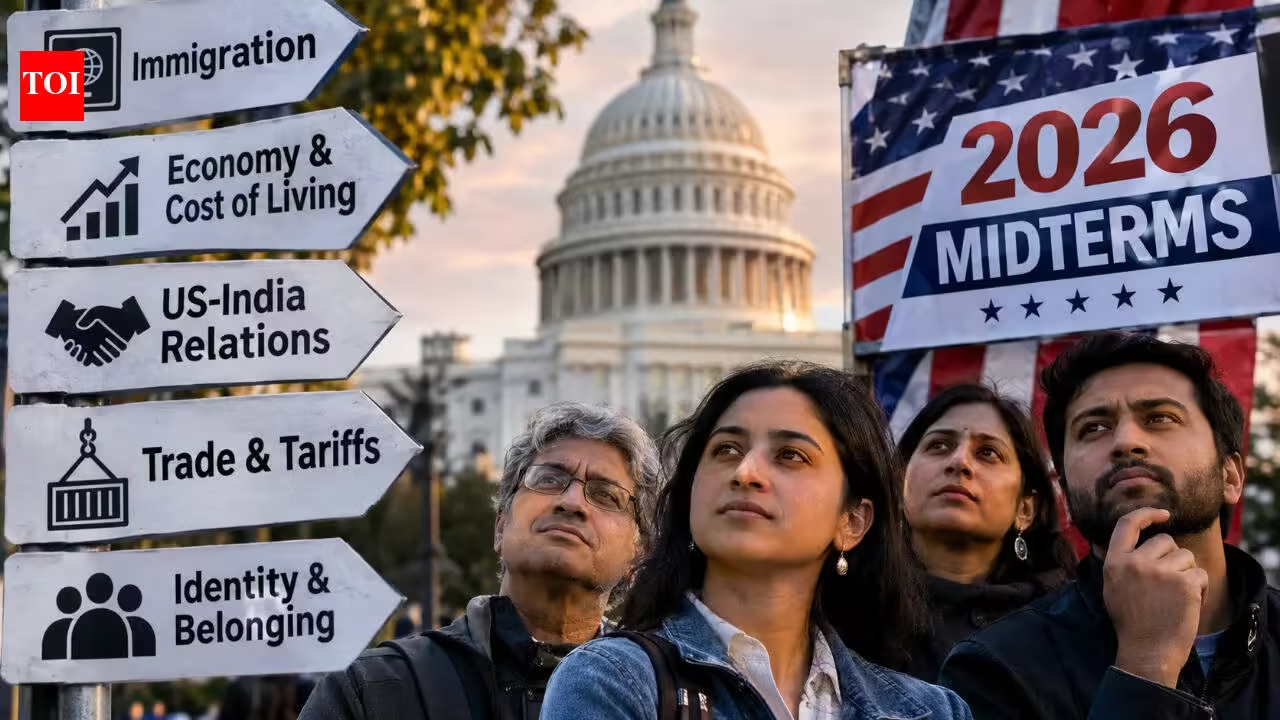

Indian-Americans may account for only around 1.5% of the US population, but their political preferences are attracting growing attention ahead of the November 3 midterm elections. A community that has traditionally been among the Democratic Party’s most dependable constituencies is once again moving decisively towards Democrats after a period of growing Republican appeal.Immigration, the domestic economy, international economic policy and the state of US-India relations have all become sources of dissatisfaction with Trump. These concerns have coincided with a broader debate over the place of Indian-Americans in US society, making the political choices confronting the community particularly consequential.
Immigration
For Indian-Americans, immigration policy also has a distinctly personal dimension, particularly for professionals who entered the US on employment-based visas and later became naturalised citizens. The H-1B programme, widely used by Indian technology workers, remains an important pathway for skilled migration and eventually citizenship.Uncertainty surrounding work visas, the ability to change employers, visa renewals and the long wait for permanent residency can affect not just individual careers but entire families. Any tightening of the system therefore has implications that extend well beyond border enforcement.Trump’s tougher approach to skilled immigration has caused havoc in the community. His administration’s moves on H-1B visas, including a controversial $100,000 payment requirement for certain new applications by workers outside the US, have raised concerns among employers, technology professionals and prospective migrants. The prospect of higher costs and tighter restrictions has also fuelled fears that American companies could become less willing to hire overseas talent.The pressure extends beyond the H-1B programme. The administration has replaced the traditional random H-1B lottery with a weighted selection system that favours higher-paid and higher-skilled applicants, while proposing higher prevailing-wage requirements. It has also expanded social-media screening to H-1B applicants and their H-4 dependents, requiring them to make their online profiles publicly accessible for vetting.For thousands of Indian professionals and their families, these changes mean greater uncertainty over employment, visa renewals and chance at naturalised citizenship.These concerns make Trump’s immigration approach particularly consequential for a community with a significant foreign-born population.The Carnegie survey found that 64% of Indian-Americans disapproved of his handling of immigration.While the study does not isolate H-1B visa policy as a separate voting issue, the broader dissatisfaction reflects the political sensitivity of immigration in a community whose professional and personal lives are closely intertwined with America’s migration system.
The economy
Economic performance is another major source of dissatisfaction with the Trump administration. For Indian-Americans, as for voters across the United States, the domestic economy is an important measure of presidential performance.The Carnegie survey found that 68% of Indian-Americans disapproved of Trump’s handling of domestic economic policy. This assessment covered issues including inflation, taxes and government spending. Economic policy is not a niche concern affecting one section of the community. It is a broad measure of how voters assess the administration’s ability to manage their everyday financial circumstances.The economy also complicates the Republican Party’s efforts to retain the support it gained among Indian-Americans in 2024. Trump’s appeal to some sections of the community was part of a wider shift that narrowed the Democrats’ traditional advantage. But dissatisfaction with his administration’s economic management has weakened the prospects of converting those gains into lasting political support.
Trade and tariffs
International economic policy is another area where Trump faces considerable opposition among Indian-Americans.The Carnegie survey found that 70% disapproved of his handling of international economic policy, including trade, tariffs and sanctions. This was the highest disapproval figure among the three broad policy areas examined in the survey.For a community with strong professional, commercial and family connections across national borders, international economic decisions can carry consequences beyond diplomatic disagreements.Trade policy, tariffs and sanctions form part of the wider economic relationship between the United States and the rest of the world. They also influence the environment in which businesses, professionals and international partnerships operate.The finding is particularly important because it suggests that dissatisfaction with Trump is not restricted to domestic economic management or immigration. His administration’s approach to the global economy is also facing resistance within a community that has traditionally maintained strong international connections.Republican gains among Indian-Americans in 2024 demonstrated that the community was not immune to Trump’s economic and political messaging. But the latest findings indicate that those gains have proved difficult to sustain.
US-India relations
The state of US-India relations is another issue shaping the political mood among Indian-Americans, although it is important not to overstate its electoral significance.For years, the strengthening of ties between Washington and New Delhi was viewed positively by many in the Indian-American community. The relationship had become an important part of the broader narrative of India’s growing international influence and the diaspora’s increasing political visibility in the United States.But Trump’s second term has brought fresh uncertainty to the relationship.The Carnegie survey found that large majorities of Indian-Americans disapproved of Trump’s handling of US-India relations, which had once been a relative strength for him. This is particularly notable because the community’s assessment of the president’s performance on India has deteriorated alongside its views on immigration and economic policy.However, there is an important caveat. The October 2026 survey does not provide a separate percentage ranking US-India relations among voters’ most important election issues. It establishes dissatisfaction with the administration’s handling of the relationship, not that foreign policy is necessarily a decisive factor in the congressional vote.The survey, however, notes that Indian-Americans may be concerned about the direction of bilateral ties, but their electoral decisions are not necessarily driven by what happens between Washington and New Delhi.
Identity and belonging
Beyond conventional policy questions, Indian-Americans are increasingly finding themselves at the centre of a debate about national identity and belonging.The Carnegie report points to an incident that brought these tensions into sharp focus ahead of the midterms. Republican candidate Bo French, running for state office in Texas, posted a photograph of University of Texas students of visibly South Asian origin celebrating their football team’s success.His accompanying remark — questioning whether the university’s graduation ceremony looked like the photograph — ignited a debate about the place of Indian-Americans in American society.The controversy showed how questions of immigration, identity and belonging can become intertwined.Indian-Americans number fewer than six million and constitute approximately 1.5% of the US population. Yet their growing presence in professional, academic and political life has made them increasingly visible in national debates.The Texas controversy also illustrates how political rhetoric about demographic change can affect communities that have traditionally been regarded as successful examples of immigrant integration.The Carnegie survey’s October article does not quantify how much this particular controversy will influence voting decisions. Nevertheless, the debate provides an important backdrop to the midterm elections. For Indian-Americans, the political conversation is not confined to taxation, economic performance or immigration rules. It also concerns how comfortably they feel represented and accepted in the country they call home.
The Republican problem
Perhaps the most consequential finding of the Carnegie survey is not about any single policy issue but the extent to which Indian-American voters appear to be moving away from Republican candidates. For decades, Indian-Americans have been among the Democratic Party’s most reliable constituencies. But the 2024 presidential election demonstrated that this loyalty was not permanent.In 2020, 68% of Indian-American citizens intended to vote for Joe Biden, compared with 22% who supported Trump.Four years later, 62% backed Kamala Harris while 30% favoured Trump.The Republican gains were significant, particularly because they suggested that Trump was making inroads into a community that had traditionally leaned heavily towards Democrats. But the latest Carnegie findings indicate that this momentum has not endured.In the October 2026 survey, 62% of Indian-American citizens said they intended to vote for the Democratic candidate in their congressional district.Only 19% favoured the Republican candidate. Another 12% remained undecided.The Democratic advantage was similarly pronounced in Senate contests. Among respondents in states holding Senate elections, 63% supported the Democratic candidate, compared with 21% backing Republicans.The figures represent a 43-percentage-point Democratic advantage in congressional voting intentions.This is considerably larger than the 32-point margin Harris enjoyed over Trump in 2024. However, the authors caution that the two figures are not directly comparable because one measures congressional voting intentions and the other presidential preferences.Read also | US midterm elections 2026: Why it’s a do-or-die fight for Trump & the Democracts – explained in 10 chartsThe reversal is particularly visible among older Indian-American men, a group that had previously shown increasing openness to Republican candidates.Among men aged 40 and above, Republican support fell to 16% in October, compared with 32% who supported Trump in January 2026. Democratic support among this group rose from 53% to 68%.Younger men have also moved towards Democrats. Among those aged 18-39, 64% now favour Democratic congressional candidates, compared with 23% who support Republicans.Among women, the picture is somewhat more mixed. Younger women remain strongly Democratic, with 58% supporting Democratic congressional candidates and 21% backing Republicans. The findings suggest that the Republican gains among Indian Americans in 2024 have largely been reversed.
A Democratic advantage
There is, however, another important dimension to the findings: Indian-Americans may be voting Democratic without necessarily identifying themselves as Democrats.The October survey found that 46% of Indian-Americans identified with the Democratic Party, while 19% identified as Republicans and 26% as independents. These figures were virtually unchanged from January 2026.The contrast between party identification and voting intentions is striking. While 46% identify as Democrats, 62% intend to vote for Democratic congressional candidates.This suggests that the party is attracting support beyond its established base.But the motivations behind that support also reveal a degree of political dissatisfaction. Among Indian-Americans intending to vote for Democrats, 65% said their decision was primarily driven by support for the Democratic candidate or party. The remaining 35% said they were motivated primarily by opposition to the Republican candidate or party.Among Republican supporters, the pattern was different. As many as 83% said they were voting primarily to support their candidate or party, while only 17% were motivated by opposition to Democrats.This suggests that negative partisanship — voting against one party rather than necessarily embracing another — plays a more prominent role in Democratic voting intentions among Indian-Americans. For Democrats, this is both an opportunity and a warning. They appear to have recovered considerable electoral ground, but the numbers do not indicate a corresponding strengthening of partisan loyalty.
Indian-origin candidates
The Indian-American story in the 2026 elections is not just about how the community votes, but also about who is asking for its vote.A growing list of candidates of Indian origin is seeking office across the country, reflecting the community’s expanding footprint in American politics.On the Democratic side, sitting Congressmen Ro Khanna, Ami Bera, Suhas Subramanyam and Congresswoman Pramila Jayapal are seeking another term in the House of Representatives. Republican Vivek Ramaswamy, meanwhile, is taking his political ambitions to Ohio, where he is running for governor after winning the party’s nomination with Trump’s backing.Read also | Indian-American candidates in 2026 US midterms: Key races, profiles, latest polling & what’s at stakeThe contest extends well beyond Washington. Nithya Raman is in the race for Los Angeles mayor, while Pooja Sethi is contesting Texas House District 47, Sandeep Srivastava is running in Texas House District 66 and Pia Dandiya is seeking a seat in Florida’s 22nd Congressional District.Their presence on the ballot shows how Indian-origin Americans are increasingly moving from political representation to positions of greater electoral influence. But they are hardly a unified political bloc: their party affiliations, ideologies and political ambitions vary widely.Indian ancestry may be a common thread, but it does not mean a common political playbook.As candidates of Indian origin seek office across the country and voters reassess their political loyalties, the community is increasingly becoming a constituency that neither party can afford to take for granted.
Source: timesofindia.indiatimes.com