
CALL FOR PAPERS
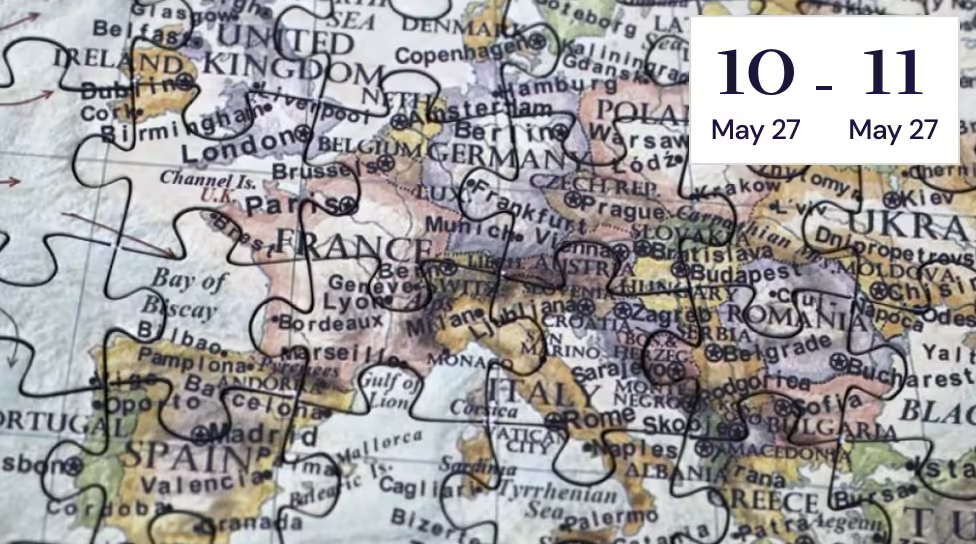
Almost four decades after the fall of the Iron Curtain, a symbolic and cultural divide between Eastern and Western Europe persists. Yet recent events – Brexit, Russia’s full-scale invasion of Ukraine in 2022 and the ensuing Zeitenwende – and the changing transatlantic relationship have destabilized the very notion of Europe, East or West, to an unprecedented degree. Still, headlines declaring the end of Europe are nothing new, and Europe persists as a cultural imaginary as much as the concept of Eastern Europe. Building on critiques of imaginary constructs of the region (Wolff, Todorova, Robin, Snyder, Kacandes and Komska, Kermani, Veliu Ashiku), this conference asks how contemporary literary, filmic, and media works produced by artists with ties to Eastern Europe resonate with, shape, or subvert these shifting realities.
Literature, film, and other artistic practices are central media through which individuals and communities articulate belonging and construct memory across shifting and contested borders, and in response to conflict and displacement. Rather than describing Eastern Europe as the Other from without, we invite contributions on works rewriting its cartographies from the outside-in or inside-out by authors and artists from Eastern Europe now writing from elsewhere, often in languages other than their first, and from positions of exile, migration, and diaspora. We are particularly interested in new forms of witnessing, testimony, and storytelling that give inherited or imposed maps new, contested, sometimes painful, sometimes healing meanings. We welcome scholars at all career stages from literary, film, theatre, translation, media, and memory studies, as well as publishers and translators. Selected contributions will be considered for a collective volume or special journal issue.
Suggested topics for proposals include, but are not limited to:
• How do memoir, autofiction, and family narratives from exile, diaspora, or the second generation hold loss and nostalgia alongside reinvention, humour, and belonging, and who may speak for a vanished homeland, and in which language?
• What new modes of witnessing and postmemory emerge among second and third generations (e.g. Anne Berest’s La carte postale)?
• What contours does the East take when it refers to a country that no longer exists, such as the former Yugoslavia mapped from Canada or Germany (e.g. Maya Ombasic’s Mostarghia or Saša Stanišić’s Herkunft)?
• How are recent works responding to the war in Ukraine? Is the East–West divide still being mobilized, or is it receding as Europe itself grapples with its legacies and future?
Conference organizers: Michel Mallet (Université de Moncton), Liza Bolen (University of New Brunswick), and Maria Mayr (Memorial University of Newfoundland)
The conference will be held in person at the University of London Senate House, Malet Street, WC1E 7HU.
Please submit an abstract (250 words) and a short bio, in English by 5 January 2027 to all organizers:
[email protected], [email protected], and [email protected].
Source: www.fabula.org