
Growing up outside of Philadelphia, I knew “Go Birds” was a legitimate greeting at least 18 weeks out of the year. While going to school in Boston, I could muddle my way through enough Red Sox small talk to work successfully in retail. When my husband and I moved to San Francisco — and decided this was where we’d build our careers, raise our family, and invest in our community — we found that what was then-AT&T Park was a surprisingly baby-friendly venue. We’d walk a few blocks from our apartment with our son wrapped to my chest and buy cheap tickets for seats in which we ate a dinner of crab sandwiches and Ghirardelli sundaes before walking home if he got fussy or making it through the ninth inning if he didn’t.
I was always on the periphery of sports fandoms. They were utilitarian for me: a way to not look like too much of an outsider, a way to make neutral conversation, a way to just get out of the house with a new baby when you weren’t sure where else to go. My primary enthusiasms lay elsewhere — in books, in politics, in my work in reproductive justice — which, from my limited view, felt distant from the world of sports.
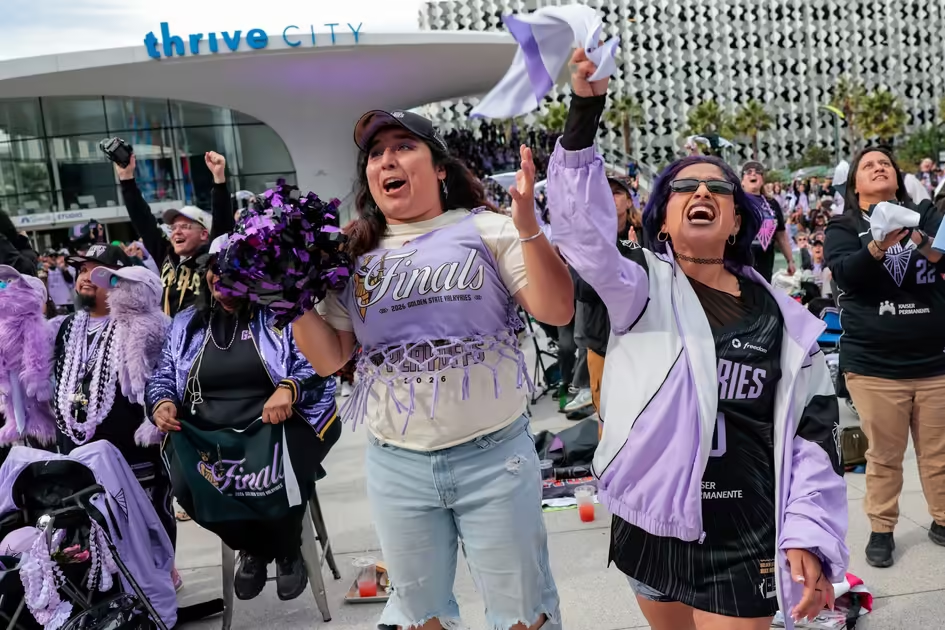
Then, in a burst of lavender, came the Golden State Valkyries. Before the first season began, my friends and I looked at one another and said: Yes, we’re doing this. I put myself on the waitlist for the worst season tickets in Ballhalla, bought myself a jacket, and showed up, ready to support women’s sports because it was the correct thing to do as a feminist. But by the end of that first game, I was hooked on a visceral level. I was excited by the game; I was charmed by the brand; I was delighted by the community of fans in which I found myself. This wasn’t about supporting women in a theoretical or political sense. It was an entire community built around the women on the court — mostly Black women, many queer women — that felt like a necessary recentering in our current moment of political stupidity and harm.
This recentering is not just the players and their identities. It’s the bridge in the logo, reminding us that this team belongs to the whole Bay. It’s the “hyphy” right before the fourth quarter, (opens in new tab)a dance that brings an Oakland-specific hip-hop energy to the stadium; it’s Angela Davis banging the GSV drum (opens in new tab) before the game; it’s the team launching a year-round campaign to celebrate Black culture. It’s coach Natalie Nakase reminding us that sports are about belonging; it’s star forward Gabby Williams dedicating a win “for the gays!”; it’s the advocates with pink-and-blue posters outside Chase Center reminding us that trans people are welcome here, and we are stronger together. It’s the late Dolores Huerta, at 96, opening the game (opens in new tab) just months before her death; it’s the Violet Vibe, our mixed-age dance troupe showing that all ages are part of our community.
Ballhalla overflows with Black joy, queer solidarity, and intergenerational connection, and it’s exhilarating to be able to witness and share in it. The energy in the Chase Center is electric — so much so that the players have referred to the crowd as the team’s “sixth man.” We show up, we get loud, and we pour out the kind of love and support that we hope carries them to victory. It’s no wonder Ballhalla has become a safe and magical space (opens in new tab) for so many.

This love isn’t unique to the Valkyries, though. I can spot a WNBA fan anywhere now. The league has deepened my connections to collaborators from across the country, because having and loving your own WNBA team weaves together sports, feminism, friendship, and a kind of mutual recognition.
The rivalries are (mostly) friendly, and the stand-out players are almost universally beloved. Who doesn’t use “my president” to exclusively refer to Los Angeles Sparks forward Nneka Ogwumike? Who didn’t tear up when Minnesota Lynx guard Olivia Miles’ parents presented her with the Rookie of the Year award? Who doesn’t love watching league MVP A’ja Wilson play? Who doesn’t love watching Dallas Wings guard Paige Bueckers do anything?
3 days ago

4 days ago

Friday, Oct. 23

The part of me that’s a mother? Look at my daughter’s light-up golden sneakers with Valkyries wings laced into them! Look at them!
The part of me that’s a feminist? Well, she’s the one who knew we needed those season tickets in the first place, and she’s never felt more at home.

Gretchen Sisson is a sociologist and author in San Francisco.
Source: sfstandard.com