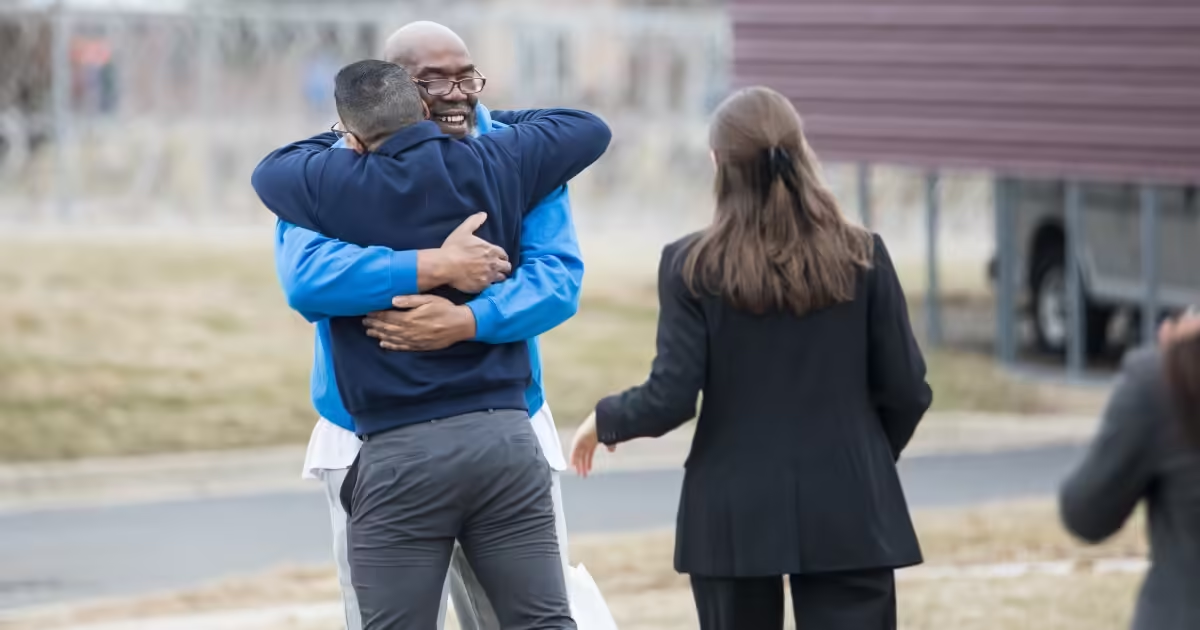

Advocates say Michigan’s post-conviction DNA testing law established in 2001 has failed to keep pace with modern forensic science. They say for years, strict legal barriers have made it difficult for wrongfully convicted people to have DNA evidence re-tested or tested at all. Now, recently introduced bills in the state Legislature aim to update the law. They would align Michigan’s rules with modern DNA testing standards.
For George Calicut Jr., the current legal barriers were paralyzing.
He spent 27 years in prison for the murder of a woman named Virgie Perkins; a crime he did not commit. He said he was coerced into signing a confession written by a former Detroit police detective, Barbara Simon. He said she convinced him that signing the statement would protect him from a first-degree murder charge.
“I had never been arrested before; didn’t know what questions to ask; found myself enlisting the help of the individuals who ultimately sent me to prison,” Calicut Jr. said.
“She was like, ‘Listen, baby, I don’t want them to do that to you. You’re a young Black man. I don’t want to see that happen to you. You got to protect yourself.’ ‘Well, how do I protect myself?’ ‘Listen, baby, I can write a statement. It don’t mean you’re guilty, it just keep them from charging you with first degree murder. Let me help you.’”
Simon, who is no longer with the police department, is at the center of at least six murder convictions that have been overturned or vacated due to false confessions. But because Calicut Jr. technically confessed to the crime, Michigan’s current law barred him from even requesting post-conviction DNA testing because the law excludes anyone who pleaded guilty or confessed.
“Most exonerees will probably tell you that they never gave up,” Calicut Jr. said. “We give up all the time. I never lost hope, but I certainly gave up.”
After Simon’s misconduct was brought to light, Calicut Jr. came across a newspaper article that detailed the detective’s coercion of false confessions. He said that’s when he knew he could do something about his circumstances and came up with a plan.
“They say the pen is mightier than the sword, and I had no money and I said, ‘I’m going to go to the law library and I’m going to write lawyers every week,’” Calicut explained. He said he wrote to lawyers until somebody heard him, and eventually they did.
The Michigan Innocence Clinic and the Cooley Law School Innocence Project saw potential in his case and took it on.
Jessa Webber, a staff attorney at the Cooley Innocence Project who represented Calicut Jr., noted that securing an exoneration through the current law is exceptionally difficult.
“Instead of filing for post-conviction DNA testing, the alternative is to reach out to a prosecutor’s office and try to get one of those stipulations for testing,” Webber said.
In this case, she’s referring to a stipulation order, where an attorney reaches out directly to the prosecutor’s office to negotiate an agreement to test DNA evidence.
Calicut’s legal team took their evidence directly to the Wayne County Prosecutor’s Conviction Integrity Unit. That office agreed to conduct modern touch DNA testing on skin cells left on 27-year-old preserved physical evidence.
The results pointed to an entirely different person, leading to Calicut Jr.’s exoneration.
“Yeah, we’re exonerated, but you always still feel like you gotta prove that you’re innocent,” Calicut Jr. said.
Webber said the companion bills in the state Senate and House (Senate Bill 1035 and House Bill 6092) were written specifically to dismantle these legal roadblocks. If passed, the legislation would allow a defendant to petition for DNA testing regardless of whether they were convicted following a trial or pleaded guilty, provided the evidence is available.
The legislation would also scrap the state’s 2001 cutoff date.
Under the current law, defendants convicted after January 8, 2001, cannot ask for evidence to be re-tested unless the original results were inconclusive. But Webber said forensic science in 2001 looks nothing like science today.
“Now we understand that just touching a piece of evidence can be enough to deposit DNA,” Webber explained. “A defendant back in the early 2000s might not have had access to DNA testing prior to trial, and then would be barred from pursuing testing under the statute because testing wasn’t performed back then.”
The bills would also lower the legal burden of proof. Currently, defendants must present “clear and convincing” evidence just to get a judge to review their petition.
“[The current statue] standard is higher than any other standard in the state,” Webber said. “We want to bring the DNA statute in line with the other post-conviction remedies available, because now it makes it really hard to get relief even if there is DNA evidence that’s exculpatory, that’s obtained via testing from the statute.”
Additionally, the legislation would mandate that police departments preserve all biological material.
Democratic State Sen. Sue Shink, a co-sponsor of the Senate bill, said updating these standards is ultimately a matter of government accountability.
“People need to have a chance to have all the evidence in their case considered,” Shink said. “I think one of the worst things a government can do is to put somebody in prison when that person is innocent. If a mistake was made, it can be corrected, and this bill will allow that to happen.”
While House Bill 6092 has yet to see movement, Senate Bill 1035 was voted unanimously out of committee this fall.
The Prosecuting Attorneys Association of Michigan Legislative Committee voted late last week to oppose SB 1035. A spokesperson for the group said the committee chair David Gilbert said the legislation would take away a lot of guardrails. Gilbert was not available for an interview.
In the meantime, exonerees like George Calicut Jr. are left living with the aftermath of a system that took more than two decades to listen to him.
“I’m telling the same story today that I told 27 years ago,” Calicut Jr. said. “So imagine how I feel now being out here and people telling me ‘you’re exonerated and you’re innocent.’ I have joy, but I’m not happy.”
Source: www.michiganpublic.org