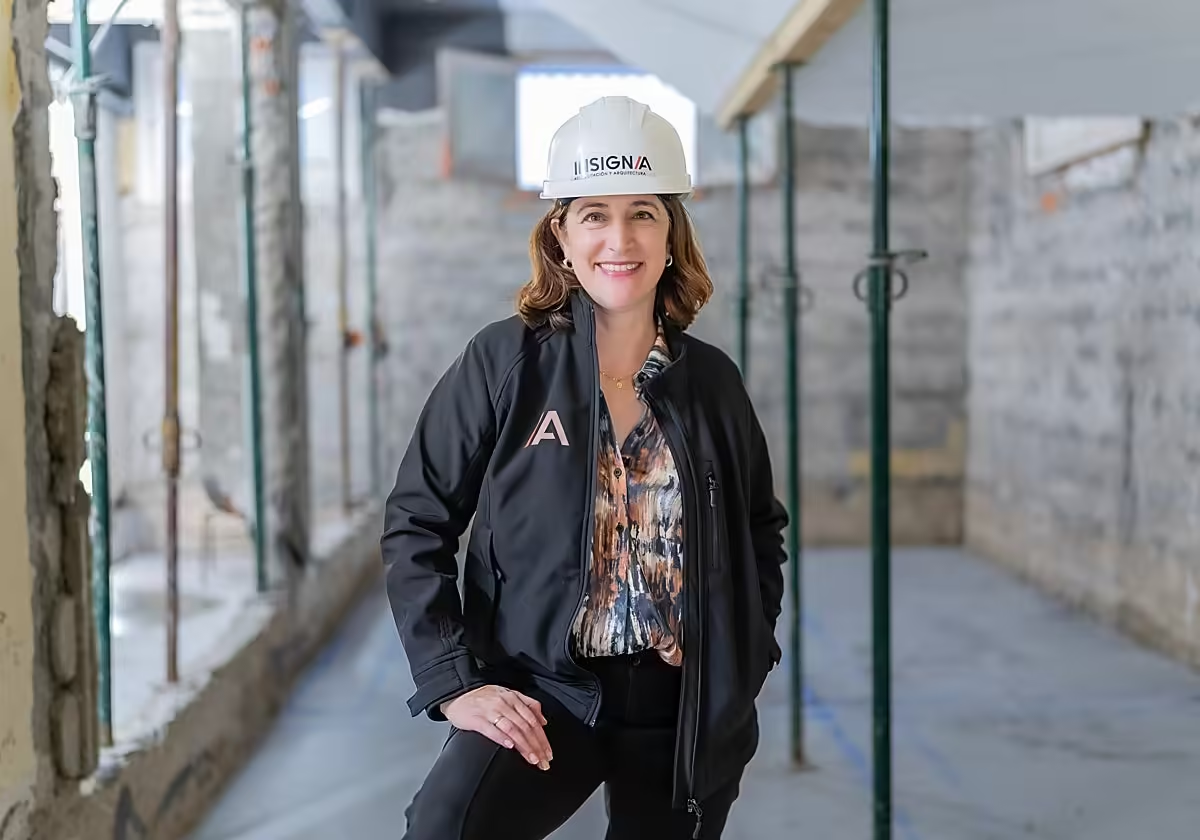

“This is what I know how to do, rehabilitate buildings.” Amaya Alonso Asla now remembers that response with which she tried to convince the … banks to finance their project. It was 2012, construction was going through a terrible crisis and she had just left her job to start her own business. I had a daughter who was not yet one year old, no experience as a businesswoman, and many doubts about what I was about to do. But he was clear that he did not want to continue getting up every morning anxious about having to go to work.
After a decade in the sector, the work environment had become unsustainable in the company where I worked. The birth of his daughter, in 2011, was the trigger for a situation that had been tense for some time. “My boss thought it was terrible that I got pregnant,” she remembers. That experience ended up pushing her to make a decision that, in the midst of the brick crisis, seemed almost reckless. «I wanted to go to work with a certain peace of mind. Without thinking: ‘What is my boss going to come up with today?’ So he left. And he decided to start his own company.
The idea was not to become a great businesswoman, but simply to be able to work comfortably. He obtained bank financing after a long negotiation and settled in Zitek Portugalete. “The banks told me that it was not the best time, that let’s see if I hadn’t heard that there was a crisis and it was called ‘construction’,” he says. She insisted that she knew how to do that. And that he wanted to do it well. His first job was actually looking for a job.
Learn to lead
Meanwhile, he dedicated himself to designing the logo, creating the website, printing his own cards and began visiting potential clients and prescribers. “I told them that I had founded a renovation company, that I did it well,” he says. There was no business structure behind it, just a technical mining engineer from Getxo who was used to solving problems. Starting a business while raising her children was not easy either. During the first years she worked too many hours, many Saturdays and Sundays, and had to organize herself with her partner to attend to family responsibilities. “There were some years that were especially hard,” he remembers.
The commitment to digitalization was one of the first decisions that differentiated Insignia. In 2012, when many construction companies still did not have an online presence, the company developed a website that allowed clients to consult photographs, documents and progress of their works through private channels. A pioneering proposal that earned it the sixth Abiatu award from the UPV/EHU, in the area of innovation. As Insignia began to grow, the first hires came and also the first conflicts. “One of the parts that has been most difficult for me to learn is personnel management,” he admits. She remembers situations of aggression between workers, lack of respect and problems of coexistence that forced her to consider what type of company she wanted to build.
The answer was to work on training staff in coexistence. «We have managed to create a culture of respect that has nothing to do with what we had fourteen years ago. It was a very aggressive environment, I have experienced fights between workers,” he explains. A task that it has maintained from the beginning and that today considers one of the company’s strengths. The company has worked with Euskalit and Ekinbarri to advance in people management and the improvement of its processes. Today, Alonso has around 30 people hired and exceeded five million in turnover last year.
«I have had cases of people who did not want to hire us because the manager was a woman»
Amaia Alonso Rises
CEO and founder of Insignia Rehabilitation and Architecture
Gaining respect in a sector as masculinized as construction, he admits, has not been easy either. When he studied Technical Mining Engineering in Barakaldo, in his first class there were around 150 students and only five women. Years later, when he started running his own company, the situation had not changed much. “I have had cases of people who did not want to hire us because the manager was a woman,” he says. She has also experienced situations in which some operators questioned her knowledge or clients who were surprised to discover that she was in charge of the company. “When they come into the office and ask for the manager, they don’t expect to see me,” he says, although he admits that he has learned to stop caring.
It is not a situation that I consider overcome. Although it recognizes that the female presence has increased in areas such as construction management or quality control, it is still a minority among operators. For the CEO, there is still a long way to go: “We are no less qualified than a man to be bricklayers, electricians or plumbers,” she maintains. In fact, it defends that incorporating women at all levels of construction is not only a matter of equality, it can also improve the efficiency of works. «When you have diverse profiles, each one contributes their own. This combination offers more diverse, more creative solutions and a better environment,” he says.
This same requirement extends to working conditions. Alonso denounces that in the sector there is still unfair competition from companies that work without fulfilling labor obligations or that use workers without registering. A situation that especially affects small renovations, where the client may have difficulties distinguishing between a company that complies with the regulations and one that does not. “This type of competition within our sector is unfortunately quite common,” admits the CEO. The future of construction lies, in his opinion, in improving productivity and attracting personnel. “We are incorporating artificial intelligence, automation and process standardization tools, although we are encountering more and more problems finding labor,” he explains.
When he asks himself what he would say today to that Amaya who was about to leave her job in the middle of the crisis, he doesn’t talk about money or business success. He talks about what he learned and how it changed his life. «I would tell him that he was going to learn a lot. It was going to change his life in ways he couldn’t imagine,” he reflects. His evolution, he assures, has been natural. From a technical professional she has gone on to run a company, manage teams and make financial decisions. Not because he had a career plan, but because he has never waited for someone to tell him what he can do. «If I want something, I try to do it. “I’m used to finding a life and solving, solving, solving,” she says.
Source: www.elcorreo.com