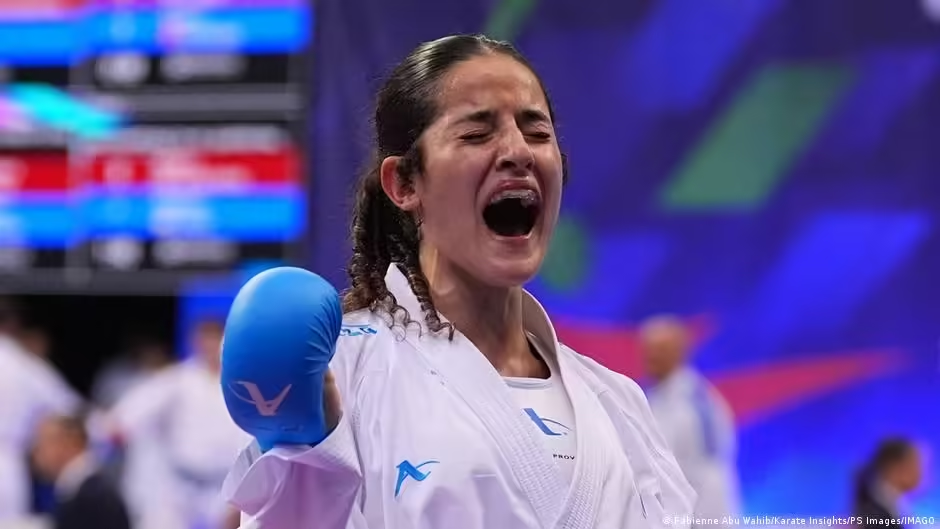

“After the referee lifted my hand to show I’m now a two-time world champion, it was a very overwhelming feeling,” Mariam Bsharat said. “Making history once is something, but making it twice is really something else. I felt very happy and I felt a big relief. Only I know how many sacrifices I made and how many hardships I needed to overcome.”
Themes of relief, joy and sacrifice are commonplace in the reflections of athletes after a big win. In Mariam Bsharat’s case, it’s about more than just dedication to training and taking care of the body. The 17-year-old won her second under-21 World Karate Championship gold medal competing for the Palestine national team in Poland in October.
“It was everyday life, seeing people get killed around me and houses getting bombed,” she told DW of her upbringing in the occupied West Bank.
“I faced challenges in transportation,” Bsharat said. “I wasn’t able to go from one city to another to be able to train with other people, so that I can actually prepare for competitions. I needed to travel to other countries like Jordan or Egypt … which was very hard for me. And, financially, the support wasn’t really the support an elite athlete needed.”
Skepticism turns to sporting success
Growing up in NablusBsharat had a narrow path to the top. But initially, it was her own reluctance that threatened to stop a champion career before it started.
“When I was a little kid, I did not really love it,” said Bsharat, who competes in the division for fighters who weigh under 66 kilograms (145 pounds).
“I started it because my family was in that sport,” Bsharat said. “My father had a dojo, and my mother also did that sport. My siblings and my aunts and my uncles — it’s a family thing. I started it because they were all doing it. In time, I started getting into it.”
Family has been a constant source of comfort and inspiration for Bsharat. Her father and uncle have acted as manager and coach respectively. While her mother and siblings moved with Mariam to Hamburg, Germanylast year, her father remained in order to take care of his business, the dojo, though he visits and tries to be with his daughter in competitions. Integration has been made easier by her mastery of the language, taught to her by her German mother.
Bsharat has mixed feelings about leaving her homeland.
“I’m thankful to be here because being in Germany opened lot of doors for me, and I think I have a brighter future here,” Bsharat said. “But also being in Palestine was just my everyday life, and I loved it there. My family was around me, my friends were around me, and I just felt comfortable, which was a big change coming here to Germany. I think every change comes with hardships.”
Pressures from homeland weigh heavy
As well as the obvious difficulties of living in an area occupied by Israelthere are particular challenges for sportspeople living in the West Bank and the Gaza Stripwith access to facilities, travel and constant security fears among them. As such, very few people from the Palestinian territories become successful on the international sporting stage. That, Bsharat said, gives her responsibilities that are unusual and heavy for a person of any age, let alone a 17-year-old.
“Being an elite athlete in Palestine is something very special because not everybody in Palestine has that opportunity. There aren’t really a lot of athletes that are elite and who win international medals,” Bsharat said.
“So all that pressure from all the country and all the people, the family, the coaches are on me because I’m representing them, raising their flag,” she said. “I sometimes even forget to fight for myself and actually think about myself.”
Olympic dream alive — should karate be an event again
That has not yet proved a barrier to Bsharat, who is is ranked first in the world in her category by the World Karate Federation (WKF). With Palestine recognized by the International Olympic Committee, Bsharat would likely have been a contender to raise that flag in Los Angeles at the 2028 Olympics. But the sport was dropped from the Games in 2024.
“The global karate community remains steadfast in our belief that the natural place for karate is within the Olympic Games, and we sincerely hope that the incongruence we suffered in Paris 2024 and LA 2028 will be corrected for Brisbane 2032, if not sooner,” the WKF wrote in response to the decision in 2024. The sport was also taken off the slate for the recent Youth Games in Senegal.
Should karate return in Brisbane, Bsharat would likely be approaching her prime. In the meantime, she is looking forward to starting her journey as a senior when she turns 18. But she won’t be hanging around.
“My goal is it to be a world champion at seniors, which is the hardest and the best thing you can achieve in karate,” she said.
“But winning an Olympic medalbeing called Olympic champion or just representing my country with that flag [is a thought that] is just full of happiness and pride.”
The interview was conducted by Janek Speight.
Source: www.dw.com