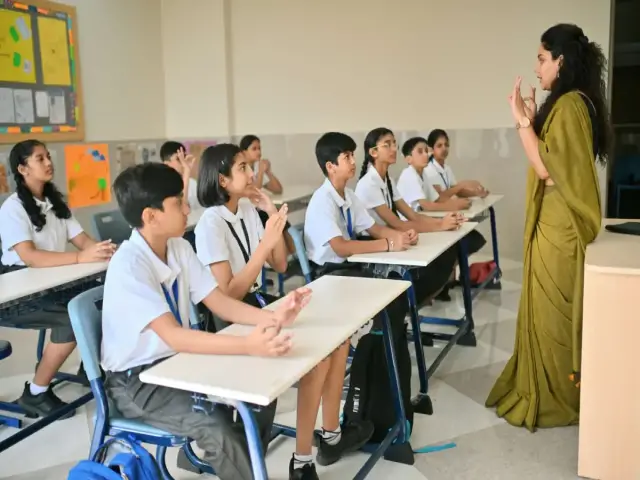

When educators feel emotionally and physically supported, they’re in a much better position to support their students. In India, where the relationship between teacher and student has long been central to education, caring for teachers is essential to sustaining that connection.
India’s education system comprises over 1 million government schools and more than 82,000 government-aided institutions. Serving approximately 167 million children, India administers the world’s largest education system. Increasingly, educators around the world recognize that social-emotional skills like navigating conflict and building healthy relationships are just as essential as academic learning—and India’s own national policies have begun to reflect that shift.
The 2020 National Education Policy calls social-emotional learning (SEL) “a critical aspect of any student’s holistic development.” That’s supported by the National Curriculum Framework, which recognizes the importance of fostering stronger student-teacher relationships to accomplish this approach.
X

Aditi Ramanthan, a high school biology teacher with almost 20 years of experience, has seen the shift toward more thoughtful discussion and implementation of SEL throughout her time teaching. However, as SEL becomes a more important part of education, the question is not only how to support students, it’s how to support the teachers who are being asked to help them develop these skills.
From this perspective, the future of teaching in India may not be defined only by new curricula or digital tools, but by whether schools can become places where the hearts of teachers are systematically cared for, so they can, in turn, care for the hearts of children.
“The primary need is psychological safety,” says Ramanathan. “Instead of constantly viewing teachers as being emotionally self-sufficient, creating a space where they can ask for help.”
Educators’ needs and challenges in India
In recent years, SEL implementation in India has been widely championed and led by school counselors, with educators throughout grade levels recognizing it as something that should be on par with academic curriculum.
“In India, social-emotional learning is just beginning to come into focus,” says Ramanathan. “Until recently, it wasn’t really part of mainstream conversations in schools, but now we’re starting to talk about it more seriously.”
Ramanthan argues that while SEL has become more widely accepted in recent years, it should be treated as a basic professional requirement for teachers, much like first-aid training, if it’s to be successfully implemented in schools. While schools routinely prepare educators to respond to physical emergencies, far less attention is given to the emotional crises that are likely to unfold in their classrooms. She suggests that SEL training should be universal for teachers, equipping them to understand and respond to students’ inner lives, not just their academic performance.
“We are not trained for SEL, and I wish we were,” says Ramanthan. “We’re given first aid training, but we are not given SEL training, and I think all of us should do SEL training.”
In a former position, Vrinda Loiwal, founder of the Center for Social Emotional Learning, designed SEL assessments for students, primarily in government-run schools. Once every three months, she would enter classrooms across the country to see how SEL was being interpreted, taught, and assessed.
“One of the challenges to children’s well-being is that even if you teach one SEL standalone lesson once a week, it has to be embodied in the math class, and the English class, and on the playground, and in the messaging all around the students,” Loiwal says. “I believe that there’s very little impact that can come with just a standalone lesson.”
Inconsistency is another challenge. Loiwal explains that about a decade ago, the Delhi school district adopted a new SEL program—and after years of teacher training and evaluation, they had evidence that what they were doing was working. However, in recent years with a new government in place, the program was scrapped and replaced.
While on paper these new policies tick all the boxes for SEL implementation, when it comes to policy, introducing new required methods every few years disrupts the system just as educators begin to find their footing. They are constantly forced to recalibrate their entire approach, which creates an immense amount of pressure on the educators who are already overwhelmed and stretched thin for time.
“All the teacher training now has to happen all over again and in a slightly new way because now there’s a new curriculum,” says Loiwal. “We all agree that you have to teach addition and subtraction in math, but we don’t yet all agree that we have to teach SEL skills or build SEL cultures. These are early efforts, and they’re building. Then the politics change and it feels like two steps forward, one step back.”
Addressing educators’ needs
At the Kaveri Group of Institutes in Pune—which includes schools that range from elementary to graduate level—leaders see the strain up close. Teachers are being asked to carry the weight of being disciplinarians, counselors, curriculum experts, and cultural bridges with no real pause in the day to breathe or reflect.
“An educator is expected to teach, educate, to discipline, to mold the child, to develop the child, to understand the parents, different stakeholders, all of that,” says Deepa Kajale, a consultant for Kaveri. “It’s really overwhelming for the educator to put up with all these kinds of responsibilities.”
Kajale is a play- and arts-based therapist and school psychologist who has worked with many interventions and iterations of SEL frameworks to foster inclusive, emotionally safe environments. While policymakers are increasingly viewing SEL as essential and not optional, Kajale and her colleagues at Kaveri are attempting to bridge the gap between newly required written frameworks and implementation.
For example, at the Kaveri Gifted Education and Research Center—which aims to identify and nurture gifted students across India—school counselors offer confidential spaces for teachers to talk about both professional and personal struggles like burnout and family stress, and they encourage educators to speak with counselors as a form of ongoing support, rather than viewing reaching out as a last resort.
Devasena Desai, a consultant and psychologist at the Kaveri Gifted Center since 2014, says that in addition to offering wellness sessions where they talk about nutrition and menopause, they also celebrate Teacher’s Day. Each year on September 5, they host a large gathering complete with awards to teachers for creativity and innovation, live music, and loud cheering as colleagues are honored.
Additionally, she says one of the most fruitful decisions they made is to offer outsourced counselors from other districts for their educators to speak to.
“Because sometimes you don’t want to talk to the person whom you bump into every day,” says Desai. “Maybe you’re not comfortable and we want to respect that. There are people who wouldn’t mind and there are some people who wouldn’t want to, so that option is there.”
Along with this more formal support, Kaveri has built in daily rituals of connection, including listening circles where they talk about how to manage varying responsibilities, as well as more sensitive topics like overload and grief.
“What we have introduced in the last two years is talking about trauma, talking about grief, talking about single parenting, blended families, and how to embrace that,” says Desai.
The importance of culturally relevant SEL
According to a paper published in June of this year that studied SEL in Nagaland, India, successful implementation requires specific teacher and parent engagement as well as dedicated training and resources. Additionally, SEL had to be contextually adapted and culturally aligned with local traditions.
The team at Kaveri understands the importance of cultural relevance when introducing these practices and often draw on concepts like guru and dharma to restore social meaning to the role of the teacher. The ideal of the teacher as a guru or a guide for both knowledge and character still carries significant cultural weight.
Unfortunately, that ideal can collide with the modern reality of rapid policy shifts, new technologies, and a workforce made up largely of women juggling caregiving at home and expanding expectations at work.
“Within the professional identity, there is a personal identity with roles, responsibilities, and a lot to take care of as a woman,” says Kajale. “So that adds up to the emotional exhaustion that an educator goes through.”
Guru is a Sanskrit word meaning “heavy” or “weighty,” used to describe a spiritual teacher or guide who dispels ignorance and leads a student toward self-realization. Rather than abandon the guru ideal as outdated, Kaveri is reclaiming it for the 21st century by rooting teacher support in Indian knowledge systems. In this model, SEL is not just a borrowed framework or a one-off workshop; it’s woven into listening circles, parenting programs, and grief support; and practiced by using a model of wellness that treats educators as whole human beings—body, breath, mind, and spirit.
“We believe that for the holistic development of a person, you have to be very balanced with all your koshas,” says Malati Kalmadi, secretary of Kannada Sangha Public Trust.
In the Panchakosha model from Vedantic philosophy, there are five koshas—or the “five layers of human existence”—including the Annamaya (physical), Pranamaya (energetic), Manomaya (psychological), Vigynamaya (intellectual), and Anandamaya (spiritual). This holistic journey begins with the Annamaya Kosha, focusing on our physical essence through the food we consume. Beyond the visible body lies the Pranamaya Kosha, the vital energy that governs our internal systems—respiratory, circulatory, and nervous.
Achieving equilibrium in these physical and energetic layers is the foundation for mastering the Manomaya Kosha, or the mind. The Vijnanamaya Kosha connects us to our intellect and discernment, while the Anandamaya Kosha is our innermost peace.
Unlike Western perspectives that often separate diet from cognition, the Panchakosha model believes that the food we eat deeply influences the nature of our thoughts, inextricably linking our physical choices to our emotional and mental clarity.
Parents play a vital role in supporting this intentional shift back toward traditional models; Kaveri is working to more deliberately support parents in lifting these inherent values. In addition to the Mindful Parenting Program Workbook they created in collaboration with the Greater Good Science Center’s Parenting Program, they have taken it upon themselves to create additional parenting modules to help parents address the evolving cultural landscape and shifts between millennials, Gen-Z, and Generation Alpha.
To help parents, students, and educators align their koshas, they have experts speak to them about how to switch from “fast food” to “slow food,” helping them become more conscious of what they put into their bodies. One of their team members also went to Bangalore for a training on traditional Indian well-being therapies to provide an alternative to Western medicine.
“We feel that once we are able to get all these things into place, then the wisdom and the thoughts actually move towards spirituality,” says Kalmadi. “Our aim is taking the child towards this track for a better society.”
While there is no single clean-cut path forward to create schools and districts grounded in SEL, educators across India are already showing that change is possible. By caring for teachers as whole people and drawing on both new research and longstanding cultural traditions, schools can create environments where educators feel supported to care for themselves, their students, and one another.
In that sense, the future of SEL in India may begin not with another mandate, but with a growing recognition that when we care for the people who teach, we strengthen the entire educational community.
“There is slowly a conversation happening between parents, and schools, and teachers, which earlier was not happening consciously, but now we are doing it very, very consciously,” says Kalmadi. “This is proving to be very beneficial for the entire educational ecosystem.”
Source: greatergood.berkeley.edu