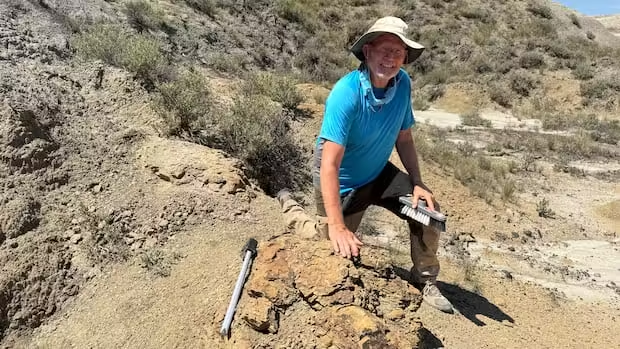

Kent Hups says he’s dreamed of discovering a Tyrannosaur rex bone ever since he was a little boy. Instead, he found something much, much rarer.
Hups, a science teacher at Northglenn High School in Colorado, was exploring the badlands of North Dakota in 2025 when he stumbled upon a series of massive footprints in the rocks.
Those footprints are now believed to be the first known trackway of an adult T. Rex, and their discovery could shed new light on how the iconic dinos moved around the planet more than 66.5 million years ago.
“It’s kind of been a roller-coaster ride,” Hups told As It Happens host Nil Kӧksal. “It’s been unbelievable. It’s a dream come true.”
Hups is co-author of a study confirming the findings that was published in September in the Journal of Vertebrate Paleontology.
Last week, he was on hand for the unveiling of the excavated prints at the Denver Museum of Nature & Science.
Why are trackways so hard to find?
Dinosaur paleobiologist Jordan Mallon, who was not involved in the research, says that while T. Rex fossils are pretty common, their tracks are strangely rare.
There have been a handful of discoveries of single, isolated footprints, he says, as well as some trackways from other members of the Tyrannosaurid family.
“But this is the first genuine T. Rex trackway, which is pretty cool,” Mallon, a research scientist at the Canadian Museum of Nature in Ottawa, said.
After 3D scanning the track, scientists excavated the prints. (Denver Museum of Nature & Science)
Why they’re so rare, he says, is unclear. It could be that the environmental conditions that fossilize bones don’t lend themselves to preserving tracks. Or, it could just be that palaeontologists digging for bones aren’t paying close enough to what’s right beneath their feet.
“There tend to be palaeontologists that specialize in looking for tracks and palaeontologists that specialize looking for bones,” he said. “And I have a feeling that, in some cases, we’re just missing them as we walk right by them.”
How scientists know it was a T. Rex
But not Hups. He says he knew right away that he’d found something special.
He was exploring Hell Creek Formation, a world-renowned rock formation dating back to the Cretaceous period, when he noticed a splash of reddish-brown colour amid the sea of white and gray.
“The colour is what grabbed my eye at first. And then I saw the three toes,” he said. “And that’s when I knew, well, I’ve got a track. And I’ve been doing it for a while, so I know how rare tracks are, but I never thought I’d ever have a T. Rex track, ever.”

The track, in the Hell Creek Formation, is made of four three-toed prints. (Tyler Lyson)
The seven-metre trackway is made up of four three-toed footprints, each nearly a metre in length.
Hubbs and his co-authors identified the prints as belonging to a T. Rex based on their size, shape and proximity to T. Rex fossil discoveries.
“Are we 100 per cent sure? No, we don’t have a dead T. Rex at the end of the trackway. But we do have these things that really, you can’t argue with,” Hubbs said.
“The size, the stride, the narrowness of the trackway. Everything fits. And it can only fit with the T. Rex because that’s the biggest thing that’s out there.”
What’s so great about footprints anyway?
Mallon says there’s a lot to learn from a discovery like this that you can’t from T. Rex fossils, including the animal’s size, how it moved, where it moved and whether it travelled in packs or solo.
“Bone really represents a dead animal, but a track represents what an animal was doing while it was alive,” he said.
He’s particularly keen to learn whether the tracks can paint a picture of the creature’s speed.
“There have been, you know, study after study now trying to model T. Rex biomechanics and model how quickly they moved [and] could they run or not. And a lot of it’s been sort of high-falutin’, you know, engineering principles and lots of mathematical equations,” he said.
“But ultimately it’s the tracks that are going to tell us what actually happened.”
So far, the researchers estimate the animal that made the tracks had a stride of approximately four metres, and was walking about 5.5 to 7.2 kilometres per hour.
According to the Denver Museum, that’s “roughly comparable to a brisk human walking pace.”
More to learn
Hups says there’s a lot more to learn about the trackway.
Before scientists excavated the prints, they took high-resolution 3D surface scans, and reproduced the track digitally for further analysis.
There’s also a lot to learn from studying the excavated prints themselves, he said. Hups is hopeful scientists will be able to extract a skin sample from them.
“It’s like a Christmas present,” he said. “You don’t know what you’re gonna get until you open it up.”

Hups shows a dino footprint to a little girl at the Denver Museum of Nature and Science. (Denver Museum of Nature and Science)
One of the four tracks, however, will remain on public display through the end of next year.
At the unveiling, Hubs says he got to show the massive footprint to a wide-eyed little girl who was so grateful for the experience that she hugged him.
“You could see the wonder and the excitement,” he said. “That’s your ultimate ending is to have that in a place where people can look at it, and it’s there for research. It’s protected.”
Source: www.cbc.ca