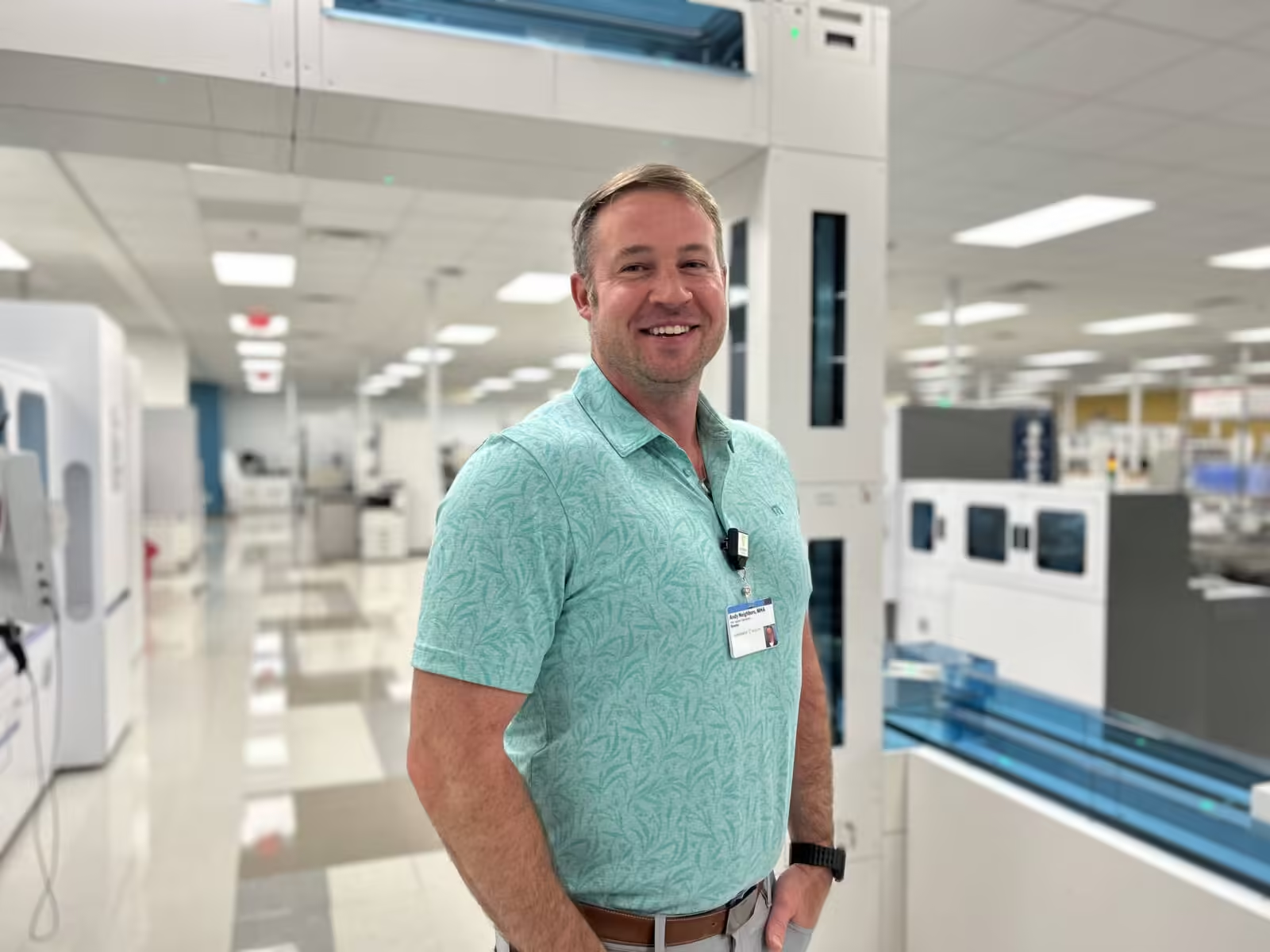

Andy Neighbors, a former Army officer who spent time deployed in Afghanistan, Kuwait and Iraq, among other places, had to face a question most veterans must answer: Where do I fit in after my service is over?
A few weeks before Veterans Day, he received his answer: Now the Director of Support Operations at Vanderbilt Medical Laboratories, Neighbors has officially transitioned into civilian life and is eager to combine his passion for medical science and health care administration with the countless skills he learned during his service in the Army.
Neighbors received his undergraduate degree in microbiology at Auburn University, where he was enrolled in the Reserve Officers’ Training Corps (ROTC) program. He officially joined the United States Army in 2006, was deployed multiple times to Iraq and Afghanistan amid the global war on terror and worked his way through numerous positions in the Medical Service Corps (MSC) over the course of his military career, both as an officer on the front lines and in medical leadership positions on U.S. soil.
Neighbors earned his Master of Healthcare Administration while serving in the Army. His first project in that program was to outline the operations of a health care system, and he chose Vanderbilt Health. As a native of Franklin, Tennessee, the familiarity with the institution made it the obvious choice for his project. Little did he know then that, with the help of the Army’s Career Skills Program, he would end up as an administrator at Vanderbilt Medical Laboratories.
Vanderbilt Health benefits from connecting veterans to the civilian workforce through the Career Skills Program
According to Neighbors, the United States Armed Forces’ veteran community includes a few archetypes. Some make a lifelong career in the military, and some disembark from a high-level command post and land directly in the corporate world thanks to their strategically minded track record. Neighbors thinks of himself as part of the remaining group of individuals — ultimately the majority of the veteran community — who complete their service and want to continue contributing to society, but welcome the helping hand of the Career Skills Program.
“They may have a goal, they may not have a goal … that’s where having a skill bridge program really helps, letting them dip their toes in and see, ‘Do I like this? What’s this really like?’” Neighbors said.
Neighbors had his sights set on working at Vanderbilt Health as he worked through the Department of Defense’s Career Skills Program.
“You can reach out to any organization and enter into a legal agreement that says, ‘This soldier is going to be paid by the Department of Defense to come work with you and learn the civilian side of whatever it is they want to do,’” Neighbors explained.
He applied to Vanderbilt Health’s Military-Civilian Programs and was accepted to complete a four-month course. His Army experience included the kind of work that naturally paved the way for operational medicine: deploying medical units in the field, supporting combat zones and working with other nations’ armed forces to develop health resources in military theaters.
“But I hadn’t done a lot in the fixed facility civilian health care setting, so I needed that transition time,” Neighbors said. “Coming out of the military, the civilian world is so different, and you need time to adjust to that. … I touched just about every portion of the hospital so I could understand how everything worked and where I want to go in my civilian career.”
Networking was easy with the help of supportive Vanderbilt Health staff
Neighbors credits the open doors of several Vanderbilt Health executives with helping him understand civilian health care, answering his questions about how to work his way into a fulfilling post-military career. Everything from building a resume to how to dress — a consideration soldiers don’t have when wearing the same uniform for 20 years — was fair game.
He found that, with the support of this career coaching, he already had the chops for whatever job he found his way into in the civilian world. Military service had instilled the same aptitude and appreciation for knowing how to manage people and relationships, solve problems and organize processes to maximize health services. Complex, high-stress environments are nothing new to any veteran, even if there is an ostensibly different daily routine facilitating a medical laboratory than coordinating a medical evacuation process for emergency trauma surgery at a forward operating base.
“We take everything behind the scenes that makes Vanderbilt Medical Laboratories work and ensures everyone on the clinical side of laboratory operations has what they need to work,” Neighbors said.
The lessons military service teaches those in health care
The events of the 21st century so far have offered veterans plenty of experience that shapes their ability to understand health care. Apart from the duty of officers in the MSC to heal while they serve, which has stood the test of time, Neighbors got to experience a once-in-a-lifetime event in responding to the COVID-19 pandemic on American soil.
“When everyone was told to work from home, we had to go to work because we had to prepare all of our medical equipment to deploy on a 48- to 96-hour notice to anywhere in the U.S.,” said Neighbors.
He was sent to the Riverside University Health System in California, where dozens of doctors, nurses and medics provided relief and “breathing room” for the doctors who had been on the front lines of the pandemic since its outset.
And while the final few years of Neighbors’ active duty, in Hawaii, were spent on American soil as well, he got the unique perspective of liaising from the middle of the Pacific region with foreign governments, including Australia, Japan and South Korea, among others, to fortify health resources on that side of the world.
Overseeing operations as helicopters land at Army bases with wounded soldiers in need of immediate surgery instills a sense of urgency and responsibility. Partnering with leaders in the Iraqi army to help them get their health system back on its feet with the country ravaged by war teaches collaboration in a stressful environment. Serving as the medical planner for a combined joint task force to combat ISIS underscores the power one person can have to influence health outcomes for a large number of individuals.
Yet even with all those high stakes, when asked how his military service has prepared him for serving as a civilian, Neighbors said it is a lot easier than one would think.
“As a leader, our job is to lead people and manage relationships with people,” he said. “Sometimes it’s just making sure they know that you’re here for them.
“The military is a cross-section of the United States,” he continued. “It’s every type of person you can think of, and they’re all pieces of the bigger picture. And that’s what the military prepared me for … to lead someone like they’re a person and not just a thing, so they know that they have value and that we all work together.”
Related
Source: news.vumc.org