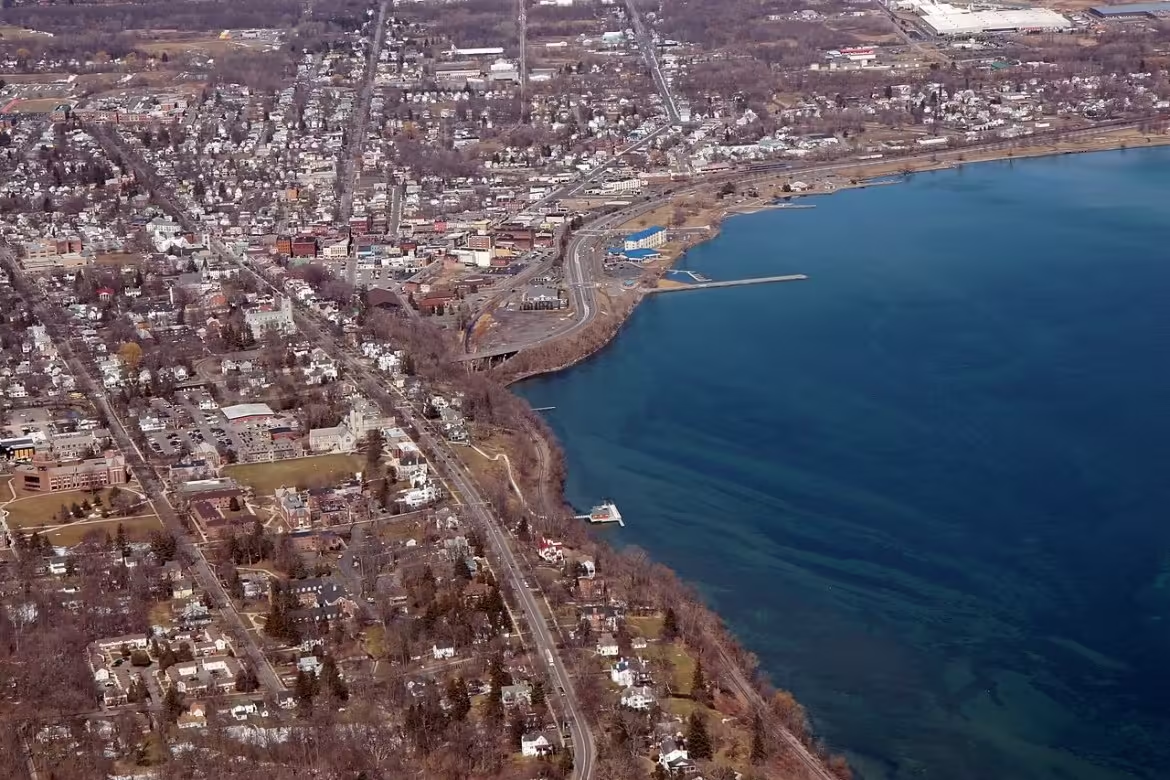


Geneva police flew a drone over two protests against U.S. Immigration and Customs Enforcement this year, including a 75-minute flight on May 24 that came after the department adopted a policy barring drone monitoring of protests unless there is a specific public-safety threat and a supervisor documents a legal basis. The department’s report on that flight describes roughly 45 to 50 people, calls the protest peaceful, cites no threat and records no legal basis.
Chief Ron Eveland, who answered questions on behalf of the department, acknowledged there is no formal documentation of the reasoning for the flights, though his written answer referred only to “this flight.” The flights are the sharpest question raised by records Geneva produced in response to public-records requests—records including four general orders, four vendor quotes, and an incident report covering a drone program, fixed license plate readers at five locations, two patrol cars with older mobile plate readers, and body and in-car cameras. Geneva has a written policy for each system. But the policies leave questions about timing and about what they do not contain.
This story is part of a Genesee Signal repository of police surveillance technology records documenting what departments have, including what they do well, and where the public record stops.
The three Geneva quotes for the body cameras, drone, and fixed readers total about $417,000 over contract terms of different lengths: 64 months for the body cameras, five years for the drone, and for the readers, a three-year cellular plan and five-year software licenses. The department’s latest renewal to support the older readers costs another $2,000, covering May 2026 through April 2027.
The department signed an Axon DFR Patrol quote on May 6, 2025, for $111,885.65 over five years starting in July 2025. It includes a Skydio X10 patrol hardware kit, a DFR Command software license, Evidence.com licenses for flight data, training, and a service for applying for an FAA waiver.
DFR stands for drone as first responder. Axon describes it as launching a drone immediately after a 911 call to get eyes on the scene, often before ground units arrive. Skydio, the drone’s maker, says agencies can carry its X10 drones in patrol vehicles or station them at docks. Geneva’s quote lists a patrol hardware kit, not a dock, and Eveland said the department does not send the drone to 911 calls as a first responder.
General Order 650, the drone policy, took effect March 13, 2026, about eight months after the contract term began. Eveland, who answered questions by email on behalf of the department, said the department flew the drone five times before then, when it was needed or useful for an investigation, with each flight approved through the chain of command. The reports for two of those five flights, both piloted by Sgt. Sebastiano Gentile on confidential investigations, list no approving supervisor. All five check a box saying the flight complied with department UAS policy, though General Order 650 had not yet taken effect. Eveland provided 21 drone logs for 2026, 16 of them dated after the policy took effect. The earliest log is dated Feb. 12, about seven months into the contract term, and the five logged before the policy took effect match the count Eveland gave. The records do not show whether an earlier drone policy existed.
The order sets specific limits. It requires supervisor approval for every deployment except to prevent imminent loss of life or serious bodily harm. It bars routine patrol and “always-on” surveillance, restricts recording where people have a reasonable expectation of privacy absent a warrant or emergency, and turns audio off by default. It also requires the program manager to audit flight documentation at least quarterly and the department to publish an annual report with flight counts and mission categories. That report isn’t due yet.
Thirteen of the 21 logs describe uses the policy lists as authorized: five searches for missing, suicidal or in-crisis people, two structure fires, three storm- or spill-damage surveys and three assists to other agencies. The other eight include the two confidential investigations, the two protest flights, and four searches for suspects or a person on a rooftop. In August, according to the report, the state Department of Environmental Conservation used the drone’s photos and video to assess a large fuel spill on Seneca Lake.
The flight reports show that Geneva flew the drone at 255 Exchange Street, the police headquarters, over what the reports call an “ICE protest” on Feb. 21 and May 24. A lieutenant is listed as approving both flights. The Feb. 21 flight, which lasted 10 minutes, came before General Order 650 took effect, and its report describes a large gathering that caused no disturbance. The May 24 flight, the longest of the 21 logged flights at 75 minutes, came after. Its report counts roughly 45 to 50 people and describes the protest as peaceful throughout.
Asked about the flights, Eveland said the drone was approved “as a precautionary measure” to monitor protesters’ safety without giving the impression that the department was trying to interfere with their right to protest. He said the department felt it necessary to closely monitor the situation because ICE is such a “hot topic.” He acknowledged there was no formal documentation of the reasoning, though the lieutenant should have noted it in the report. His written answer, to a question about both flights, referred only to “this flight,” so it is unclear whether it covers Feb. 21, May 24 or both. Only the May 24 flight came after the policy took effect. The May 24 report checks “Large Event/Crowd Monitoring” as the reason, describes no threat, and has no field for a legal basis.
The policy, however, bars using the drone to monitor or record people engaged in First Amendment-protected activity “unless there is a specific public safety threat and a Supervisor documents an appropriate legal basis and scope limitation” (§ VIII.C.1). The order lists crowd safety at special events among authorized uses, subject to those restrictions (§ VII.A.4), and separately bars generalized crowd monitoring without a defined incident or perimeter and supervisory approval (§ VIII.D.1). Both protest reports list the thermal camera among the equipment used; the order does not address thermal imaging.
Geneva’s body camera order, General Order 409, also tells officers to avoid recording people at protests unless an obvious criminal violation is occurring. Eveland said all drone video is stored on the department’s Axon digital evidence server. He did not directly say whether video from the two protest flights exists, and neither report checks the box for photos or video obtained. The order requires non-evidentiary drone video to be kept for at least six months (§ XI.C.2), so any video from the May 24 flight should still exist through at least Nov. 24.
Of the 16 reports dated after the order took effect, only three list a supervisor other than the pilot as approving. Nine leave the approving supervisor line blank, and four list Gentile as both pilot and approver. Gentile piloted 13 of the 21 flights. Eleven of those 13 came after the policy took effect, and none of those 11 reports lists approval from anyone else: seven are blank and four name Gentile himself. The three approved by another supervisor (May 19, May 24 and June 13) were flown by other pilots. Two of the blank ones concern flights by other pilots, on April 12 and Sept. 13.
Some of the nine blank reports describe flights that could fall under the order’s emergency exception, such as the March 21 and March 23 searches for people in crisis and the March 22 search for a shooting suspect. Others, such as the March 26 and June 13 storm-damage surveys for the public works department, do not obviously fit it.
Eveland acknowledged that “quite a few” reports lack supervisor approval. He said Gentile is a member of his command staff and the program manager. Because Gentile is a supervisor, Eveland said, he can deploy the drone as needed without seeking approval. An officer in charge can approve a flight when no supervisor is working. Asked whether the April 12 and Sept. 13 flights were approved or fell under the emergency exception, Eveland did not address them specifically.
The order says deployments “require approval by a supervisor.” Its only exception is for deployments needed to prevent imminent loss of life or serious bodily harm, which it says must be documented and reviewed afterward. It does not exempt supervisors, and it does not say whether a supervisor may approve his own flight. It also makes Gentile, as program manager, responsible for reviewing flight reports and auditing them at least quarterly (§§ XIII.A.3, XIII.B.1). Under that structure, the reviewer of record is also the pilot on 11 of the 16 post-policy flights and the listed approver on four. Asked whether any quarterly audit had been completed, Eveland said he reviews the reports monthly but did not say whether one exists.
The order also requires the department to keep mission request and approval records for at least six years (§ XI.C.4) and to log who views, exports or shares drone video (§ XI.D.1). Neither those records nor any quarterly audit were among the documents Geneva produced.
The reports’ outcome checkboxes raise a related question about how the department records the drone’s usefulness. The Aug. 8 report checks “Missing Person Located,” and the Sept. 13 report checks “Suspect Located,” while the narratives say another officer or patrol units found the person. Eveland said he would have to review the footage to explain what the boxes meant. He said the person was located, “whether by officer or by drone,” as the report shows.
Livestreaming and FAA authorization
The order never uses the term “drone as first responder,” and a section headed “ReadyLink/Axon Fusus/Livestreaming” names products that don’t appear in the drone quote. Fusus is an Axon platform that, according to Axon’s DFR guide, brings live streams from drones, body cameras, fixed cameras and license plate readers into a single map-based view. ReadyLink is a Skydio setting that sends a drone’s livestream to Axon’s Respond platform. Skydio says flights over its 5G connection generate a livestream automatically, and that who can watch depends on permissions an Evidence.com administrator sets. Geneva’s quote includes warranty coverage for a cellular 5G X10. The order limits livestream access to people with an operational need, but the records don’t show whether Geneva has livestreaming set up or who can see it.
The FAA piece is similar. The quote includes a Skydio waiver-application service priced at $14,119.65. Axon’s DFR guide lists “waiver drafting and BVLOS documentation” among its regulatory support, and Skydio says remote piloting through DFR Command requires a permit for flights beyond visual line of sight, known as BVLOS. The order says Geneva’s flights stay within the pilot’s line of sight unless the FAA authorizes otherwise.
Seventeen of the 21 flight reports check a box for compliance with a certificate of authorization, or COA, an FAA approval for public agencies, and four check Part 107, the FAA’s small-drone rule, instead. No FAA authorization was among the records. Eveland described the COA as authorization granted by the FAA but did not say which kind Geneva holds or whether it also has a waiver. The FAA says the blanket and jurisdictional COAs it still issues cover only flights within line of sight, while new beyond-line-of-sight approvals for public-safety agencies go through a combined waiver.
The fixed plate readers raise a different timing question. Eveland signed a Rekor quote on Feb. 12, 2025, for $123,520. It covers six Edge Max systems at five locations, with eight cameras in all; three years of cellular service for each system; five-year per-camera software licenses; and installation. General Order 640 took effect Dec. 19, 2025.
Asked when the readers went live, Eveland first said summer 2024, well before the quote was signed. Asked whether the quote covered an expansion of readers already in service, he said Rekor was implemented in summer 2025. Under that account, the policy followed the readers by three to six months. The records don’t establish an exact date. Eveland also said the cameras are periodically disrupted, “sometimes for prolonged periods of time,” without specifying how often.
The order is specific about some things. An alert must be visually checked against the plate and state before a stop and confirmed through dispatch or eJusticeNY when circumstances allow. Officers should document why they add a plate to a hot list, and misuse can result in discipline. The order defines a “read” as an image of the plate and vehicle with the date, time, and location. Historical searches should follow “established departmental policies and procedures,” but the order does not describe audits of who searches the data.
The department keeps Rekor data for 21 days, Eveland said, mirroring the retention period used by the city’s IT department. Geneva officers can search the system, and the department shares its license plate reader data with the Monroe County Crime Analysis Center. Eveland said no other outside agencies have access. He also said Geneva has a memorandum of understanding with MCAC but had not located a copy as of Oct. 5.
The order itself does not state the 21-day retention period or name MCAC as a recipient. Instead, the chief or assigned administrators set retention, while sharing follows “any current memorandum of understandings [sic] or established departmental policies.” The order says outside dissemination should be documented on an incident report or call for service. The records Geneva produced did not include the retention or access protocols the order tells administrators to establish (§ IV.B) or the MCAC agreement, although the public-records requests asked for any data-sharing agreements.
The order also says the readers support “forensic video reviews at designated sites” (§ II.A), which suggests the cameras may keep video as well as plate reads. The order and the records don’t say whether video is retained or for how long.
Daniel Schwarz, senior privacy and technology strategist at the New York Civil Liberties Union, speaking generally about license plate readers, says audit logs are what let the public see who outside a department is querying plate data and how far a sharing network reaches. Even so, he says, it is “impossible to assess from the outside” whether individual searches are legitimate. The NYCLU backs a state bill, A.10808/S.9890, that would require plate data to be deleted within 48 hours unless it is evidence or held under a warrant, and would require audit logs of every query showing who searched, when and why. Geneva’s order does not describe audits of searches, and Eveland says the department keeps its data for 21 days.
A Leonardo quote Eveland signed on Feb. 25, 2026, renews support for two ELSAG plate readers on patrol cars at $1,000 each, covering May 1, 2026, through April 30, 2027. Both are listed as installed on Nov. 7, 2018.
General Order 635, the readers’ one-page policy, took effect June 17, 2024, more than five years after installation. That is the same date as the body camera order, so the records don’t establish whether an earlier mobile-reader policy existed. If none did, the readers operated for more than five years without a written policy. The order lists no revisions; the body camera order, which took effect the same day, lists one dated Feb. 14, 2025.
The order covers the readers’ purpose and says DMV data loads twice a day. It does not say how long reads are retained, who can search them, or with whom the data is shared.
Geneva’s body camera records are detailed about policy but leave a different gap: the software. The Axon quote, dated Feb. 22, 2024, covers $181,979.60 over 64 months for 35 Axon Body 4 cameras, docks, and unlimited cloud storage on Evidence.com. It includes Pro and Basic license tiers that the quote does not describe: three Pro and 32 Basic licenses on five-year terms.
An Axon pricing sheet for South Carolina’s Department of Public Safety describes Basic licenses as allowing officers to upload, view, tag, and share evidence, while Pro licenses cover redaction and system administration. Geneva’s records do not specify what its licenses include. General Order 409, effective June 17, 2024, and revised Feb. 14, 2025, details when recording starts, including automatic triggers for the in-car system, and sets retention periods by category. It says nothing about which additional software features the department uses beyond storing footage. Eveland said the department does not use Axon’s automated transcription or redaction features.
The quote also schedules two camera refreshes: 35 replacement cameras and five docks for delivery Oct. 15, 2026, and another round in April 2029. The first was due Oct. 15, and the records don’t show whether it happened or whether the policy will change. An order written for one generation of camera has to hold up for the next.
The order also covers Axon’s in-car cameras, but the records Geneva produced do not include a contract for them. Eveland said the department’s Axon partnership includes in-car cameras, set to expire in 2028, along with body cameras, Tasers, and the drone. He said the in-car cameras do not read license plates.
The last record is an incident report from a June 7 traffic stop that ended in an arrest. The narrative notes that the camera was activated, as the body camera order requires. It also contains something the paper alone doesn’t explain: its list of license suspensions has double asterisks around each label, as in “Type:” and “Order Number:”. That is markdown formatting, which can appear when chatbot text is pasted into a system that does not render it. People also type markdown by hand, and this is only one record.
Asked about the formatting, Eveland did not address the report itself. Instead, he said the department has no AI policy yet and that he is working on one. He plans to roll it out after deciding whether to adopt Axon’s Draft tool. Officers are discouraged from using AI platforms such as ChatGPT or Claude to help draft reports or charging documents.
Asked whether “Axon Draft” was the product Axon markets as Draft One, Eveland said yes. He said Geneva does not currently use it.
Axon describes Draft One as software that uses generative AI to draft report narratives from body camera audio, with an officer required to review and sign off on each report. Axon says its default settings exclude incidents that end in arrests, though agencies can set their own policy on which reports are eligible.
The formatting remains unexplained, and the report does not establish that an AI tool was used. The copy released is marked approval pending, with no supervisor sign-off, so it may not be the final version.


Geneva produced written policies for every system, but the records leave important questions unanswered. The drone paperwork doesn’t document the justification the policy requires for the post-policy protest flight, and nine of 16 post-policy flight reports leave the approving supervisor blank; only three name an approver other than the pilot. In addition, the chief described a 21-day retention period and data sharing with the Monroe County Crime Analysis Center, but the fixed-reader policy mentions neither, and the sharing agreement hasn’t been located. The records also don’t show which features the department’s Axon licenses include or whether the livestreaming tools named in the drone order are in use.
Geneva’s policies also followed its purchases. General Order 650 took effect about eight months into the drone contract term, General Order 640 came three to six months after the fixed readers went live by Eveland’s account, and General Order 635 arrived more than five years after the mobile readers were installed. Schwarz says approval should come first, from local legislators in a public forum, before a technology is purchased or deployed, with the department disclosing what it can do, what it will be used for and under what policy. He points to the American Civil Liberties Union’s Community Control Over Police Surveillance model, known as CCOPS, which he calls a “no-brainer” good-governance standard. The records Geneva produced do not show whether city officials or the public reviewed any of the systems before they were bought.
These gaps don’t establish that Geneva police misused its technology. They show where the available records stop short of explaining how the systems operate and how the department documents its decisions.
Will Cleveland is a Rochester Beacon contributing writer and a former Democrat and Chronicle reporter. He writes about beer in the Finger Lakes region and Western New York at Cleveland Prost and publishes investigative pieces at The Genesee Signal.
The Beacon welcomes comments and letters from readers who adhere to our comment policy including use of their full, real name. See “Leave a Reply” below to discuss on this post. Comments of a general nature may be submitted to the Letters page by emailing [email protected].
Related
Source: rochesterbeacon.com