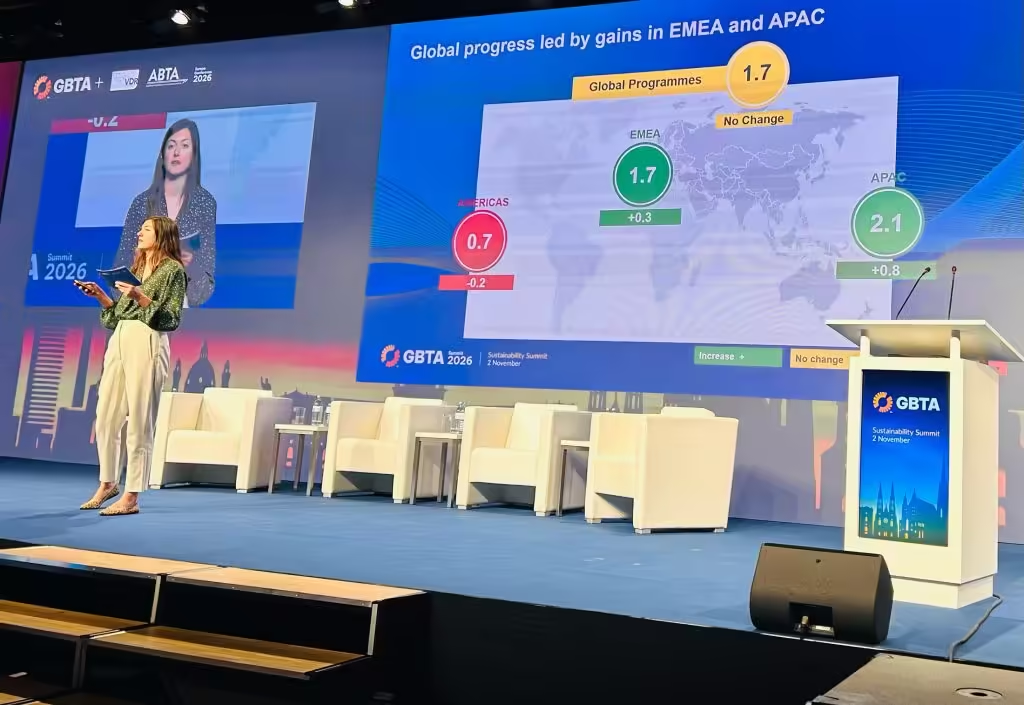

A global benchmark to measure the sustainability maturity of travel programmes has shown a steady increase again in 2026, despite economic uncertainty and other competing corporate priorities.
The GBTA Foundation’s Sustainability Acceleration Challenge, which analyses data from 204 companies across 28 countries, shows the average travel programme maturity score for sustainability efforts rose to 1.5 out of 5 in 2026, compared with 1.4 in 2025 and 1.3 in 2024.
Regionally, Asia Pacific recorded the strongest gains and Europe rebounded, while the Americas lost ground overall.
Progress was strongest in the areas of sustainable procurement and decarbonisation, including Sustainable Aviation Fuel (SAF) purchases.
According to the GBTA member data, SAF investment has risen year-on-year from 20% to 22%, inclusion of Electric Vehicles in 2030 planning from 31% to 33%, and carbon compensation initiatives from 25% to 32%.
The share of companies embedding sustainability in their travel policies increased from 60% to 62%, while employee engagement rose from 39% to 41%.
Use of sustainability features in booking tools remained unchanged at 60%.
Travel emissions tracking remained at 71% and target-setting at 25%, while Science Based Targets initiative (SBTi) validation of Scope 3 targets increased from 29% to 33%.
More companies are selecting suppliers based on climate criteria (38% to 41%) and embedding sustainability requirements in contracts (32% to 39%). Meanwhile, reliance on sustainability questions in RFPs declined from 61% to 57%, suggesting companies may be drawing sustainability information from a broader range of sources.
The results and awards were unveiled at the GBTA Sustainability Summit held in Vienna this week.
Since being launched in 2024, 540 companies have taken part in the Challenge, representing more than $36 billion in combined business travel spend.
“Three consecutive years of progress show that sustainable business travel is becoming more embedded in how companies manage their programmes, even in a difficult operating environment,” said Delphine Millot, Senior Vice President, Advocacy & Sustainability, and Managing Director of the GBTA Foundation.
“But incremental progress isn’t enough. The next challenge is to scale the solutions that can deliver measurable emissions reductions, from procurement and traveller choices to Sustainable Aviation Fuel (SAF).”
Source: thebusinesstravelmag.com