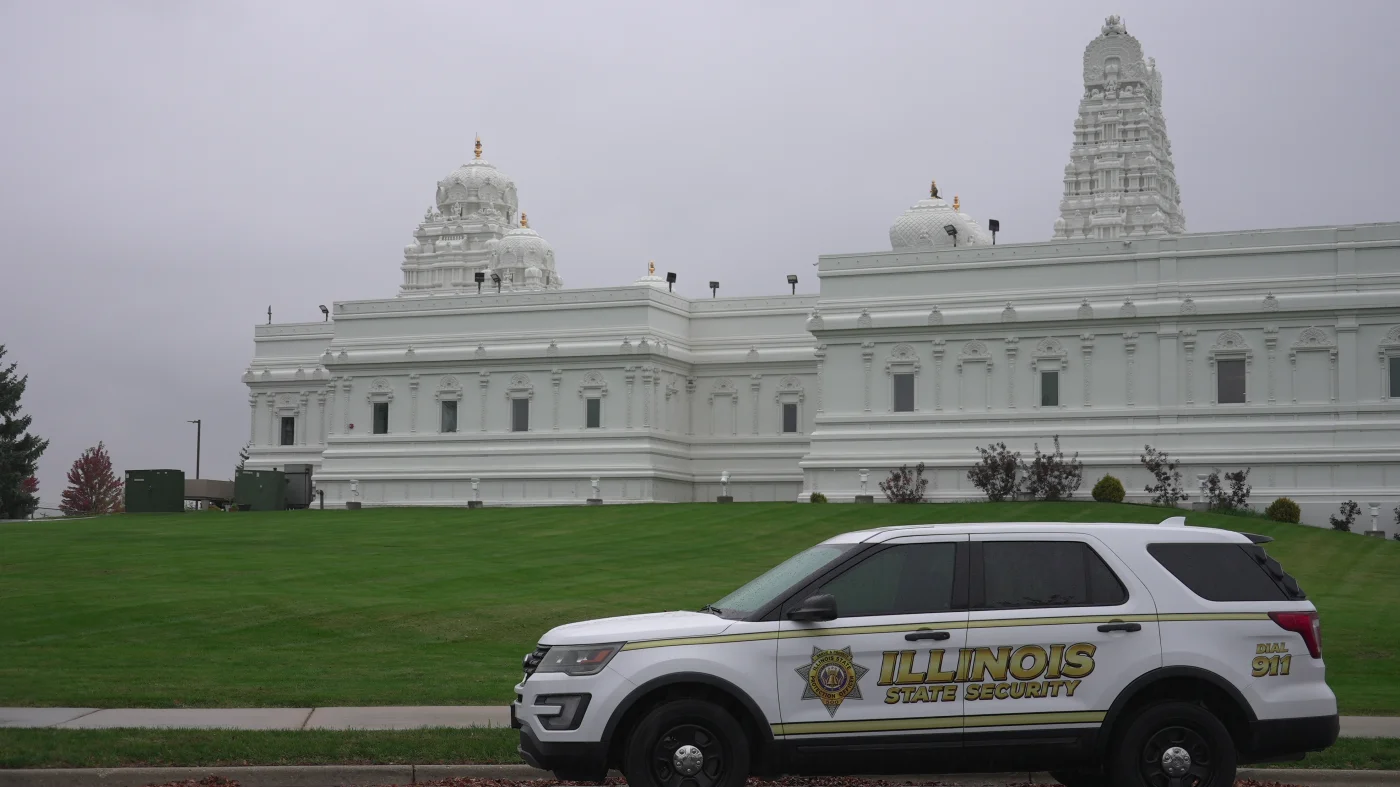

A security vehicle is parked outside of Sri Venkateswara Swami (Balaji) Temple in Aurora, Ill., on Oct. 15, 2026.
Laura Bargfeld/AP
hide caption
Laura Bargfeld/AP
A 19-year-old man’s alleged plot to carry out a mass shooting at a Hindu temple in suburban Chicago last month is drawing attention to a recent and steep rise in anti-South Asian and anti-Hindu hate. Police in Palatine, Ill., announced that on Oct. 11, a college student and Taco Bell cashier named Alexandros Paporakis tried to carry out the attack at the Sri Venkateswara Swami Temple in Aurora, Ill., roughly 40 miles west of Chicago. They said the plot was averted by a jammed gun.
“Something of this scale … has not been directed at South Asians before,” said Rohit Chopra, professor of communications at Santa Clara University and visiting fellow at the Center for South Asia at Stanford University.
Two decades ago, the predominant narrative about Indian immigrants to the U.S. was glowing, describing the relatively small population as a “model minority.” But Chopra says that over the last four years, a combination of growing anti-immigrant populism, economic anxiety and rising political visibility have dramatically changed the script. Today, he said, online and political discourse more often depict Indian Americans and a broader community of people of South Asian descent in conspiracist, degrading and dehumanizing ways.
“It’s become a question of who is American, and deliberately trying to keep the Hindu- and Indian-American community out of those conversations entirely with these sort of preconceived notions and bias against the community,” said Prasiddha Sudhakar, a board member of the Network Contagion Research Institute. Sudhakar was formerly a researcher at the NCRI who coauthored some of that organization’s reports on the topic.
Most concerning, said Sudhakar and Chopra, is that the toxic online rhetoric they have documented has moved from fringe social media platforms to mainstream ones in a short period of time. And, they said, they see strong connections between online hate and offline violence.
“It didn’t start off as mainstream, maybe even like a year or a few years ago. You still saw it on the internet,” Sudhakar said. “But what has actually become more important now is that this is reaching many different parts of society in a scale that we’ve never seen before.”
A massacre averted
Paporakis has been charged in Illinois with making a terrorist threat and unlawful possession of a rifle, both felonies. Police said his coworkers called to report the attempted massacre. One of them, according to an affidavit filed by a Cook County assistant state attorney, had spoken by phone with the defendant shortly after the attempted attack. The affidavit further states that Paporakis had also sent that coworker messages, including an eight-page document he had written outlining his motivation for the alleged plot.
Later that day, police said that a search of Paporakis’ apartment turned up a bag containing an AR-style rifle, 300 rounds of ammunition, eight loaded magazines, one loaded extended magazine and body armor. They also found a gas can and items bearing Nazi symbols and anti-Indian slurs.
“The seriousness of this alleged threat cannot be overstated,” said Palatine Police Chief William Nord at a press conference.
Court filings state that the written document was filled with “derogatory and racially charged slurs” directed at “people of Indian ancestry, Jews and African Americans,” and that it described those groups as “subhumans.” It also indicated that the defendant had settled on the temple location two months prior, but had been planning an attack for two years. In the writings, the defendant allegedly described himself as “a sociopathic white supremacist Neo Nazi filled with hatred, fantasizing about mass murder nearly every day.”
The day that the defendant allegedly went to the temple coincided with the beginning of a major Hindu nine-day festival. Among the many in attendance were U.S. Congressman Raja Krishnamoorthi D-Ill., and his family. Krishnamoorthi has since called for the FBI to investigate the incident as a federal hate crime.
Grafting antisemitic conspiracy theories onto a new group
Sudhakar, whose research was published through the NCRI, said that fringe social media spaces such as 4chan and Gab were the original loci of denigrating and dehumanizing rhetoric about Indians and South Asians. But around 2022, Sudhakar said, her research started to see some of the negative attitudes morph into full-blown conspiracy theories. One of them was a baseless theory about a “Brahmin Organized Government.”
“This is the idea of, oh, there’s like this elitist group of people that are of high class, high privilege that are sort of occupying the entire government, that this is all like some sort of secret ploy,” Sudhakar said.
The term echoes the conspiracy theory of the “Zionist Organized Government,” or “ZOG,” widely espoused by neo-Nazis. This baseless narrative posits that a cabal of powerful Jews runs global affairs, and closely ties with the Great Replacement Theory. It claims that Jewish puppetmasters are deliberately diluting the power of white Christians by promoting immigration, interracial relations and diversity.
Sudhakar said the main distinction is that the anti-Indian conspiracy theories center more heavily on fears over immigration and jobs, rather than changing demographics. Just as the narratives position people of Indian origin as all-powerful, they also invoke dehumanizing tropes about Indians as “dirty” immigrant “invaders” being brought to the U.S. to displace technology sector workers.
“What we saw was that what began as sort of this anti-Hindu meme that began on 4chan started moving into these mainstream platforms [like X],” she said. “And every time that you’d see Indians or anyone of Hindu origin kind of gain prominence, that these same code words would also be increasing.”
Sudhakar said those spikes coincided with events such as Parag Agarwal’s appointment as CEO of Twitter, Sriram Krishnan’s selection as former White House policy adviser on Artificial Intelligence and the installation of Usha Vance as second lady.
But 2025, said Sudhakar, was when online anti-Hindu and anti-Indian hate truly mushroomed. Chopra, the professor at Santa Clara University, found the same, in research co-authored for the Center for the Study of Organized Hate. It found that between January 2025 and June 2026, anti-South Asian hate speech on the social media platform X was 240% higher than it was in January 2024.
“I think the right has very effectively succeeded in making the H-1B visa issue a political hot button,” Chopra said, noting that Indian nationals account for more than 70% of H-1B visas. “Every time there was some development to do with the H-1B visas or a remark that might be made by a figure in authority, you’d find a spike in hate online on X.”
A community new to fighting back
Since the alleged temple massacre was disclosed to the public, calls are growing within the Hindu and Indian communities in the U.S. to speak more vocally about racism. Congressman Krishnamoorthy released a video urging the community to become more engaged. Chopra said that in some ways, the rapid uptick in anti-South Asian hate online has been possible because there has been little organized opposition.
“The South Asian community is particularly vulnerable for, I think, a number of reasons. One is this combination of high median income of certain groups of visible success … combined with the fact that it does not have significant political power,” Chopra said.
The rise of Indian Americans on the political stage in recent years has been significant, given that estimates put the community’s population only around 5 million. These figures include Usha Vance, FBI Director Kash Patel, former Director of National Security Tulsi Gabbard, Ohio GOP gubernatorial candidate Vivek Ramaswamy and former GOP presidential candidate Nikki Hayley. But Chopra said that these milestones do not equate to the political power of an organized constituency.
“It doesn’t have the kind of political power that can … significantly shift elections, Chopra said.
Additionally, explicit racism directed at South Asians has become disturbingly evident within the political arena, Chopra said. In September, a Republican candidate for statewide office posted a screenshot to X of cheering University of Texas football fans after a team victory. It featured a crowd of revelers that included many of South Asian and Asian origin, with the candidate’s comment that “social media is exposing how many Americans have been displaced by foreigners. It’s everywhere and far worse than any of us could imagine.”
The Department of Homeland Security also set off controversy when it shared an image of a poster captioned “Transformers,” with an image of a Sikh man and the words “Get off our roads, you don’t know how to drive Mr. Singh.” The message was understood to refer to an August 25 tragedy, in which a commercial truck driver of Indian nationality illegally made a U-turn on a Florida highway, and killed three people. After a backlash, DHS took the post down.
But while calls are mounting for the community to organize, there are unique challenges. For one, said Pushpita Prasad of the Coalition of Hindus of North America, Hindu temples do not serve quite the same function as houses of worship do in many other religions.
“We don’t belong to temples and we are not part of congregations,” Prasad said. “So for us, organizing and finding our voice and sharing information is that much harder.”
Additionally, Prasad noted that the economic and professional success of many people of Indian origin in the U.S. masks the uncertainty many may feel about their long-term status in the country. According to the Pew Research Centertwo-thirds of the Indian population in the U.S. are immigrants, and of those, nearly half are not naturalized citizens.
“If you happen to come from India, you will find that a lot of Hindus who may be very well off have a great job, seem very well established, they’re not really able to speak because they’re in that weird sort of immigration limbo,” Prasad said. “So that’s another reason why a community that seems well off, at least in media chatter, is not as vocal or as organized as it probably should have been.”
Source: www.npr.org