
Simplifying the possibility of doing business is the objective sought by countries with free zones: territories delimited under fence by the authorities in which customs duties are not settled to be able to compete in today’s globalized world. Andalusia has a lot to say in this field as it has two of the seven tax-free areas in Spain. Una de las más antiguas, la de Cádiz, está de actualidad al ser capital de dos importantes eventos: la XXIX Conferencia de Zonas Francas de Iberoamérica y el Blue Zone Forum.
They currently operate in the Free Trade Zone of Cádiz 450 companies. Fran González, special delegate of the State for the Free Zone of Cádiz, explains the transformation of the premises: “The evolution of the Free Zone was undoubtedly a matter of necessity. The economic situation was very difficult, we found ourselves with a debt of more than 190 million euros that we have had to gradually reduce with new lines of work and the acquisition of new business models. This has led us to reinvent ourselves, seeking that identity within the blue economy and achieving new market lines. If we understand that Free zones in the north, like Barcelona or Vigo, are specialized in automotive, I think it makes a lot of sense to look at the sea. For Cádiz, foreign trade means looking fundamentally at Latin America.
Its strategic position between two continents allows importing, exporting, manufacturing and storing with important tax advantages.
González details the profile of the installed companies and their areas of action: “Normally we move within a range of 70% national companies who seek the uniqueness of our spaces to operate in foreign trade, and 30% who come from abroad. We have developed investments and infrastructure in 13 municipalities. The province has a place for shipbuilding from a dynamic vision, the processing of marine raw materials or the recovery of natural spaces for aquaculture, all with our support.”
Countries in the region request replicas of our ecosystem, with projects financed by CAF. We also recover abandoned salt flats with digitalization for extensive aquaculture or as industrial carbon sinks together with the University of Cádiz, generating opportunities in ecotourism and pharmaceutical research with algae.”
Among the established companies, it stands out Chico Flask, dedicated to the fishing sector.
For its part, Elecam Group was born 50 years ago in Cádiz, has 200 employees and maintains a presence in almost all of Andalusia. Jaime Jiménez, its commercial director, highlights the value of being in the Cadiz facility: “We have been growing on average more than 30% in turnover in recent years. Logistical conditions are what helps the most in the Free Trade Zone. Our international operations are based on buying a lot of European material, so being exempt from tariffs is not essential, since only 40% are involved in international projects. However, we have the services of the Consortium for export and import”.
Jiménez adds that “it was difficult to find a site in Cádiz that suited the logistics space we need, especially for the offices where we develop engineering projects. The current value lies in offering comprehensive solutions associated with electrical panel projects for instrument control, production processes, power generation or electrical protection. We work for refineries, platforms and shipbuilding within the supply chain.”
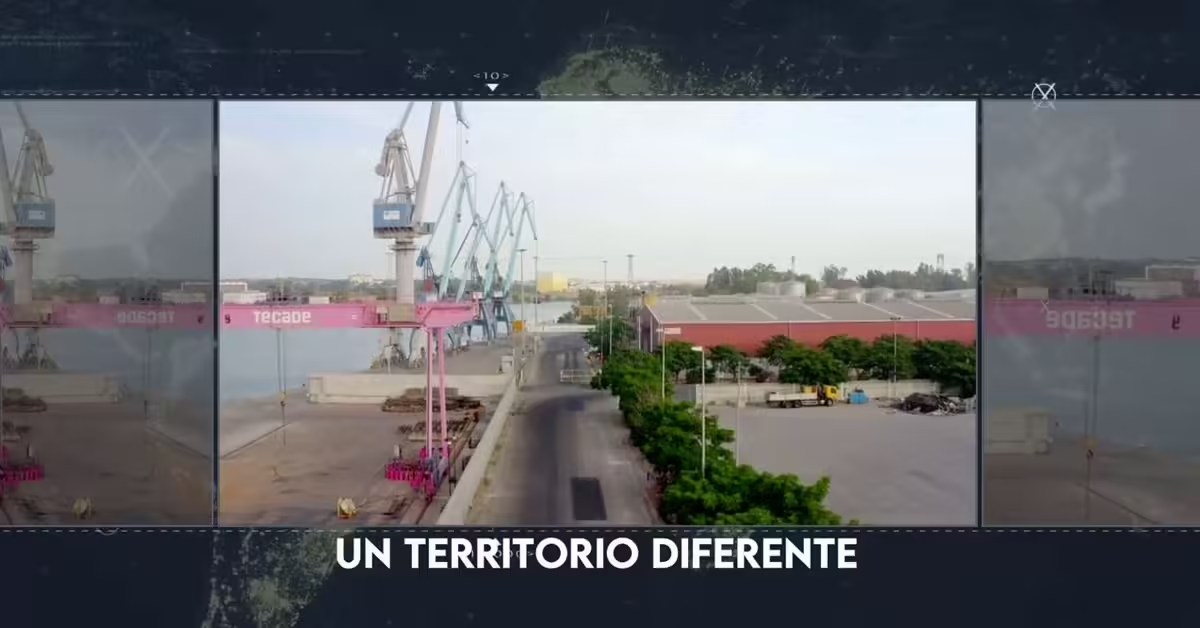
In the case of the Sevillian Free Trade Zone, its greatest strength is being inserted in the only river port in Spain. This space depends, in addition to the Ministry of Finance, on the Ministry of Transportation as it is located on port land. It is worth remembering that the Andalusian industry has exported 25.8 billion euros in six months thanks to the promotion of large business centers.
Carmen Tovar, special delegate of the State for the Seville Free Zone, describes its characteristics: “We are in a strategic space on port land 84 kilometers from the Cádiz coast. We have 16 large companies installed – six in the Torrecuéllar industrial estate and ten in Astilleros – that complete almost 125 hectares, specialized in the metallurgical sector. Jannone has a presence in theme parks in America; GRI builds 200 offshore wind towers a year and employs workers in nine countries; “Megusa has built international bridges and Gemetal built the metal structure of the Cairo Museum.”
Tovar emphasizes the diversity of the Sevillian area: “There are also service companies essential for the transit of goods. Hispalense de Líquidos has two million formulas of fertilizers and DCM decontaminates industrial soils. About 1,500 workers move through the area daily. Together with the Port, the Seville City Council and Customs, we study the expansion of land in Dos Hermanas. In addition, we maintain reserves for two new companies dedicated to the manufacture of green hydrogen and the repair of aviation engines.”
The delegate of the Seville Free Zone highlights the competitiveness of the model: “It is a model aimed at large companies with high export and internationalization capacity. The deposit of goods or manufactured products is unlimited in time, unlike the 90 days of other customs figures, and does not require a deposit. As it is port land, occupancy and activity rates are paid in a facility monitored 24/7. The suspension of taxes improves the income statement because the tax is not paid to the treasury until the merchandise leaves. to third countries. The Andalusian metallurgical sector is booming along with aeronautics and mining, with nine companies dedicated exclusively to large structures.”
At a global level, the list of countries with the greatest number of free zones is led by nations such as Panama, Costa Rica or the United Arab Emirates. In these territories, tariff and tax exemptions are combined with labor flexibility, exemption from income and property taxes, and direct access to government credits.
Alberto Borrás, financial director of Jannone Grupo—a firm that imports wood and steel pipes for construction—analyzes his company’s experience: “We were installed in these port lands before the free zone was created and we decided to take advantage of the tax benefits to bring merchandise in transit without paying taxes until it is available. However, the culmination of a free zone would be to re-export to third countries without charges. Here there is hyperregulation at the European level that reduces competitiveness compared to free zones such as China or Singapore. “Strict regulations and the need for highly specialized personnel put us at a certain disadvantage.”
Along the same lines, Roberto Memo, general director of Internacional Hispacold, explains the situation of his company: “We are dedicated to the manufacture of air conditioning systems for passenger transport and we export to more than 100 countries. Although currently our exports represent 50% of production and the advantages are not so high, The new regulations will allow us to take better advantage of the free zone right. “Importing components from outside the European Union and then exporting the final product outside the community market will be a key tax advantage to compete with the Asian product.”
From the employer’s perspective, José Andrés Santos, president of the Confederation of Businessmen of Cádiz, values the function of these spaces: “Without a doubt it is an economic engine that concentrates a multitude of companies from various sectors that collaborate with each other. What we need is for the tax area and logistics spaces to grow even more. The province of Cádiz has two ports of general interest, but suffers from a deficit in transport infrastructure by train, plane and road, in addition to a low energy supply that causes the loss of new investments.”
Companies need investment deadlines to be facilitated, and financial tools to grow and that bureaucratic obstacles be reduced, which are the ones that hinder competitiveness the most.
This desire to take the lead has led China, under the premise of “one country, two systems”, to become the largest free zone in the world. Its Hainan island and the territories of Hong Kong and Macau operate as free trade ports without walled enclosures, having eliminated levies on more than 6,500 products, including industrial equipment and raw materials. As a singular note, China only taxes tobacco, liquor and hydrocarbons in its free zones. Napoleon already predicted it: “Let China sleep because, when it wakes up, the world will tremble.”
Source: www.canalsur.es