
Europe was left bracing for another day of chaos on Friday after bomb threats were reported at TV studios and airlines, mirroring a series of similar incidents that have taken place across the continent this week.
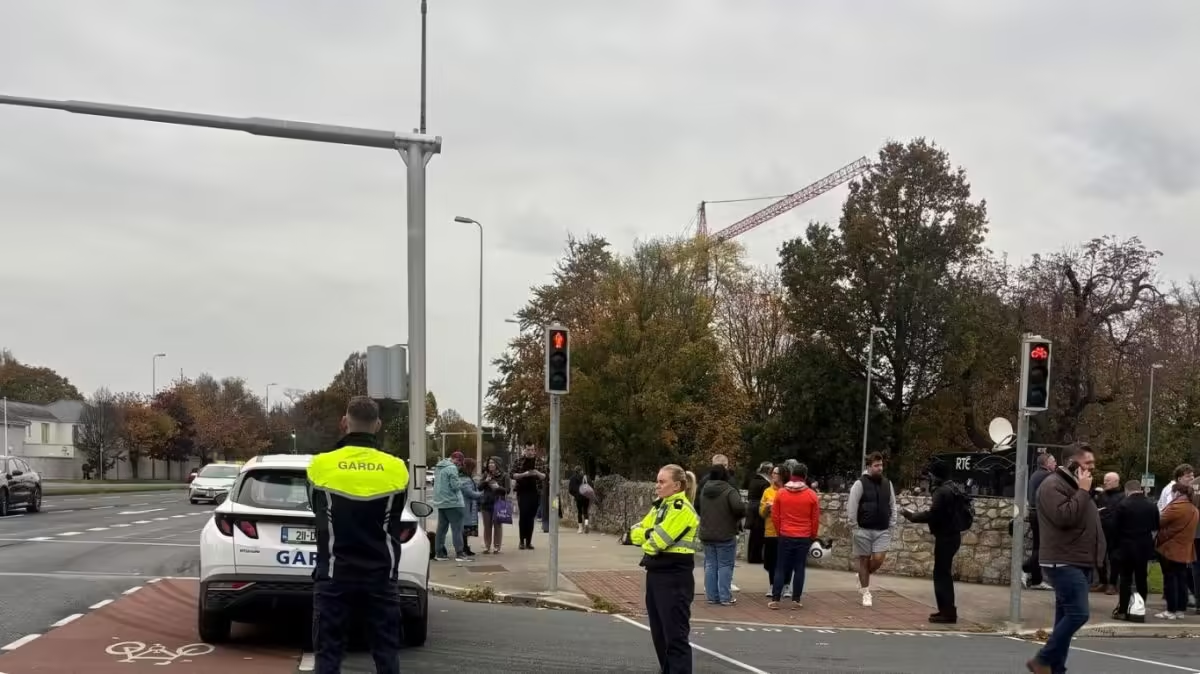
Irish state broadcaster RTÉ was forced to abandon its Donnybrook campus in Dublin after a threatening email was sent to their newsdesk on Friday morning. The Irish Independent and Bauer Media also evacuated their premises after receiving threats. Virgin Media also received a threat but did not evacuate their building and continued to broadcast.
Meanwhile, bomb threats were also made against a Ryanair flight from Rome heading for Lisbon, and a WizzAir Flight from Prague to Rome, according to Italian news agency ANSA.
Read More on News
Hoax bomb threats have disrupted dozens of passenger flights in Europe this week and follow a slew of hybrid incidents across the continent in recent weeks.
Taunting Email
A copy of the email sent to Irish media, seen by Cork Live95, reads: “Hello. I am Mikhail Andropov, one of the leaders of the group responsible for the bomb threats against airplanes in Europe over the past week. European authorities have once again shown that they are incompetent fools who are incapable of doing anything to stop us.
“We experimented with multithreading, and we succeeded in causing widespread panic, as well as forcing European authorities to spend a fortune on all these procedures. But this is only the beginning. What happened this week is just a small part of what awaits Europe in the near future.
“Right now, we’re preparing a new wave of attacks. Right now, we’re recruiting residents of your countries who are actively cooperating with us. We’ve also gained access to compromised devices, servers, and accounts belonging to residents of Europe, as well as those outside its borders—which will allow us to use this against you.”
The group said they will be “blowing up your airplanes, cruise ships, subway stations, and trains,” and “want the whole world to know about us.”
“[Which] is why one of our operatives has planted an explosive device in your building,” they added. “It will detonate in 45 minutes. The clock is ticking.”
RTÉ’s scheduled radio programming abruptly cut off mid-broadcast following the evacuation, with the scheduled show replaced by music and a pre-recorded message.
Gardai (police) say they were alerted to the threats at RTÉ and “immediately took the precautionary actions that were necessary in co-operation with those who have been targeted.”
Posting on Instagram, RTÉ presenter Sarah McInerney confirmed the building had been evacuated due to a bomb threat.
“I’m standing outside RTE, we’ve just come off air on Morning Ireland and the whole building has been evacuated because there has been a bomb threat,” she wrote. “I can’t move because my car has been blocked in by the guards. There’s a general sense that it is almost certainly a hoax.
“The bomb threat seems to have gone out to a number of different news organisations in Ireland and possibly across Europe.”
Irish Taoiseach Michael Martin told RTÉ the incident is “worrying,” and notes it comes after yesterday’s threats to aviation across Europe, which “appear to have been coordinated.”
Speaking to Cork radio station 96FM, Irish Deputy Prime minister Simon Harris said: “There is a very serious and evolving situation this morning and obviously this comes on the back of a number of bomb scares yesterday and in recent days in relation to airlines as well.”
He added: “We don’t yet know who is responsible for what is happening this morning. We don’t yet know whether it’s an individual behind this effort or some form of a co-ordinated effort.
“What I do want to ensure the people of this country is that this is an issue being taken very seriously by the gardai (police force), by our security forces and our cyber experts. They are working now on this issue.”
Fianna Fáil MEP Barry Andrews noted the bomb threats were similar to ones in Denmark last month ahead of a summit of the European Political Community (EPC). The group’s next summit is set to take place in Dublin on November 12.
“There’s a vulnerability this week ahead of the EPC, and that seems to be what these threats are for,” Andrews told The Irish Times. “The Danes were convinced a state actor was involved.”
He added: “This follows a pattern of hybrid warfare, disinformation and other cyberattacks. It’s a well-trodden pattern that we need to be aware of.
“It’s intended to cause maximum disruption, sow confusion and to undermine confidence in state authorities and news outlets.”
More Threats to Flights
Bomb threats have continued to affect flights across Europe today. A Ryanair flight bound for Lisbon from Rome received a bomb threat at 9 a.m. that was later found to be a hoax, airport authorities confirmed. A similar threat was made two hours later, which forced a Wizz Air flight from Prague to Rome to make an emergency landing in Venice.
Local media initially reported the bomb alert came from an anonymous phone call made to air traffic control, but a source later denied this was this case, Reuters reported.
Four additional bomb threats were called into flights traveling over French airspace today, the French PM’s office said in a statement. All of the planes landed safely and bomb disposal squads have been conducting inspections.

In the Czech Republic, eight bomb threats were made against aircraft at Prague Airport, an airport spokesman told French outlet Liberation. “The threats concerned flights arriving from Denmark, Spain, and Great Britain. Departing flights were to the Netherlands, Cyprus, Romania, Italy, and Great Britain.” No explosives have been found so far.
“We are once again at Copenhagen Airport today in connection with threats directed at air traffic,” Copenhagen Police said in a statement. “We are now investigating the incident and have a visible presence at the airport.”
Emergency Landings
Hoax bomb threats have disrupted dozens of passenger flights across Europe this week, mostly affecting low-cost airlines flying across eastern Europe. Some flights were forced to make emergency landings while others were intercepted or escorted by fighter jets, with passengers being kept at military bases overnight.
To date, no explosive ordnance has been found on any of the affected flights and no arrests have been made. The threats follow a number of incidents in Europe in recent weeks, including attacks on electricity substations in Germany, supermarket freezers in France and airstrike notification apps in both Russia and Ukraine.
Although no culprit has yet been identified, a threatening email sent to Rome Fiumicino Airport was signed by a group calling themselves “Fighters of the Male State,” who threatened to “turn the skies red” with explosives.
The Male State, an ultra-nationalist group that emerged in Russia in 2016, initially started as a misogynist movement, before rebranding as a vocal supporter of Russia’s war in Ukraine. A Russian court deemed the group an extremist organization and banned it in 2021. Its founder, far-right activist Vladislav Pozdnyakov, was sentenced to two years probation for inciting hatred toward women, but his sentence was overturned just three months later when Russia changed its laws on political extremism.
Pozdnyakov, however, has denied involvement, saying the group no longer exists and was not involved in any way.
Many officials have linked the attacks to Europe’s support for Ukraine in its war against Russia, claiming cyberattacks are part of a “hybrid” effort from Moscow designed to weaken infrastructure with cheap, easily deniable attacks that do not warrant an armed response.
Spanish Foreign Minister José Manuel Albare described the attacks as an act of “hybrid aggression,” telling state broadcaster TVE that while it will take some time to determine who is behind the attacks, “it cannot be mere coincidence that so many incidents with exactly the same modus operandi are happening across Europe.”
“The most reasonable assumption is that we are facing an attempt at hybrid aggression and a form of psychological warfare,” he added.
Contact Newsweek editors on this story: Tobias Meyjes and Tony Phillips.
Source: www.newsweek.com