
Industry representatives discuss producer responsibility, illegal dismantling, vehicle traceability and the practical implications of Europe’s new regulatory framework.
An International Roundtable on Auto Recycling (IRT) webinar examined how the EU’s new Circular Vehicle Regulation will affect automotive recyclers. Industry representatives discussed extended producer responsibility, illegal dismantling, vehicle traceability, EV battery handling and recycled parts, raising concerns over compliance costs, enforcement and the need to protect authorised treatment facilities from unfair competition.
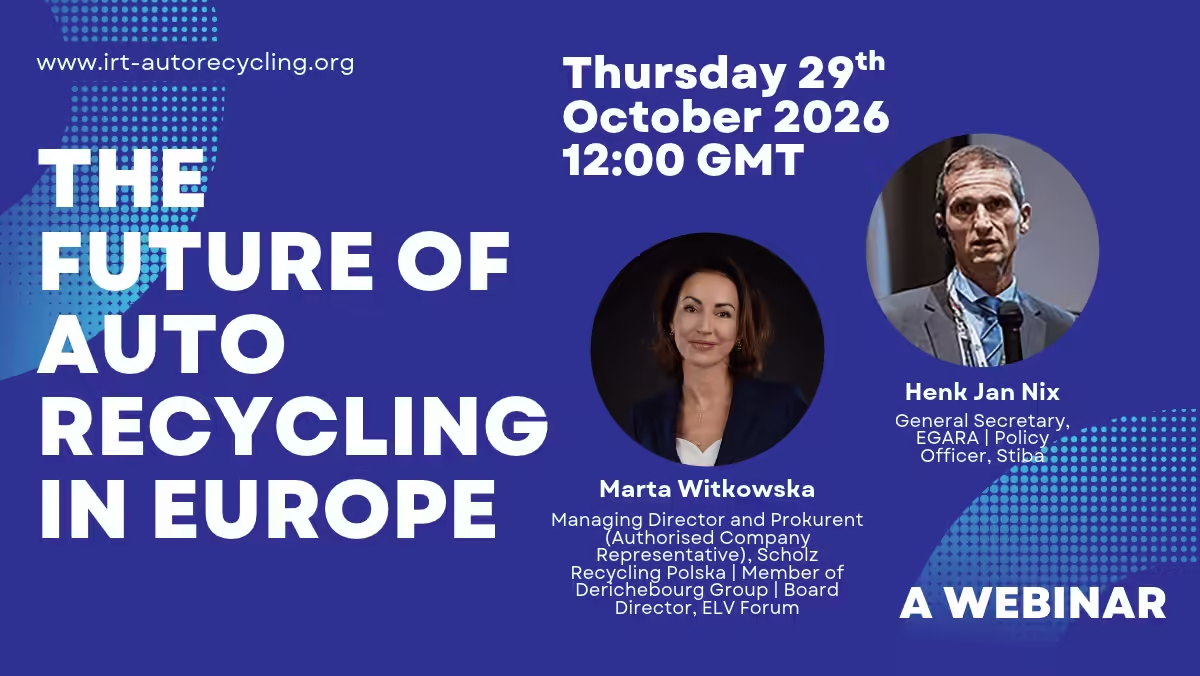
An International Roundtable on Auto Recycling (IRT) webinar on 29 October 2026 focused on the implications of the EU’s new Circular Vehicle Regulation for automotive recyclers. Co-hosted by Steve Fletcher of the Auto Recyclers of Canada and Haydn Davies of Auto Recycling World, the webinar featured Henk Jan Nix, Secretary General of the European Group of Automotive Recycling Associations (EGARA), and Marta Witkowska, Managing Director of Scholz Recycling Polska and a board member of the ELV Forum. Both speakers welcomed the regulation’s intentions but raised concerns about how it will work in practice, particularly the financial and operational responsibilities facing authorised treatment facilities (ATFs).
Producer responsibility and the cost of compliance
Henk Jan Nix outlined the regulation’s main changes, including extended producer responsibility (EPR), additional material recovery requirements, and measures intended to improve vehicle traceability. Although the regulation will apply directly across EU Member States, national governments still have considerable scope to determine how certain provisions are implemented. He warned this could create differences between countries and increase administrative requirements for dismantlers already maintaining detailed vehicle and parts records.
A particular concern was how manufacturers will fulfil their financial obligations under EPR arrangements. Nix favoured centralised producer responsibility organisations over separate manufacturer-specific schemes, arguing that multiple systems would create unnecessary complexity for ATFs. He also questioned how dismantlers would be compensated for recovering materials with little or no commercial value. While recyclers already remove valuable components because a market exists for them, additional mandatory recovery requirements could add considerable labour and processing costs. He preferred functioning markets for recovered materials over an industry increasingly dependent on compensation.
The discussion also addressed the complications surrounding electric vehicle batteries. Nix explained that once batteries are removed from vehicles, separate battery legislation applies, potentially creating additional producer responsibilities for dismantlers preparing them for reuse. He warned that such requirements could discourage reuse rather than support circularity. Battery safety, insurance and access to appropriate dismantling information were further concerns, particularly when dealing with severely damaged vehicles containing energised high-voltage batteries. He also pointed out that improvements in vehicle design for dismantling will take years to benefit recyclers, as vehicles manufactured under existing requirements will continue entering ATFs for the foreseeable future.
Illegal dismantling and missing vehicles
Marta Witkowska provided a Polish perspective, highlighting the difficulties faced by authorised recyclers competing against an extensive illegal dismantling market. Poland has approximately 850 ATFs, 80 collection points and ten shredders, with around 499,400 end-of-life vehicles processed through authorised facilities in 2025. However, she estimated that almost 500,000 vehicles annually are dismantled outside the authorised system, illustrating the scale of the problem facing legitimate operators.
She described practices involving fictitious vehicle sales and stripped vehicle shells being delivered to ATFs for certificates of destruction after valuable components have already been removed. Meanwhile, legitimate businesses must comply with demanding environmental requirements, financial guarantees and fire protection measures. Witkowska explained that obtaining an ATF permit in Poland can take at least two years, placing authorised recyclers at a significant disadvantage against operators avoiding these obligations.
Both speakers considered improved vehicle registration and traceability essential to addressing the problem. Witkowska highlighted the difficulties surrounding damaged vehicles sold through salvage auctions, particularly when they move between countries without clear information about their eventual treatment. She welcomed plans for the European MOVE-HUB system to improve information sharing between national registration authorities, although implementation remains several years away. Nix argued that Europe had missed an opportunity to establish a comprehensive registration system identifying who is responsible for every vehicle throughout its life. Without reliable information about vehicle ownership, deregistration and destruction, he questioned whether the regulation could fully address illegal dismantling.
Manufacturers and the future of recycled parts
The webinar also considered the increasing involvement of vehicle manufacturers in recycling operations. Responding to questions about manufacturer-owned facilities, Witkowska suggested that direct involvement could help manufacturers better understand the operational difficulties faced by dismantlers. Nix, however, questioned whether independent ATFs could increasingly become contractors within manufacturer-controlled recycling networks, potentially affecting their commercial independence and freedom to sell recovered parts.
Restrictions on parts reuse were another concern, particularly where manufacturers retain control over vehicle software or limit the resale of certain components. Witkowska highlighted the importance of insurance companies supporting repairs using recovered parts, referring to practices in France as an example. Both speakers considered commercially viable parts reuse essential to the future of authorised vehicle recycling, alongside reliable markets for secondary materials.
The discussion concluded with agreement that successful implementation will require closer cooperation between vehicle manufacturers, dismantlers, shredders, insurers and national authorities. For Witkowska, priorities include ensuring vehicles reach authorised facilities and protecting the commercial market for recovered components. Nix emphasised the importance of recyclers remaining involved in national discussions as governments determine how the new requirements will operate.
Although Europe’s regulatory direction has been established, important questions remain over funding, enforcement and the responsibilities of manufacturers and recyclers. For ATFs, the challenge will be ensuring that the regulation supports legitimate recycling businesses rather than adding costs while illegal operators continue to avoid the rules.
View the webinar below:
To view previous IRT webinars, go to: www.irt-autorecycling.org/https-www-irt-autorecycling-org-webinar
Further Reading on Auto Recycling World
Source: autorecyclingworld.com