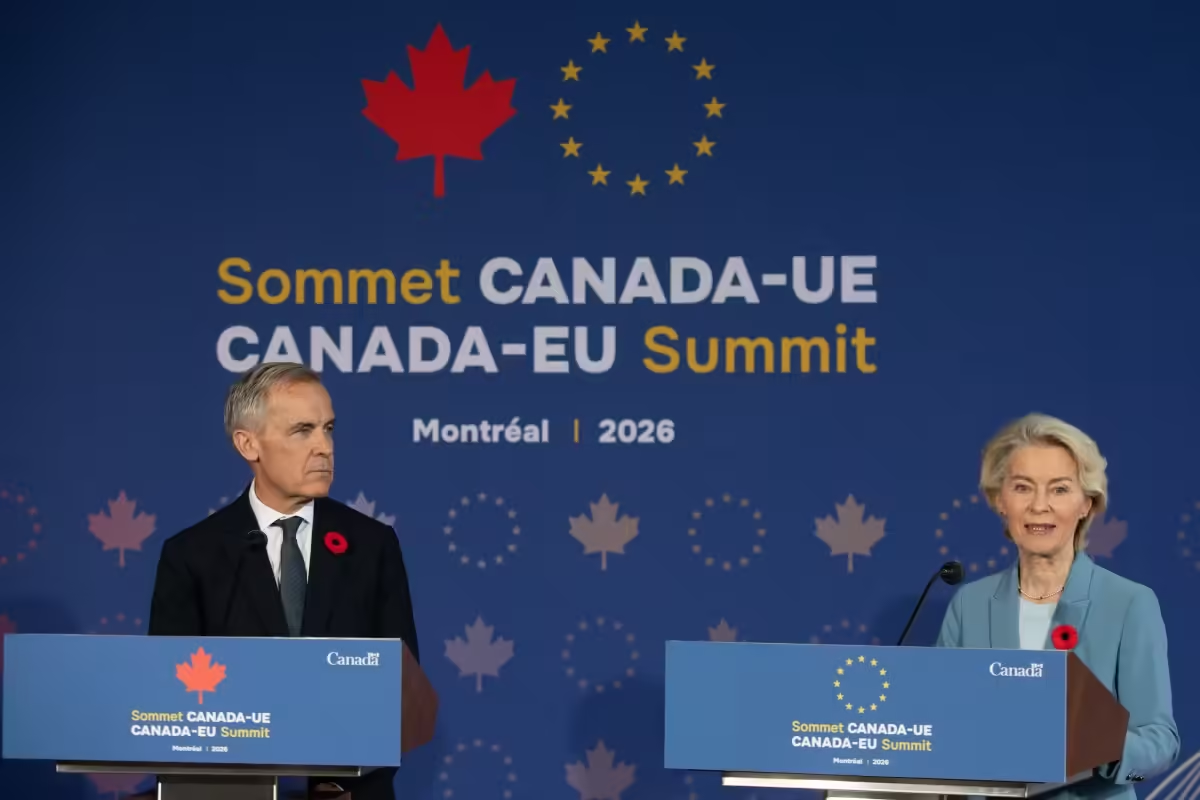

Montreal, Oct. 31 (SANA) The European Union and Canada announced a series of strategic agreements to deepen bilateral cooperation across critical minerals, artificial intelligence, and digital trade, establishing what both sides termed the closest partnership between the EU and a non-European state.
The announcement came at the conclusion of the two-day EU-Canada Summit held in Montreal, during which Canada also reiterated its intention to participate in the €90-billion European loan program supporting Ukraine.
Strengthening Resilience and Sovereignty
Canadian Prime Minister Mark Carney emphasized that the alliance reinforces national sovereignty, collective resilience, and joint capabilities to navigate global supply shocks, affirming that Canada will not passively await outside forces to dictate the future of artificial intelligence.
President of the European Council António Costa praised the partnership as the deepest and most resilient agreement established by the bloc with a non-European nation, noting Canada’s alignment with core European standards.
The agreements build on the Comprehensive Economic and Trade Agreement (CETA) signed a decade ago, accelerating strategic alignment amid changing trade and geopolitical dynamics involving Washington.
Critical Minerals and Artificial Intelligence Infrastructure
Under the new terms, critical minerals—essential for clean energy transition, electric vehicle batteries, and advanced technologies—formed a key pillar of the accords. The agreement enables the European Investment Bank to finance critical mineral projects in Canada, boosting mining investment while assisting the EU in diversifying supply chains away from single-source reliance.
In artificial intelligence, both sides agreed to expand cooperation in advanced supercomputing, opening European supercomputing infrastructure to Canadian researchers and enterprises to advance secure, sovereign AI technologies.
The agreement follows Ottawa’s recent €1-billion investment in Canadian AI firm Cohere, operating in partnership with Germany’s Aleph Alpha—a move Carney cited as a practical model of transatlantic innovation.
Digital Cooperation and Expanding Alliances
The accords also include provisions for digital trade to streamline cross-border electronic transactions, along with ongoing discussions regarding Canadian participation in EU initiatives such as the Erasmus student exchange and the Galileo satellite navigation network.
Looking ahead, both parties signaled interest in expanding the strategic coordination framework to include key international allies, such as Japan, South Korea, and Australia, to build a broader economic coalition resilient to international market shifts.
Kh.A / H.H
Source: sana.sy