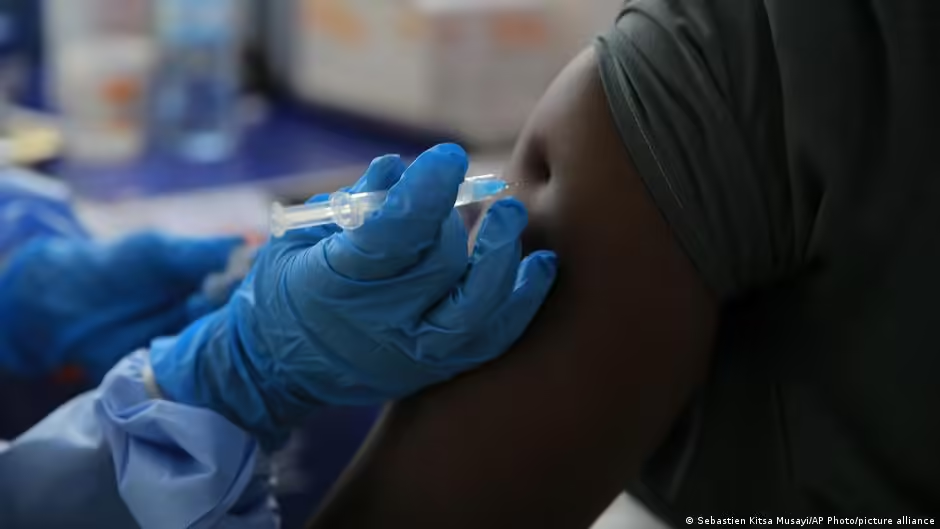

1976: A hitherto unknown disease breaks out near the Ebola river in the country then known as Zaire, now the Democratic Republic of Congo (DRC). This was the first scientifically documented Ebola epidemic.
Now, 50 years on, the DRC once again finds itself at the center of a major Ebola outbreak. This time the pathogen is the less common Bundibugyo type of the genus Orthoebolavirus. The virus was identified in 2007 during an outbreak in Bundibugyo, Uganda. Another outbreak occurred in the DRC in 2012.
Bundibugyo: Preparations could have been made
How can a virus that has been known for decades continue to infect thousands of people, yet there is still no licensed vaccine or official treatment?
Torsten Feldt, a doctor of tropical medicine at Düsseldorf’s University Hospital, sees this as a missed opportunity. “We had come across the Bundibugyo virus in two previous outbreaks: 2007 in Uganda and 2012 in DR Congo. So we had enough time to develop vaccines and therapeutic options. But we didn’t make use of this opportunity, meaning crucial time was lost during the current outbreak.”
Leonie Mayer from the German Center for Infection Research (DZIF) and the Institute for Infection Research and Vaccine Development at the University Medical Center in Hamburg-Eppendorf agrees. “They could of course have developed a vaccine and run pre-clinical trials before,” Mayer told DW. She stressed, however, that their effectiveness can only be assessed and confirmed during an actual outbreak.
Mayer is the lead author of a recently published study that examined whether Ervebo, an Ebola vaccine that has already been licensed, can be used against other types of Ebola as well.
Why Ebola is a good candidate for vaccine development
From an immunological point of view, and compared to — for example — influenza or HIVEbola is a very worthwhile candidate for a vaccine. Influenza viruses are constantly mutating, and the human immunodeficiency virus is particularly good at evading our immune defenses. Ebola is far more predictable.
“I think — and perhaps it’s kind of a blessing in disguise — that it will be relatively straightforward to develop a vaccine against Bundibugyo,” says Mayer.
Herein lies the paradox. From a scientific point of view, Ebola is a good vaccine candidate, yet there is still no licensed form of prevention against the Bundibugyo variant that is currently circulating.
Mayer explains that vaccines cannot be developed as a precautionary measure against every potential pathogen. Lack of funding or the prioritization of other pathogens often have a role to play. Many researchers had assumed that a fresh outbreak of the Sudan Ebola virus was more likely, and vaccine development for this strain is more advanced.
Different types of Ebola
Another part of the problem is that Ebola is not one single virus. The known, highly dangerous orthoebolaviruses include Ebola virus (EBOV), previously called the Zaire Ebola virus (ZEBOV), the Sudan virus (SUDV), and the Bundibugyo virus (BDBV). The existing vaccine, Ervebo, was developed and licensed for use against the Zaire variant. But there is still no approved protection against the others.
This is why the existing Ebola vaccine has been of only limited use to people in the areas of the current outbreak.
Another factor may also be relevant: The Bundibugyo virus appears to be less aggressive than the Zaire variant. At first, that sounds like good news, but it may make it harder to contain, as people remain mobile for longer after being infected, and can pass on the virus without realizing.
Ervebo vaccine: Immune response to Bundibugyo
In the recently published study, Mayer’s research team from the DZIF investigated whether the already licensed Ebola vaccine could trigger an immune response not only against EBOV, but against other types of Ebola as well. They found cross-reactive T-cell responses against Bundibugyo, and also, to a lesser extent, against the Sudan virus.
For Mayer, this is already an important finding: “We now know that the immune cells can most likely also recognize the Bundibugyo virus.” But she also observes: “Our data does not enable us to answer the question of whether this immune response actually provides protection, or if it results in a milder progression of the disease.” This is currently an important gap in our knowledge.
Why the existing vaccine cannot currently be deployed
If there’s a vaccine that has already been licensed, and indications that it could protect people, why isn’t it simply being deployed?
Mayer explains the dilemma. For one thing, she says, it’s not ethical to deploy a vaccine if you’re not sure whether or how well it works. Also, if it were used on a large scale, it would no longer be possible to establish whether it actually works: A reduction in cases could also be a result of other measures, or the epidemic might already have passed its peak.
Jürgen May, a specialist in tropical diseases at the Bernhard Nocht Institute, also warns against mass vaccination: “Mass vaccination without proof of efficacy could create a false sense of security, forfeit trust, and, if it does not provide sufficient protection, make study impossible.”
It’s very important for there to be acceptance on the ground. “If we inoculate people with a vaccine on a large scale, and afterwards it turns out that it was nothing like as effective as we expected, it’s very difficult to communicate that to people on the ground,” Mayer says. In a worst-case scenario, people could subsequently refuse inoculation with more effective vaccines.
Why Ebola is still so difficult to contain
But the current outbreak also shows that medical innovation alone is not enough. Conflictsdifficult transport routes, attacks on healthcare facilities, and gaps in contact tracing all make it harder to contain.
Torsten Feldt says identifying Bundibugyo is no longer a problem in itself. What is often limiting is the practical availability of diagnostic tools. “In remote or conflict-affected regions, samples often have to be transported over long distances,” he explains.
Here we see another Ebola paradox. The world is getting ever better at diagnosing infections, but it still struggles to contain outbreaks fast enough. The authors of an article in the current issue of Nature come to the same conclusion: The problem is often not identifying cases, but the speed with which people react. Finding Ebola is often easier now than stopping Ebolathey write.
From a Bundibugyo vaccine to a pan-Ebola one?
Many researchers believe the current crisis could potentially also provide a great opportunity. The so-called Tumaini study, which is testing different vaccine candidates, has now been launched in the DRC.
These include Ervebo, developed by Oxford University, and a Moderna mRNA vaccine. The study aims to provide the first reliable data about their efficacy against the Bundibugyo virus.
Whether these vaccines could still help control the current outbreak is uncertain. There is hope, but experts estimate that, realistically, it will be several months before any such vaccine is available for widespread use; perhaps not until mid-2027.
“Ideally, we will develop cross-reactive pan-Ebola vaccines,” Christof Geldmacher, a co-author of the DZIF study, says of their long-term plans. This is also something that is being worked on. For now, though, the focus is on developing an effective vaccine against the Bundibugyo variant of the virus.
This article has been translated from German.
Source: www.dw.com