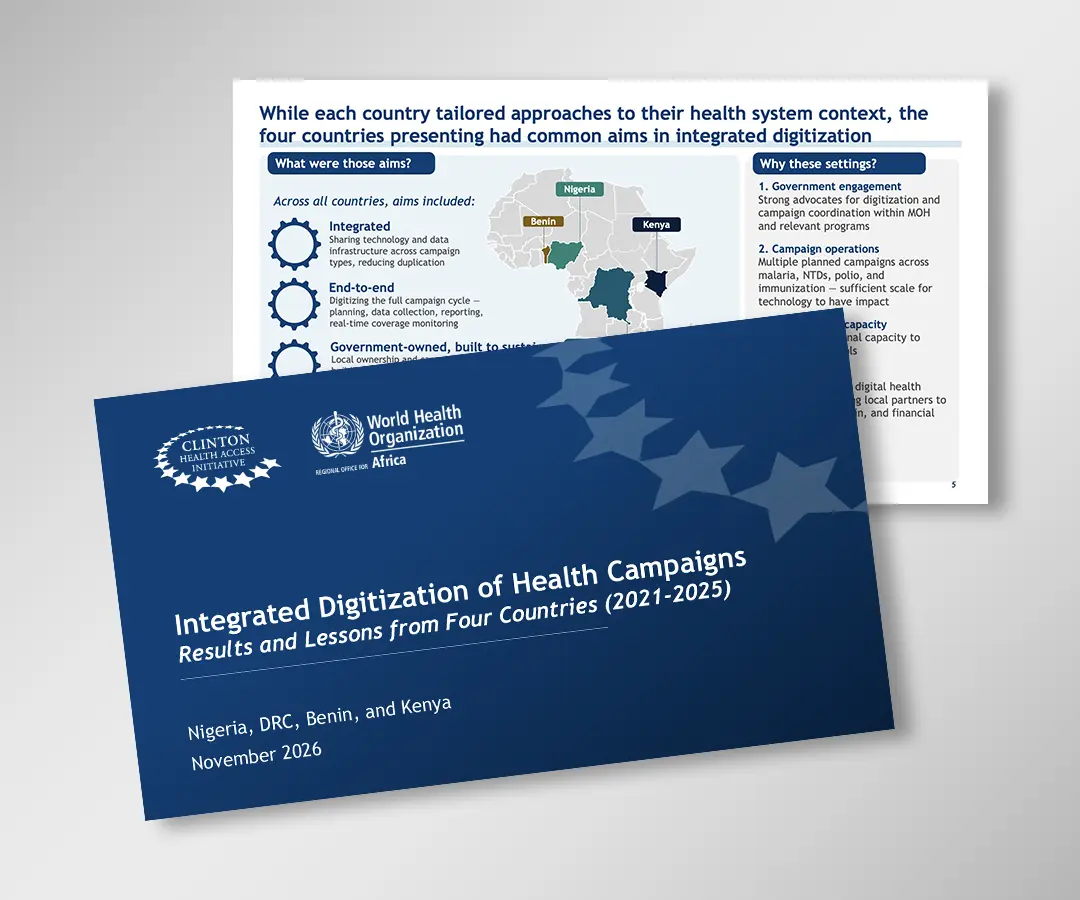

Lessons from four African countries between 2021 to 2025.
Health campaigns deliver millions of bednets, vaccines, and medicines every year. Hundreds of campaigns run across Africa alone. Well-run campaigns can reach very high coverage in a short time, including among people that routine services often miss, such as families in remote areas, mobile and displaced populations, and households far from a health facility.
But each campaign is usually planned, funded, and run by separate disease programs, with their own calendar, budget, and data. Data is rarely shared between campaigns and are often too high-level to show where coverage is falling short, so many gaps come to light only after a campaign ends. Four countries tested whether digitizing health campaigns could change that.
Results and lessons from Integrated Digitization of Health Campaigns (2021-25) is the final report. It covers how each country built its system, results on data quality, data use, coverage, and cost, and recommendations for ministries, funders, and partners.
Read the report
How ministries digitized health campaigns
Between 2021 and 2025, ministries of health in Benin, the Democratic Republic of the Congo (DRC), Kenya, and Nigeria (Kano State) worked with CHAI, the World Health Organization Regional Office for Africa (WHO AFRO), and partners to build integrated, government-owned digital campaign systems.
- Digitized means using digital tools across the whole campaign cycle: mapping and counting the population, planning, tracking delivery and stock, supervising teams, and viewing coverage on live dashboards.
- Integrated means all campaigns, including malaria, neglected tropical diseases, polio, and immunization campaigns, share the same tools and data.
Over four years, digitized campaigns in these countries reached about 24 million people. More than 240 national and subnational staff were trained to manage them without outside support.
What changed
The clearest gains came in data quality, and in some places, better coverage.
Kano State, Nigeria piloted digital tools in a lymphatic filariasis campaign in 2024, in one local government area (LGA), Tofa. Data arrived much faster: 92 percent of records reached the central system within four hours of collection, compared with an estimated 60 days or more for paper reports. Because Tofa’s teams could see coverage as it happened, they could act on it. In Langel ward, supervisors spotted low coverage in the first two days and recruited seven more community drug distributors. By 2025, digitization had expanded to multiple campaigns and LGAs, and reach grew from about 140,000 people to more than 2.5 million.
Benin had digitized its campaigns since 2020, but on a partner-run platform. It moved to a government-owned one in 2023, which included several additional features as well. Digital tracking of individual children during seasonal malaria chemoprevention campaigns helped health workers find those who missed a dose. The share of children who received every dose rose from 52 percent in 2022 to 68 percent in 2023 and 73 percent in 2024. While other factors also contributed, follow-up of missed children via digitization helped reach these numbers.
When DRC moved to a single, digital national platform, teams could see campaign results at the facility and village level, not just for a whole health zone. That showed what zone-level reports had hidden. In a 2024 polio pilot, the digital campaign identified and located 3,038 children who had never received a vaccine; missed in previous reporting at only the health zone level.
When Kenya moved from mostly paper and 13 small, partner-run digital tools to a single national platform, supervisors could act on data as it came in. In the 2025 neglected tropical disease campaign, 80 percent of supervisory visits were prompted by alerts from the system rather than routine check-ins. The platform also produced lists of children who had missed doses, so health workers could follow up with them.
What it costs. Digitization costed more at the start, but those costs fell with scale. In Kano, the added cost of digitization dropped from US$0.20 per person during the 2024 pilot to US$0.12 per person in 2025. When a paper-based campaign misses its coverage target and must run an extra round, digital can cost less overall. In one Kano LGA, an effective digital campaign cost US$0.96 per person, compared with an estimated US$1.68 per person on paper once the extra round was counted.
Five lessons for ministries, funders, and partners
Technology was rarely the hard part. Across four countries and four different platforms, the harder work was in governance, technical capacity, and data use habits.
- Start with governance. The systems most likely to last are built into existing national initiatives and coordination structures, with common rules for sharing campaign data and systems across programs.
- Treat data use as the main constraint. Digital tools delivered good data quickly, but teams often had no regular way to review it and act. Countries that turned dashboards into better coverage also set up clear reviews: who looks at the data, when, and what they can do about problems that arise.
- Pick a platform and commit to it. Multiple platforms can meet the core needs of a given team; committing to a chosen tool, including the people and budget to sustain it, matters more than finding the perfect one.
- Expect population figures to be the slowest problem to solve. Programs and partners continue to use different population estimates for the same area, reflecting in denominator and coverage inaccuracies. Digital tools alone cannot produce the required agreement across programs for shared population estimates.
- Fund shared systems alongside disease-specific ones. Most campaign funding flows through individual disease programs, which creates a natural pull toward separate systems. Funders and ministries can counter this by budgeting for shared infrastructure, data, and the ministry staff who manage them.
Join the conversation
Join our webinars to hear from the people who led this work. Speakers from CHAI, the WHO, the Health Campaigns Effectiveness Coalition, and ministries of health in Benin, DRC, Kenya, and Nigeria will share practical insights and recommendations.
Part I: Nigeria & DRC
Thursday, November 5, 2026 | 2:00–3:00 PM WAT
Part II: Benin & Kenya
Thursday, November 12, 2026 | 2:00–3:00 PM WAT
Source: www.clintonhealthaccess.org