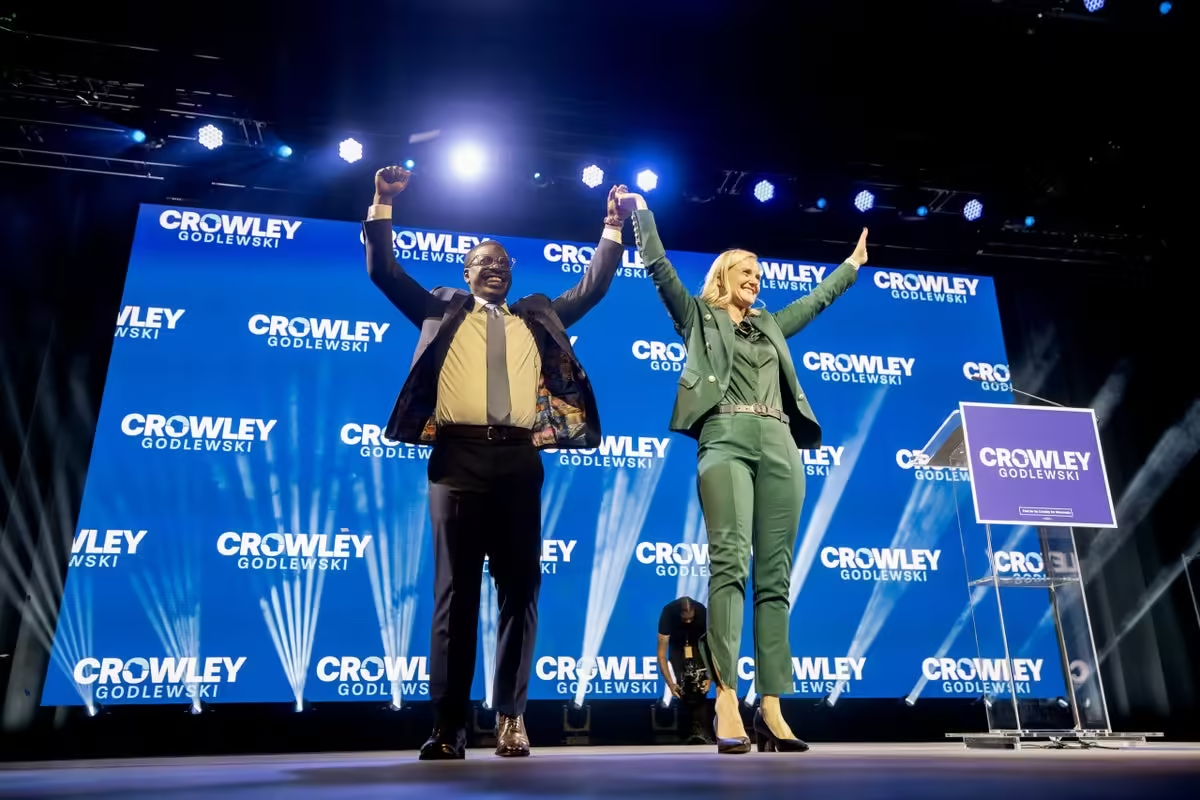

Democrat David Crowley will be Wisconsin’s next governor, making history as the first Black person to hold the office.
Crowley, who is Milwaukee County’s executive, defeated Republican U.S. Rep. Tom Tiffany of Minocqua. Tiffany conceded in a speech at 9:45 p.m. and Crowley delivered a victory address shortly after 10 p.m.
The Associated Press called the race at 10:28 p.m.
Understanding Wisconsin, Together.
WPR’s “Wisconsin Today” newsletter keeps you connected to the state you love without feeling overwhelmed. No paywall. No agenda. No corporate filter.
All results are unofficial until they’re certified by elections officials in coming weeks.
In a victory speech at Landmark Credit Union Live, a music venue in his hometown of Milwaukee, Crowley pledged to represent the entire state of Wisconsin.
“I’d rather be a governor for all of us, and tonight that includes everyone who didn’t vote for me,” he said. “I want you to know that I’m going to listen to you, that I’m going to work for you, and I hope to earn your trust the best way that I know how.”
Throughout his speech, Crowley repeated a theme of unity, even on a night that Democrats won resoundingly in races across the country.
“Let’s be the state where elections make us better, not bitter. Where we stop asking where an idea came from and instead ask where will it take us,” he said. “People who work together will win, not Democrats, not Republicans, but people, y’all. And I learned that people beats money and power each and every single day.”
Crowley’s victory comes as Democrats also appeared to take control of both houses of the state Legislature. It would be the first time Democrats have held unified control of state government since 2010.
Crowley’s victory seemed impossible just this summer, when he briefly dropped out of the race for governor, only to drop back in.
His path to the office represents an extraordinary ascent from a difficult childhood in one of Milwaukee’s most troubled neighborhoods. As a candidate, he often discussed his parents’ struggles with addiction and a childhood marked by multiple evictions as motivation for his political work.
He began his career working on former U.S. Sen. Russ Feingold’s 2010 reelection campaign, and worked as a staff member in county and state government before being elected to the state Assembly in 2016.
In 2020, he became Milwaukee County’s youngest and first Black county executive. While in office, he returned to school and became the first person in his family to graduate from college.

But his bid for governor failed to gain momentum this year, and he exited the race in early July. Ten days later, after Lt. Gov. Sara Rodriguez ended her campaign, he reenteredthis time with the backing of outgoing Gov. Tony Evers. It was a clear effort by mainstream Democrats to pose an alternative to Madison Rep. Francesca Hong, the democratic socialist who had run at the front of the pack for months.
Crowley’s primary win against Hong, by less than a percentage point, came as a middle-of-the-night shock. He emerged a battle-tested candidate, someone many Democratic voters said would have a better chance of winning the general election in November.
Wisconsin Democrats had high hopes going into this election cycle, expecting Trump’s low approval ratings and rising frustration with high prices and a war with Iran to translate into a midterm “blue wave.”
But a decisive victory for Crowley was not a certainty. A September poll showed his race with Tiffany was tightening, as Republicans bombarded Crowley with negative ads and Tiffany distanced himself from Trump, who had endorsed him.
Tiffany’s campaign focused on Crowley’s record in Wisconsin’s most populous and diverse county, with messaging about Milwaukee’s crime and tax rates. His ads cautioned that a win for Crowley would export Milwaukee’s urban challenges statewide. And one of Crowley’s core victories as county executive — a deal struck with legislative Republicans that allowed Milwaukee city and county to raise sales taxes to increase revenue — offered easy attack fodder at a time that voters expressed deep concern about high costs.
Crowley and his supporters countered by tying Tiffany to Trump at every turn, and Crowley repeatedly hammered Tiffany’s connection to the president in the pair’s only debate. While Tiffany’s ads presented him as a get-along candidate, his conservative voting record stretched back yearsin both state and federal government.

Tiffany concession strikes somber note
By the time Tiffany walked onto the stage just before 10 p.m., the room at his election night watch party had already grown silent. Some supporters seated at tables near the podium held their heads in their hands. Others wiped away tears. Tiffany said it wasn’t the outcome he’d hoped for, while thanking supporters for trusting his campaign.
“I want to congratulate David Crowley on his victory; while we have our differences, we both love this great state, and I wish him and his family the very best as he prepares to serve as Wisconsin’s next governor,” Tiffany said.
When some in the audience started jeering Crowley, Tiffany stopped them and said, “We’ll be magnanimous tonight.” He said the issues he fought for during the campaign — reducing taxes and holding government accountable — still matter.
During an impromptu press conference after his concession speech, Tiffany talked about the timing of his race with inflation and gas above $4 per gallon. He was asked whether voter frustration over President Donald Trump’s policies was a factor in his loss to Crowley.
“The responsibility for this race and us not winning as Republicans falls on me,” Tiffany said. “I did not deliver the message clearly enough, or lay out an agenda that the people of the state of Wisconsin said we’re going to choose you. The responsibility lies with me, and that’s that’s the way it is.”
Tiffany’s loss ended a winning streak for the northern Wisconsin congressman dating back to his election to the state Assembly 16 years ago. It was the first time he had run statewide.
Secretary of State Sarah Godlewski, Crowley’s running mate, was also elected Wisconsin’s lieutenant governor Tuesday. The two will take office in January.

Wisconsin Public Radio, © Copyright 2026, Board of Regents of the University of Wisconsin System and Wisconsin Educational Communications Board.
Source: www.wpr.org