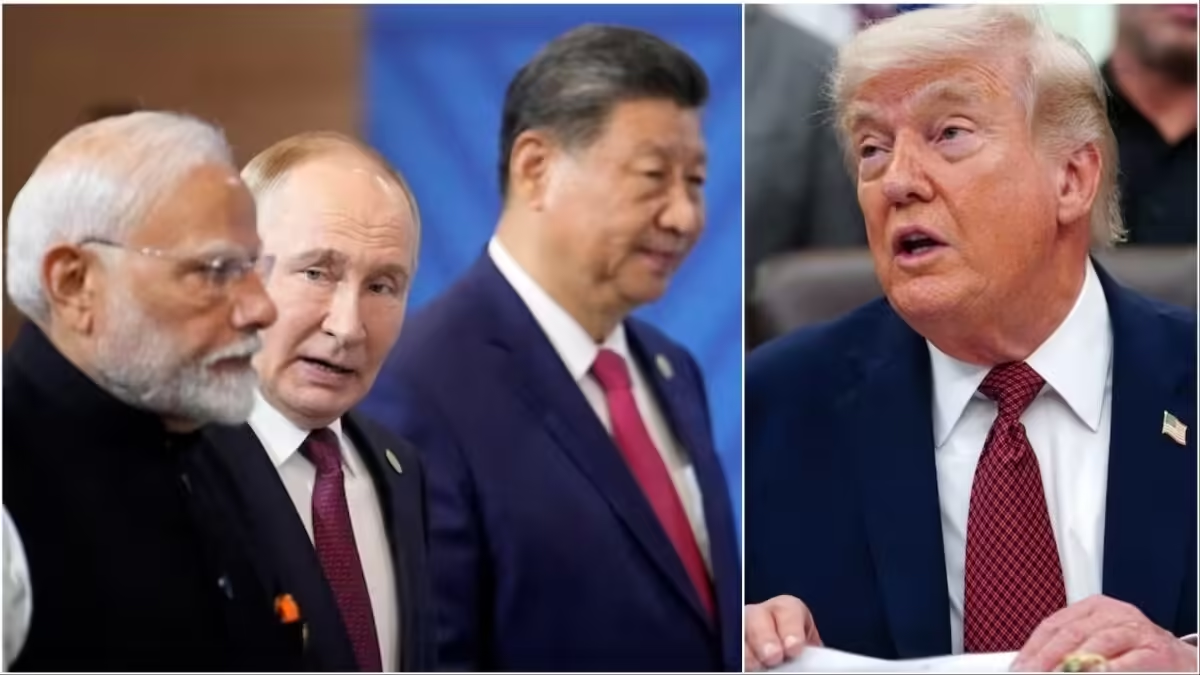

The eyes of the whole world are on the 18th BRICS summit which is going to be held in Delhi. All the major member countries of the organization including Russia, China, Brazil and South Africa are participating in this conference being hosted by India.
Actually, this time brix It is being organized at Bharat Mandapam in New Delhi on 12th and 13th September. The main agenda of this meeting is to reduce dependence on the US dollar in global trade, promote the use of local currencies and strengthen energy security. It is being said that in the current global situation, this meeting can prove to be a new turning point for developing countries like India.
What is BRICS?
BRICS is a strong international organization of emerging economies of the world. Initially four countries Brazil, Russia, India and China (BRIC) were members. Then in 2010, after South Africa joined, it became ‘BRICS’. Recently the organization has expanded again, and now countries like Egypt, Ethiopia, Iran, Indonesia, Saudi Arabia and the United Arab Emirates (UAE) have also joined it as full members or associates.
This organization represents approximately 45% of the global population and more than 30% of global GDP. Its main objective is to increase economic cooperation among member countries, ease trade, and strengthen the voice of developing countries in global politics and economy.
Especially this time, there is a possibility of vigorous discussion on trade in local currencies on the BRICS platform. The priority of BRICS countries will be to reduce the dependence on the US dollar for international trade. Maintaining the supply chain will be a hot issue amid tensions in the Middle East. Along with this, sharing of digital payment system is going to be an important topic.
Are BRICS countries able to trade in their own currency?
Technologically and practically, BRICS countries are currently partially able to use their own currencies for bilateral trade. But there are still many challenges at the global level. If trade between two countries is balanced i.e. imports and exports are almost equal, then they can easily do business in local currency. For example, mutual trade between China and Russia is now happening largely in yuan and rubles.
But when there is huge disparity in trade between two countries, then there are difficulties in doing business in local currency. An example of this can be the trade between Russia and India. India buys large quantities of crude oil from Russia. But India does not sell that much goods to Russia. When India paid Russia in Indian rupees, Russia had billions of rupees deposited in Indian banks. Russia’s hushed complaint has been that where should it use these rupees, because the Indian rupee is not an option for trade at the international level. Later, to handle this trade, we had to resort to currencies like UAE Dirham and Chinese Yuan.
Can BRICS countries challenge the dollar and boost their currencies? Or is global trade impossible without dollars? At present, in the current situation, global trade is not impossible without dollars. But it is definitely difficult. By the way, BRICS countries talk about making their own currency. The Chinese Yuan is trying to become an alternative to the dollar. But due to China’s strict government control on capital, the countries of the world do not completely trust the Yuan.
Business is rampant between Russia and China
However, in the last 3-4 years, after the sanctions imposed on Russia by Western countries, the use of trading in local currencies has increased rapidly. To push the dollar on the backfoot, India has allowed more than 20 countries to open special Vostro Accounts to trade in the Indian Rupee. But there are many challenges in its path. If a country’s currency such as the ruble or rupee suddenly falls sharply, the other country suffers huge financial losses.
Meanwhile, about 65 percent of the total trade among BRICS countries is now being settled in local currencies (like Yuan, Ruble, Rupee, Dirham etc.) without dollars. More than 95% of the trade between Russia and China is being done in Chinese Yuan and Russian Ruble instead of US Dollar. After Western sanctions, more than 80% of crude oil and commodity trade between India and Russia was settled through the non-dollar system (rupee, ruble and UAE dirham). The figure of more than 60% in non-dollar trade within BRICS is mainly possible due to the large trade between Russia and China.
However, the use of local currencies has increased within BRICS. But the dollar’s share in total global trade is still more than 85%. This experiment of BRICS countries is mainly limited to bilateral level.
With how many countries does India trade in rupees?
RBI has allowed more than 100 banks from 22 countries to open ‘Special Vastra Accounts’ in India. In which major countries include Russia, United Arab Emirates, Singapore, Sri Lanka, Mauritius, Bangladesh, Nepal, Bhutan, Malaysia, Oman and some African countries. Most of India’s trade with Nepal and Bhutan is traditionally denominated in rupees. Trades are also being done with UAE and Malaysia in Rupee-Dirham/Ringit. Transactions through Special Vastra Accounts (SRVA) have registered an annual growth of more than 30% to 40%.
How big a challenge is this for America?
Global trade without the dollar could be a warning shot for the US at present and a serious economic crisis in the long term. Because America imposes financial sanctions on any country whenever it wants, and excludes them from the SWIFT system. If countries start trading in their own currency instead of dollars, then this economic weapon of America will become ineffective.
Let us tell you, when the whole world keeps the dollar as a reserve currency, then America can easily print notes and take loans from all over the world. If demand for dollars decreases, inflation and interest rates may increase in America. The challenge for America is not that the dollar will disappear overnight, but the challenge is that the world has now looked for alternatives instead of relying only on the dollar.
Now the question arises that why is the dollar so dominant? It is well known that the American economy is considered the most stable in the world. The dollar is easily accepted all over the world and can be exchanged for any other currency at any time. Crude oil and most commodities are traded in dollars in the world.
—- End —-
Source: www.aajtak.in