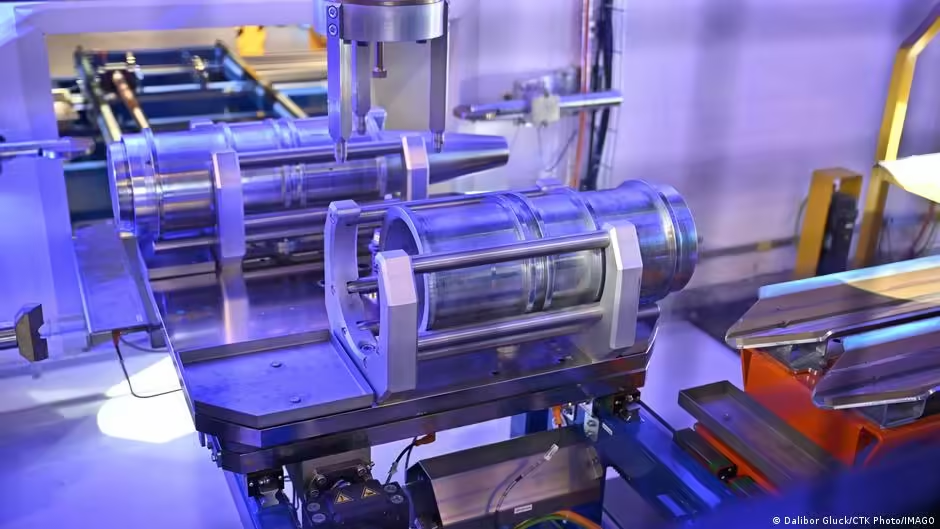

The Czechoslovak Group (CSG) arms maker announced in mid-October that it has acquired a stake in Canadian space technology manufacturer MDA Space.
This space mission is part of the company’s bid to continue riding the boom that has transformed its fortunes in recent years.
When it listed on the Amsterdam Stock Exchange earlier this year, CSG soared to become the most valuable company in Central and Eastern Europe, with a market capitalization of €14.6 billion ($16.4 billion), propelling its owner, Michal Strnad, to the top of the region’s rich list.
From 90s startup to major European player
CSG began life as a 1990s startupselling military surplus amid the collapse of the Warsaw Pact, the military alliance between the Soviet Union and Europe’s socialist Eastern Bloc nations, which was founded in 1955 and disbanded in 1991.
It has since grown to become the second-largest producer of ammunition in Europe after Germany’s Rheinmetall and now produces across Europe and in the US.
The impact of the war in Ukraine
The main driver of the company’s rising fortunes has been Russia’s war in Ukrainewhich has driven a dramatic boom across the Czech defense industry as a whole.
In 2021, the sector’s exports totaled €600 million. In 2025, these exports had expanded to €4.7 billion, powered by orders placed by Kyiv and its European allies.
By the end of that year, European states had procured approximately €11 billion worth of military support for Ukraine from Czech defense firms.
Orders to the value of roughly €4 billion have arrived via the Czech Ammunition Initiative, a program that coordinates the transfer of artillery shells to Ukraine.
Amid the avalanche of orders sparked by Russia’s full-scale invasion of Ukraine in 2022, CSG and Czech peers such as STV, Colt CZ and PBS have been busy expanding production to pump out military vehicles and planes, guns, grenades, shells and bullets.
Historical link
“The war in Ukraine, particularly in its early stages, was especially well suited to Czech firms,” Krzysytof Debiec of the Centre for Eastern Studies (OSW) told DW.
Debiec says that this was largely due to the major role that the former Czechoslovakia played in supplying Warsaw Pact countries.
“Specialization in the production of ammunition — including Soviet calibers — the repair of Soviet-era equipment and the manufacture of relatively unsophisticated systems that could be rapidly introduced and were compatible with the Ukrainian army’s existing stocks,” have all been key, he explained.
At the same time, European states eyeing the threat from the east and broader geopolitical instability are boosting their own defense budgets.
“The shift in US policies vis-a-vis NATO is forcing European nations to increase their defense spending dramatically, and that’s another factor” in the Czech defense industry boom, Jan Jires, a former deputy defense minister and now a senior advisor at the International Institute for Strategic Studies, told DW.
Export dependence
However, since launching on the stock exchange, CSG’s share price has performed erratically, illustrating the shifting sands on which Czechia‘s booming defense industry now stands.
The government in Prague has responded to the sector’s surge by transferring the defense industry portfolio from the Ministry of Defense to the Ministry of Industry and Trade to align its growing role in exports with national economic and trade policy.
At the same time, the populist ruling coalition that took power a year ago is made up of parties that have either promised to lower support for Ukraine or — in the case of the far-right Freedom and Direct Democracy party (SPD) — are openly pro-Russian.
As a result, the coalition has halted contributions to the Czech Ammunition Initiative and is dragging its feet on raising defense spending to meet NATO targets.
This only limits an already small domestic market, leaving the industry dependent on exports for about 90% of its revenue — the vast bulk of which is still linked to Ukraine — and lacking a stable base for expansion.
“The Czech industry has outgrown the country’s financial means,” said Jires. “Unlike German, French or British companies, Czech manufacturers cannot rely on domestic demand to make them globally relevant.”
What the future holds
Increased global defense spending looks set to continue, but an end to Russia’s war in Ukraine, a change in US foreign policy or a calmer geopolitical environment would hit Czech arms manufacturers hard. For this reason, they must ponder what the future of war, and its funding, might look like.
The conflict in Ukraine offers some indicators, having become increasingly focused on swarms of drones and a technological race between Kyiv and Moscow to improve the performance of the unmanned aircraft.
Major questions must now be asked regarding “the size and role of the military, how it is equipped, what should be purchased and when new weaponry can arrive” Andor Sandor, a defense analyst and former commander of Czechia’s Military Intelligence Service, told DW.
For a company like CSG, for which bullets and shells currently account for around 60% of sales, these are vital questions.
“Czech companies — many of which still focus on relatively unsophisticated military production — must invest more in innovative manufacturing,” said Debiec, who notes that most are well aware of the challenge. “They have reinvested their extraordinary profits and are already more technologically advanced and diversified in their production than they were in 2022.”
Space mission
CSG’s acquisition of MDA Space is part of such efforts.
The company, which already held interests in British and German space technology companies, pointed to the close link between the space and defense industries when it announced the deal.
Noting that global government spending on space defense accelerated to €65.83 billion last year, CSG estimates that the overall space economy will triple in size to €1.6 trillion over the next decade.
Developing capabilities in space is “a natural extension” of its activities, the company stated, noting plans for further development in the segment, including a “dedicated space team.”
To power such missions, Czech defense companies must make sure they’re in a position to tap into funds for defense and space under the next EU budget, which could rise as high as €130 billion, said Jires.
“If they fail to do so, and all this money is grabbed by German, French and Italian companies,” he warned, “Czech manufacturers may miss the opportunity to truly scale-up.”
Source: www.dw.com