
On 15 October 2026, the Periodic Labour Force Survey (PLFS) bulletin for September put unemployment among urban women aged 15–29 at 26.6 percentwhile the overall unemployment rate stood at 5.0 percent. Among young, urban women in the labour force, 26.6 percent are actively seeking work but have yet to find it. Only 22.1 percent of urban young women were in the labour force that month, so the unemployed among them were only 5.9 percent of all urban young women. Who, then, does the youth unemployment rate count, and who does it leave out?
Four Groups, One Headline
On the annual usual-status measure used in the rest of this piece, youth unemployment was 9.9 percent in 2025against 3.1 percent for all people aged 15 and above. That 3.1 percent covers both men and women, but disaggregation shows that 79.1 percent of men and 40.0 percent of women were in the labour force. When the unemployment rate is calculated basis the labour force, this gap goes unnoticed.
However, dividing young people into four mutually exclusive groups allows a more grounded, granular analysis. Based on an ORF working paper using PLFS data, it is found that among women aged 15–29, 24.4 percent are employed, 3.1 percent unemployed, 31.6 percent studying outside the labour force, and 40.9 percent outside both the labour force and education.[1] For men, the shares are 58.0, 6.0, 33.4 and 2.6 percent. The gender gap is two percentage points on the unemployment rate and 33.7 points on actual employment. The denominator can also mislead over time. If one in every 100 young women stopped looking for work and left the labour force, their unemployment rate would fall from 11.3 to 8.0 percent with no new job anywhere.
Two Different Populations
Among unemployed young women, 82 percent have never married and 74 percent are graduates. Among those outside work and education, 73 percent are married, 18 percent are graduates, and 47 percent have less than secondary education (Figure 1).
Figure 1: Who Is Unemployed and Who Is Outside Both Work and Education (Women aged 15–29)

Source: Author’s calculations from PLFS 2025 unit-level data.
Never-married women who are not employed are mostly studying or looking for work, whereas married women are mostly doing neither. On the unemployment rate alone, married young women appear far better off.
The difference is shown most clearly by marriage. Among women aged 20–29, the employed share is almost the same for the never-married and the currently married (Table 1). Never-married women who are not employed are mostly studying or looking for work, whereas married women are mostly doing neither. On the unemployment rate alone, married young women appear far better off.
Table 1: Women Aged 20–29 by Marital Status (Percent)
|
Outcome
|
Never married
|
Currently married
|
|
Employed
|
31.1
|
31.9
|
|
Unemployed
|
10.5
|
1.2
|
|
Outside the labour force, attending education
|
32.1
|
1.4
|
|
Outside both
|
26.4
|
65.5
|
|
Unemployment rate (share of labour force)
|
25.2
|
3.7
|
Source: Author’s calculations from PLFS 2025 unit-level data.
The similar employment shares partly reflect composition: married women are older, less educated, and more often rural. After adjusting for these and other recorded characteristics, marriage is associated with a 14.3-point lower probability of employment for women and a 32.1-point higher probability of being outside work and education. These are associations, since who marries and when also depends on education, family circumstances, and job prospects.
Why Are Women Out Of Work?
Among women outside both, 81.5 percent cite childcare or personal commitments in home-making as their main reason for being outside the labour force. A daycare trial in Rajasthan raised the probability of paid work the previous day by 2.6 points and left other labour-force and income indicators unaffected.
The answer also depends on the jobs on offer. A woman may report domestic duties when the available job involves long travel, unsuitable hours, or low net earnings. Household choices also respond to opportunity. When recruiters offered business-process-outsourcing placement services in randomly selected Indian villages, young women became less likely to marry or have children and more likely to work or study.
More Jobs for Women
The first requirement is more labour demand. Women who are already searching struggle to find work: 29.4 percent of young female graduates in the labour force are unemployed. If one in 10 women outside both entered the labour force with no new openings, the unemployment rate of young women would double from 11.3 to 22.8 percent. Hiring them all would require young women’s employment to rise by about 17 percent. Care and transport support, in addition, makes this a demanding ask.
The first requirement is more labour demand. Women who are already searching struggle to find work: 29.4 percent of young female graduates in the labour force are unemployed.
Just 11.0 percent of young women hold paid non-farm work, including self-employment, and 5.8 percent hold a regular salaried job, against 38.3 and 18.7 percent of young men. A survey cross-section cannot rank demand against other constraints. However, panel evidence finds women moving in and out of the labour force often, for reasons unrelated to marriage or childbirth, which is consistent with a shortage of steady paid work.
Problem-specific Policy
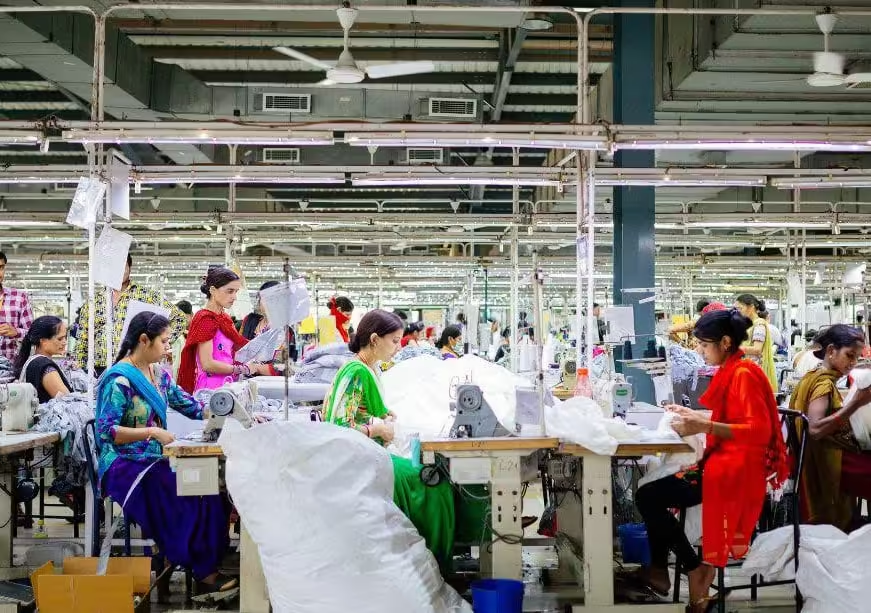
Policy therefore needs to expand work that women can take up. Labour-intensive sectors such as apparel and textiles accounted for less than 20 percent of formal manufacturing value added in 2020 but over 40 percent of its jobs. Apparel is also the largest non-farm source of work for young women, yet 80 percent of those women work on their own account, and only 9 percent hold regular salaried jobs. Bangladesh’s garment growth was followed by later marriage and childbirth among exposed girls, along with more schooling and work outside the home. Tamil Naduwith about 40 percent of India’s women factory workers, has paired its factories with state-built housing for 18,720 women near Sriperumbudur.
First, India needs labour demand. The Union and state governments should direct working capital, common facilities, and logistics to firms in apparel, leather, and food processing with confirmed orders. The monitoring and assessment framework should be tied to net female job creation per unit of investment. Pradhan Mantri Viksit Bharat Rojgar Yojana pays employers up to INR 3,000 a month for each additional worker, and nearly 30 percent of its beneficiaries are women. Before its window closes on 31 July 2027, the Labour Ministry should publish additional hires by sex and sector, and survey a sample on what recruits were doing earlier.
Second, enhance access. Palna has 4,172 Anganwadi-cum-crèches with about 43,000 beneficiaries. State departments should map crèche hours, working-women hostels and transport against the clusters that are hiring, and test them through a phased rollout with a comparison group.
Third, improve measurement. The monthly bulletin reports only participation, employment, and unemployment rates. MOSPI should consider publishing the four-group split by sex in the quarterly bulletin. It should also ask those outside the labour force whether they want work and could take it, as the International Labour Organization’s potential labour force measure requires.
The unemployment rate remains a useful measure of those searching for work. It should not be read as a measure of access. A lower rate among young women means little unless employment rises with it.
Conclusion
The unemployment rate remains a useful measure of those searching for work. It should not be read as a measure of access. A lower rate among young women means little unless employment rises with it. For that, India’s growth has to produce many more paid jobs that young women can reach, and states should assess their industrial and employment schemes on this basis.
Arya Roy Bardhan is a Junior Fellow with the Centre for New Economic Diplomacy at the Observer Research Foundation.
Acknowledgement: Claude Code (Claude Opus 5.5) has been used to process unit-level data and generate infographics.
[1] PLFS 2025 first-visit unit records, usual principal and subsidiary status, with released weights. The group outside both is an attendance-based measure of those not in the labour force, education or training; it omits some training and differs from the official NEET estimate of 42.2 percent for young women, which also includes the unemployed. The survey analysis is taken from the author’s ongoing work. The bulletin figures in the opening paragraph use current weekly status and are not comparable with these annual estimates.
The views expressed above belong to the author(s). ORF research and analyses now available on Telegram! Click here to access our curated content — blogs, longforms and interviews.
Source: www.orfonline.org