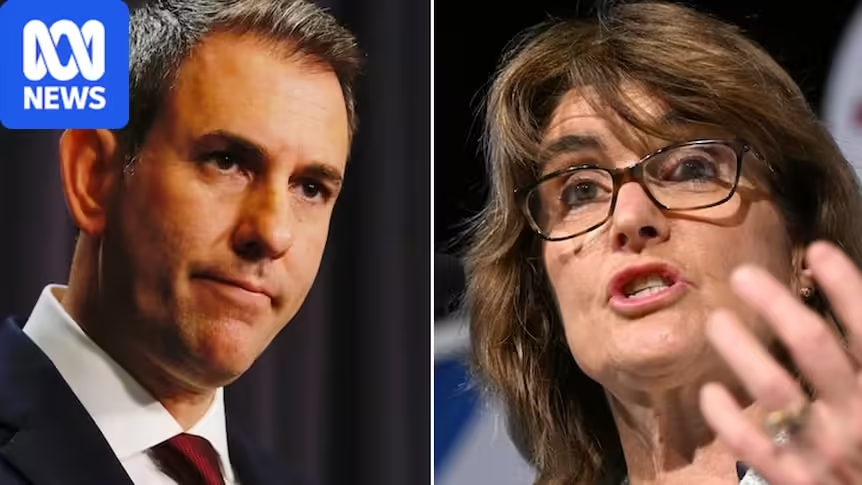

The Reserve Bank is tipped to increase interest rates tomorrow because of an ongoing concern that inflation is not under control. It would be the fifth hike of the year, and the 18th in five years.
The consequences are familiar: rates are a “blunt instrument”, painful for all borrowers.
But is there an alternative? In the past week, much commentary has focused on whether government spending cuts could be a “precise instrument”, taking pressure off inflation in a targeted way and alleviating the pain of high rates.
The government has flagged at least some fresh savings. So where could cuts come from, and could they influence inflation?
How inflation happens
In simple terms, inflation happens when an economy is operating above capacity. When the demand to spend is more than what an economy can supply, the extra demand pushes prices up.
The cause can come from anywhere. The Reserve Bank thinks the resurgence of inflation in the past year has been driven by the Middle East war, an AI investment boom, and the fact Australia was already above capacity before those things.
Whatever its origins, economists worry about inflation becoming entrenched in an economy. RBA governor Michele Bullock explains it this way:
“High inflation hurts all Australians, especially the most vulnerable. Every household has seen how the price of everything has gone up in recent years. Pay packets don’t go as far as they used to …
“It’s critical that we stop [this] from becoming embedded in price-setting decisions across the economy or the problem will only become worse.”
How interest rates work
Policies to fight inflation can seek either to expand supply or suppress demand. While supply policies are important, demand suppression works quicker and is the main frontline response.
The aim is not to address the causes of inflation or to lower specific prices. For example, policymakers can do little about high fuel prices. Instead, they aim to take pressure off elsewhere as a counterweight.
The Reserve Bank has one main lever: higher interest rates. High rates suppress demand in multiple ways. Existing borrowers — people and businesses — pay more on their loans, leaving less money to spend elsewhere. New borrowing is discouraged.
Saving is encouraged, because the returns are higher. And Australian dollars become more expensive, pushing down overseas demand for our exports.
How government spending can help or hinder
The government’s main lever is its budget. Every year, the government raises and spends hundreds of billions of dollars. Taxing more or spending less can directly reduce demand.
This can be a precise instrument because the government can choose exactly what programs it cuts, or exactly where it raises taxes.
In theory, it means the government can fight inflation with regard for “fairness” in a way that the Reserve Bank cannot, because it can decide who should bear the brunt of the pain. But inflicting pain with higher taxes or spending cuts is politically fraught.
And in fact, governments are often pulled in the other direction. When prices are high, voters expect relief in the form of tax cuts or subsidies. Governments often oblige, even though this can push up inflation by expanding demand rather than suppressing it.
The cost of ‘cost-of-living relief’
The Albanese government has made a virtue of offering this sort of cost-of-living relief, and despite its criticisms, the Coalition has advocated for relief too. Treasurer Jim Chalmers argues this is justified, because the government has multiple roles:
“We have to balance the inflationary pressures in our economy with the fiscal pressures in our budget and try to do the best that we can for people … We think we’ve struck [the balance] relatively effectively.”
How much has the Albanese government spent?
There are several ways to assess how the government has struck that balance. One is to look at the overall level of spending. On that measure, spending under the Albanese government is abnormally high, remaining at levels comparable to the pandemic.
But many of the drivers of this spending are long-term factors that are hard to control. Of the fastest-growing spending categories, only child care has been substantially expanded by the Albanese government. Another, the NDIS, has been curbed.
Another way to approach the question is to look at how the budget has changed under Labor. Taking the combined effect of all the government’s budget updates, the budget balance has improved in most years, meaning lower deficits and even two surpluses.
But that graph includes factors that the government cannot take responsibility for. In fact, even inflation itself has helped: inflation means people pay more income tax, improving the budget.
Stripping out these external factors shows a different picture, with the budget balance worse off in each year thanks to government decisions.
This is often described as the “truest” picture of the government’s responsibility. But even this is imperfect, because the government argues that many of these “decisions” are unavoidable and would be made by all governments, like the indexation of some payments and the listing of new PBS medicines.
Going line by line
Each of these measures tells us something about the contribution of the government to inflation, but not everything. Doing that requires evaluating each government decision line by line.
Here are just a handful of the largest decisions highlighted in budget papers. This non-exhaustive list shows one of the reasons government ministers have defended their spending decisions. The items are central to the government’s political narrative, including its changes to bulk-billing, cheaper child care and tax cuts.
| SPENDS | SAVES | ||
|---|---|---|---|
| Tax cuts | $23.5 billion | NDIS | $50.3 billion |
| Public hospitals | $18.1 billion | Tax changes | $7.9 billion |
| Bulk-billing | $14 billion | ||
| Defence Strategy | $12.5 billion | ||
| Cheaper Home Batteries | $8.6 billion | ||
| Child care wages | $7.2 billion | ||
| Energy Bill Relief | $5.3 billion | ||
| Cheaper Child Care | $4.7 billion | ||
| Welfare increase | $4.7 billion |
In theory, the government could have taken pressure off inflation if it had decided against any of these new spending policies. But as well as any political consequences, the result would also be less money for the recipients of these policies.
Some of the government’s political opponents have pointed to individual policies that could be cut. For example, the Coalition has named the Cheaper Home Batteries Program and the EV discount, among others. Independent MP Allegra Spender has named fuel tax credits, an existing subsidy that costs more than $10 billion a year.
Cutting some of these spending programs could mean fewer rate hikes. Economist Chris Richardson estimates that $7 billion to $10 billion of spending cuts per year is equivalent to one rate hike (note: the figures in the table are over four years, not per year).
But the challenge for the government, and for other political parties, is deciding whether the pain of those spending cuts is preferable to the pain on borrowers from a rate hike. Either way, the intent is the same: to suppress demand.
Loading…
Source: www.abc.net.au