
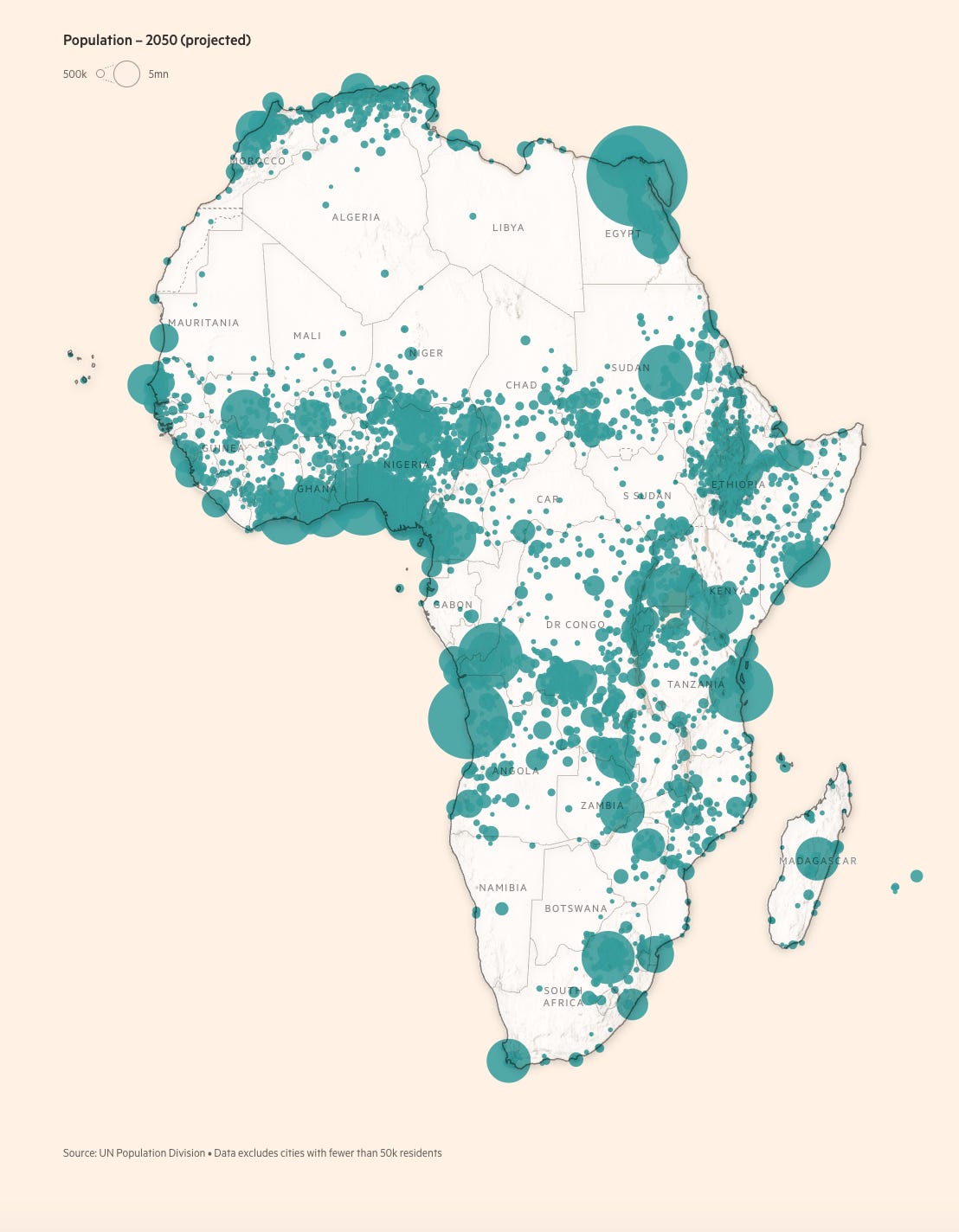
Of all the mega trends at work in the world today the combination of population growth and urbanization in Africa is one of the most dramatic.
As David Pilling and Jacob Judah remark in a noteworthy piece in the FT.
In 1950, there were 228mn people living in Africa, with about 33mn in cities. Today there are 1.6bn Africans, 19 per cent of the world’s total, of whom 670mn live in cities.
In decades to come, 80 percent of Africa’s powerful population growth will be absorbed by urban sprawl.
Forecasting by the indispensable researchers at Africapolis suggests that by 2050 Africa will be home to by far the largest urban population in the world. Even if these projections are exaggerated, it will be very surprising if Africa’s urban population does not exceed that of China and India by hundreds of millions of people by the mid-century.
Source: Africapolis
This is a truly spectacular transformation in world society as we have hitherto known it. The story of human life in towns and cities that began with the neolithic will enter a new chapter in which Africa is the center of the largest and most extended urban settlements and civilizations. Given expected population trends beyond 2050, Africa will likely retain that status into the 22nd century.
Within Africa itself, the balance will tip away from South Africa and Egypt and towards huge new urban conglomerations in West Africa, Angola, Ethiopia, Kenya, Tanzania and the Great Lakes region.
Africa’s conurbations are notoriously underprovided with the kind of services that city dwellers in Asia, Europe and North America take for granted. But one crucial point emphasized in the early 2010s by Sean Fox is that even at relatively low per capita incomes the emergent cities of the 21st century are not centers of diseases and mass death, as they would have been in Europe in the 19th century. Modern facilities of medicine and rudimentary public health do a remarkable job in enabling huge agglomerations of people, even at low incomes to continue growing.
Africa is not the first place these forces have come together. But the scale is new and dramatic. As Pilling and Judah tell us:
When China’s urban growth peaked in the 1990s, its cities were adding roughly 14mn people a year, according to the UN’s The World Cities in 2025 report. African cities expanded by 15mn people annually in the past few years and are expected to grow by 19mn annually by 2050. That’s almost two Londons a year, or more than 50,000 new African city dwellers every day.
So Africa, is urbanizing at a rate never before seen.
Given the urgency of the development question, many scholars and much journalistic coverage is devoted to the question of whether urbanization will help to accelerate and sustain African growth.
Are Africa’s cities “consumer cities” fueled essentially by resource rents appropriated by elites (Gollin et al)?
Are they too closed to world trade and too internally inefficient and fissured to generate the agglomeration economies (Lall et al) seen elsewhere?
Between the stark dichotomy of production v. consumption cities, do we need to develop a more open-ended classification of city-economy types (Jedwab et al)? Will Africa’s cities be “neutral-cities”, neither dominated by production or consumption?
These are crucial questions, but because of their orientation towards the common metric of growth, they also deflect from the originality, radicalism and innovation of African urbanization at the scale we are witnessing. They fit the history that Africa’s people are making into preexisting templates, standards and timelines, rather than concentrating on the novelty and innovation of this phase of African world history.
This was brought home to me with real force by a short but remarkable piece in the Economist about the East African state of Burundi. I would love to attribute this piece of writing, but, as always for Economist staff work it is anonymous.
As the Economist author(s) remarks:
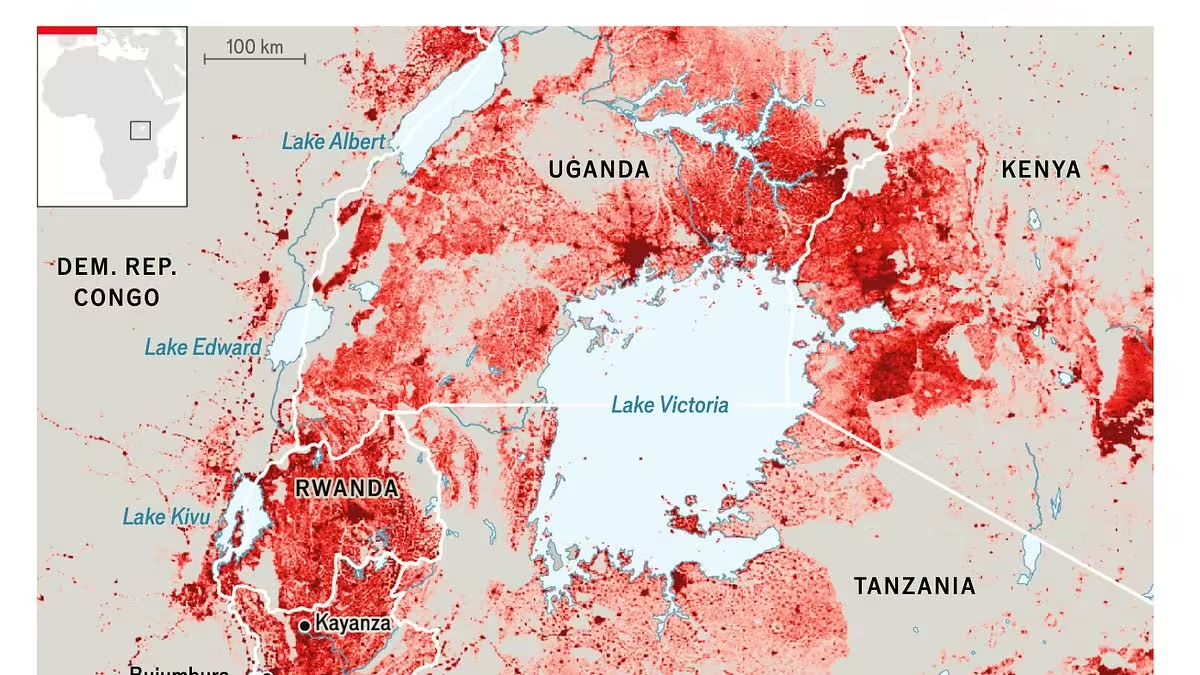
(Burundi is) an extreme example of how population pressure is changing African societies. For most of history, Africa has been sparsely populated, and much of it remains so. But the continent now has ten times as many people as a century ago, and places like the Niger delta (on which Pilling and Judah’s piece focused) and the Ethiopian highlands are getting crowded. So, too, is the region around Burundi, from Kenya to Congo, a swathe of humanity packed between Africa’s Great Lakes, where there are good rains and enough altitude to soften the equatorial heat. Density does not necessarily mean cities. Most Burundians still live in the collines, the rolling hills, growing bananas, cassava and beans on steep slopes that crumble into the valleys. On roadsides, in gardens, between houses, it feels like every spare scrap of land is planted with maize. By conventional measures, often based on administrative divisions, Burundi is one of the most rural countries on the planet. A research project called Africapolis led by the oecd, a group of mainly rich countries, considers a place urban if it has more than 10,000 inhabitants in buildings not more than 200 metres apart. By that measure 78% of Burundians are already urban; by 2050, most of their country will be one solid agglomeration.
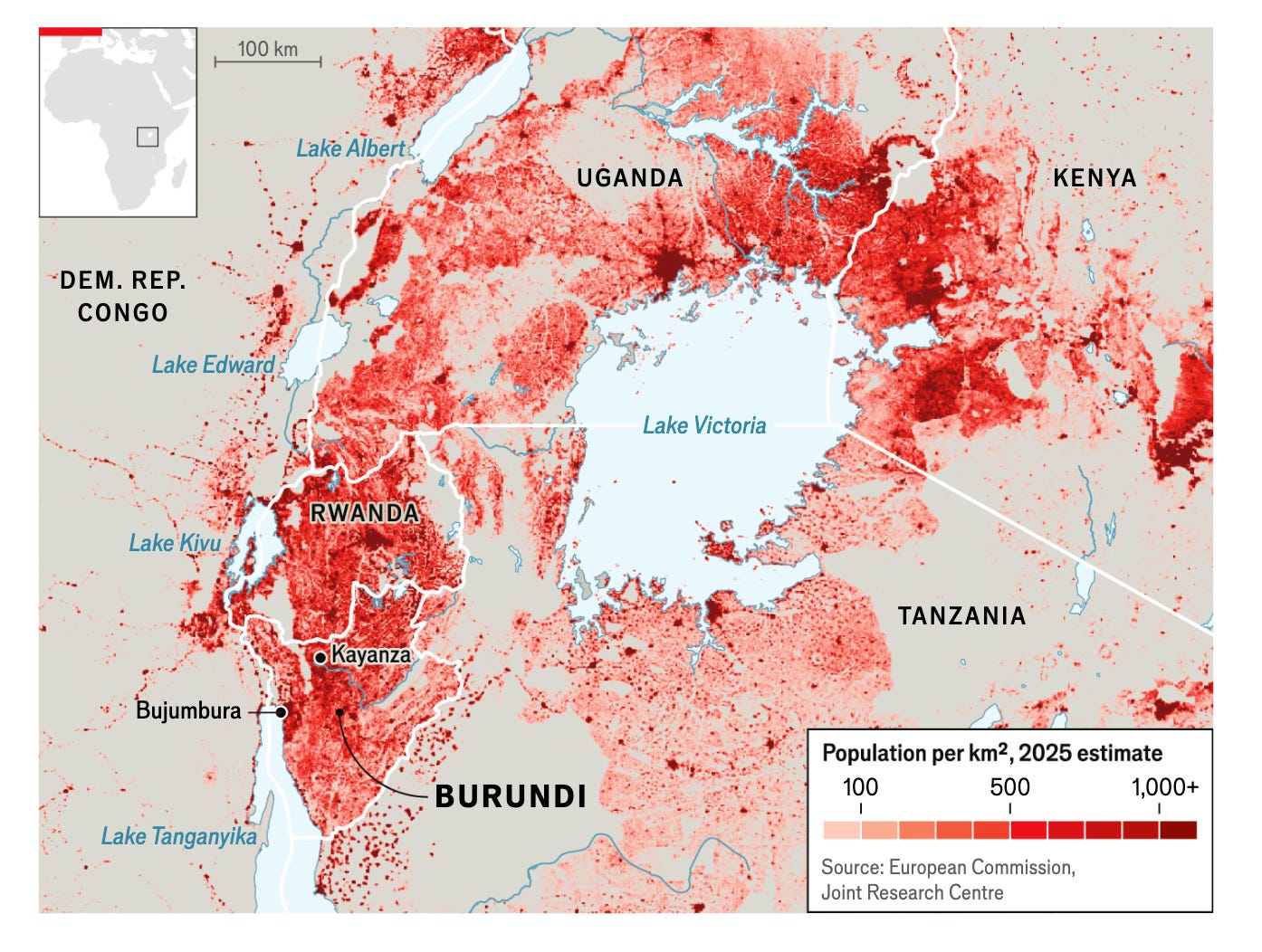
But then the Economist delivered the truly spectacular line: Simplistic classifications into urban and rural “should not be taken too literally. It might be better to say that much of Burundi is becoming an in-between place: not quite country, not yet town.”
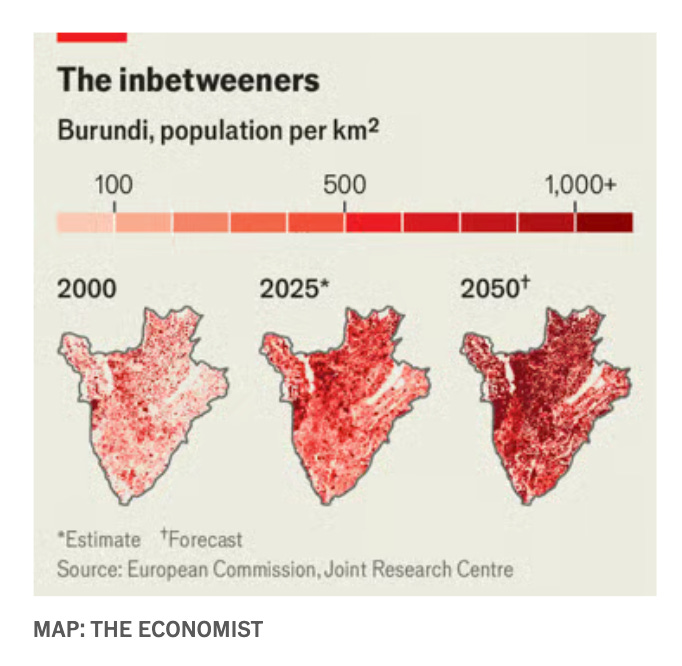
Under dramatic population pressure:
“society is being reinvented. The traditional sources of prestige in Burundian culture are land, cows and children. In future people will have less of all three. Interviewees often describe strained relations between siblings, between neighbours, between young and old. Land disputes clog the courts. Daily life is becoming more monetised: to borrow a male animal for breeding now attracts a fee. Many young Burundians are migrating to work on farms in Tanzania, in cities across east Africa or as domestic servants in the Gulf. … Long ago, when Burundi had a king, it was believed he would die if he set eyes on Lake Tanganyika. Now people flood down from the hills to Bujumbura, the city on its shore. They settle in the outskirts, in an unfinished no man’s land of brick kilns and timber yards, where the roar of circular saws drowns out the bleat of goats. What little work there is tends to be in transport, trade or building the city itself. …. population pressure is like a persistent hum in the noisy politics of the Great Lakes, a region that has rarely known peace. Burundians remember ethnic massacres, civil war and, most recently, the unrest of 2015 that triggered a failed coup. An army checkpoint still seals off the road to the national broadcaster, the first target of would-be putschists. Beside it, on a green verge, someone is growing maize.”
This is the sense of novelty and incongruity that allows us to appreciate the radicalism of what is going on.
If it is true that dense agglomerations of people are incubators of innovation and change, the mistake is to focus on the degree of conformity with, or convergence to some predefined vision of modernity, rather than to focus on the “reinvention of society” that the Economist so aptly highlights.
Indeed, if African urbanization at its current rate were to turn into a matter of “catch up” with some model defined by Asia or “the West”, that should, itself, be regarded as a great historic surprise.
It is certainly one of the surprises of the late 20th and early 21st century, that so much of East Asia’s urbanization has cleaved so closely to a generic vision of modernity. Whenever I see standardized and well-maintained public toilets in Chinese cities, neatly labeled in both Putonghua and English, I marvel at the exercise of governmental power and authority their existence implies.
The remarkable dispersion and decentralization of urbanization that Ken Opalo highlighted as characteristic of Nigeria, may well generate a rather different profusion of alternative models.
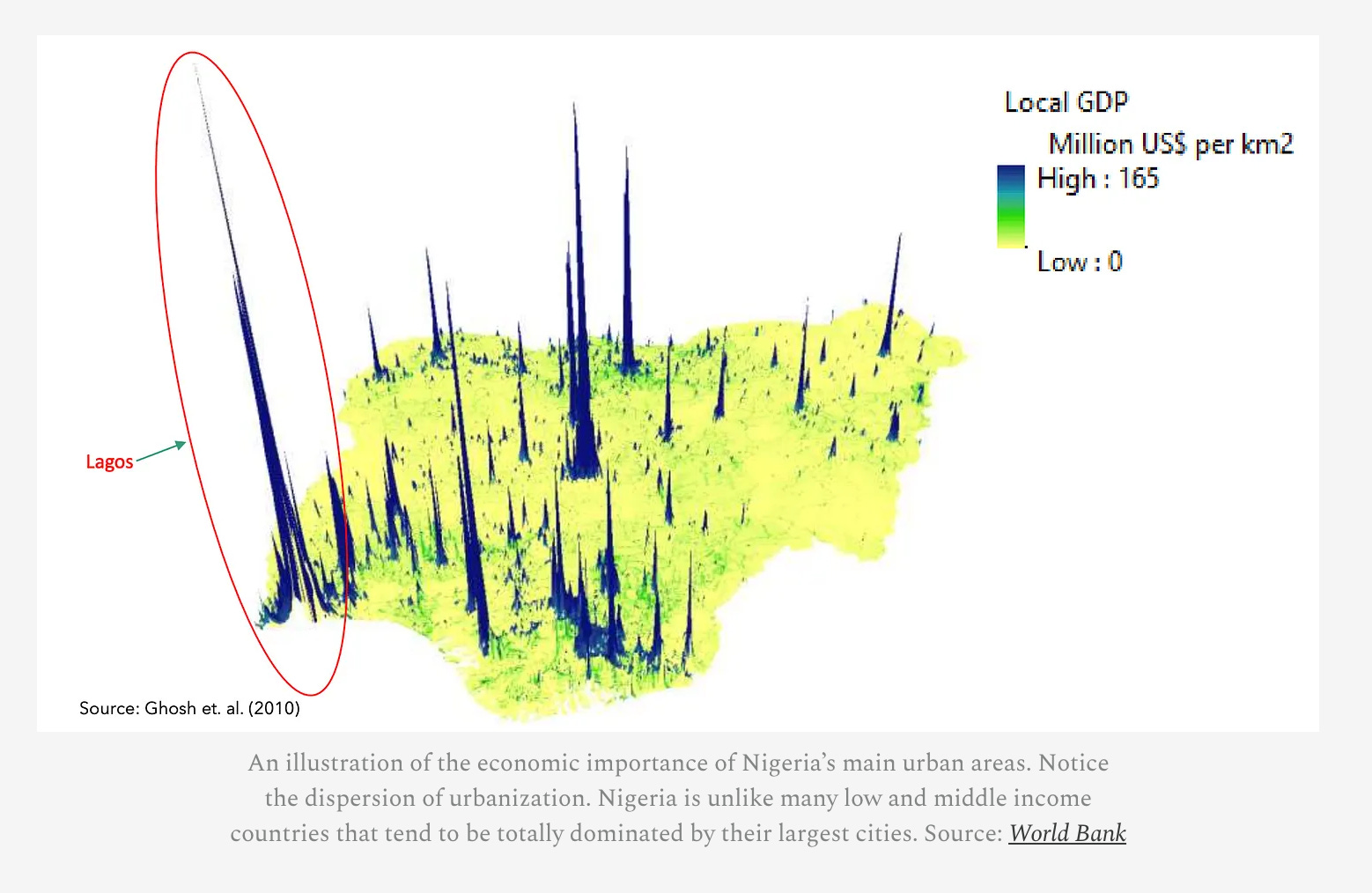
Pilling and Judah’s piece is studded with acknowledgments of this novelty:
Yet the growth in Africa’s cities is not following a familiar path.
With great variations, Africa is urbanising with a nominal average income per capita of around $2,000.
Many city dwellers have to hustle for a living
“fast, late and poor”
“What we don’t know is what happens if agglomeration precedes economic development.”
Yet even cities of the scale and frenetic energy of Lagos can feel like villages
herders graze cattle beneath flyovers
“rurification” (Opalo)
face-me-I-face-you
“Even inside your room, the fish will come and greet you,”
She keeps chickens, but she also operates as a banking agent
“Someone in the informal sector doesn’t pay tax but they use roads and water.”
practically everyone carries a Chinese smartphone.
so ubiquitous is the Chinese presence that westerners are greeted “ni hao”.
“We may not have systems, but we have some of the most dynamic people on the planet,”
“trying to empty a swimming pool with a teaspoon”.
“The affluence is just as real as the struggle,”
And then a quote from Opalo delivers the political punchline: “people discuss debt burdens and the cost of credit on TV talk shows” rather than ethnic politics. “In Kenya the economy is now a much bigger part of the political discourse than it was even a decade ago. That is an urbanisation story.”
For me thinking about African urbanization feels like another iteration – more positive and interesting – of the question of historic normalization I raised with regard to AI and the Manhattan Project a few weeks ago. As I said there: “Given the extremity of our moment there is an understandable desire to look to history as a possible source of orientation”, mapping the trajectory of Africa urbanization onto that of Asia would seem to fall very much into that rubric. Such mental mappings may be reassuring, but they can also be deeply misleading: “What we underestimate is that we may not be in a re-run. This may not be the latest installment of a familiar franchise. We may be in a radically new script or, at the very least, in a new mash-up the likes of which we have simply never seen before.”
As Kim Stanley Robinson put it to me: ‘historical analogy is the refuge of those who can’t face the current situation’
Amongst mainstream Western news sources that have been doing a good job bringing the radicalism of these developments to a global audience, I would commend both the FT and the Economist. My sense is that the FT is more West African centered whereas the Economist is particularly strong on East Africa. From the Economist I’ve found all of these pieces interesting:
Can Africa take the Asian path to growth?
Social change without economic transformation
Small cities transforming the continent
I love putting out Chartbook. I am particularly pleased that it goes out for free to thousands of subscribers around the world. But, writing this newsletter takes a lot of work. If you are enjoying it and would like to support the project, sign up for one of
Source: adamtooze.substack.com