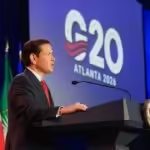
Prime Minister Mark Carney said Canada is working to become the European Union’s first associate member, his most definitive statement on the issue to date after hosting the bloc’s leaders in Montreal this week.
It still remains unclear what that would look like and cost.
This year’s Canada-EU summit saw Canada and European officials finalize a number of negotiations and launch a long list of new commitments as part of a deeper alliance, but the issue of what to call the allies’ deeper partnership has somewhat overshadowed the work between Ottawa and the 27-member bloc given some members are against the proposal.
“We are working toward the deepest possible partnership, short of accession because of our geography, with Canada becoming the European Union’s first associate member,” said Carney in his closing remarks.
“Over the coming months, we will determine the substance, scale and scope of this form of membership.”
Carney previously stayed away from using the “associate member” title, instead arguing the nomenclature doesn’t matter.
By Friday, though, he he added a timeline to the debate, saying the plan is to conclude negotiations in June, when he’ll join European Council meetings.
He also said he, European Commission President Ursula von der Leyen and European Council President António Costa will convene the College of the European Commissioners and Canada’s federal cabinet in March.
Von der Leyen first raised the prospect of making Canada an associate member — a status that doesn’t currently exist in the bloc — in a speech last month and has continued to spearhead the initiative despite objections from some members, notably Germany.
No talk of cost
Speaking on background after the news conference, a Canadian official couldn’t answer what what legislation would be needed in Canada and across the EU member states.
“It’s a concept,” the official said, noting there’s no existing formal process to becoming an associate member.
Asked what the cost of joining as an associate member could be, Carney said “we don’t view this as paying for something, we view this as coming together.”
While von der Leyen, Costa and Carney are all now championing the title, it’s far from a done deal. EU members would have to vote, and Carney has said a new partnership with the European Union will be put up for debate and a vote in Canada’s Parliament.
“Canada is by far the most European of the non-European countries,” Costa said on Friday morning.
Canada-EU sign agreements
Division over what to call the partnership was apparent in the crafting of the joint statement released at the end of the summit.
Sources with knowledge of what happened said the “associate member” term was removed from the draft version, given some members’ disapproval. One source said Germany called it a red line. Instead, the final document calls for “an ever-closer association of Canada to the EU, short of full membership itself.”
Outside of the title, the document makes clear Ottawa and Brussels have lots to agree on as they move ahead on what’s being dubbed the “alliance for the future”
On Friday the two sides announced they finished negotiations between Canada and the European Investment Bank to support investment in critical Canadian resources, notably critical raw materials and another on countermeasures to fight anti-competitive activity.
They also wrapped negotiations on a digital trade agreement between the EU and Canada meant to improve legal certainty and facilitate cross-border data flows, as well as finalized an agreement giving Canadian researchers and businesses access to European supercomputers.
Canada will also join a EU program for aid to Ukraine, called Ukraine Support Loan.
When it comes to next steps, the two sides have agreed to expand opportunities for Canadians and Europeans to study, work and conduct research. There’s also a promise to launch talks to secure international connectivity between Canada, Europe and Asia through new subsea cable infrastructure.
The document includes commitment on a long list of other areas, including the Arctic, foreign information manipulation and interference and advancing co-operation on artificial intelligence (AI) security and safety.
It also calls for reforming the World Trade Organization instead of replacing it, and doing more on border security and fighting climate change.
“It means, at its base, sovereignty,” said Carney. “Greater resilience [and the] ability to withstand shocks together.”
But it is unclear how much all the new programs will cost either.
Finance Minister François-Philippe Champagne dodged questions on Thursday, saying Canadians should see only “opportunities.”

After Canada’s ‘associate membership’ of the EU was reportedly removed from a proposed joint statement on Wednesday, European Commission President Ursula von der Leyen mentioned the idea again on Thursday, suggesting a partnership ‘that comes closer to membership than anything we’ve done before.’
Canada’s Opposition Leader Pierre Poilievre said the summit featured “big talk” but a lack of concrete results.
“There was a lot of talk at the summit about aligning Canada with the insane European taxes, debt, immigration and anti-oil and gas policies that have left parts of Europe bankrupt and burning,” he posted on social media Friday.
“Does any of this lower your mortgage payments, rent, grocery bills or gas prices, back here in the real world? Of course not.”
Carney points to EU’s strong belief in democracy
The summit was billed as a way to deepen ties with like-minded leaders in the wake of an unpredictable and volatile White House under U.S. President Donald Trump.
While the three leaders in Montreal were in step around their common goals, shifting political winds on the continent could test that alliance, notably in France and Germany — both heavyweights within the bloc.
In France, presidential hopeful Marine Le Pen’s far-right National Rally is leading in polls ahead of the spring 2027 election. Le Pen, an advocate for strict immigration limits, has criticized the EU-Canada trade pact.
In Germany, the far-right and isolationist Alternative for Germany (AfD) continues to gain ground in regional parliaments and national polls.
Asked Thursday if he has concerns about dealing with a potentially different political makeup, Carney praised the EU’s adherence to democratic values.
“One of Europe’s strengths is democracy, freedom and a core belief in the rule of law. There will always be different governments, governments of different stripes in Europe,” he told reporters.
“Over the course of decades, the European Union has continued to develop, and strengthen, throughout, and be enriched by the national democratic processes of those countries.”
Carney also downplayed the notion he was looking to secure commitments with the EU before the French election. “We’re not tying it to any political cycle, but to the fundamentals of what they deliver … for Canadians,” he said.
Asked earlier this week about the summit potentially attracting retaliation from Trump or right-wing leaders in Europe, a senior Canadian government official told reporters the gathering isn’t directed against anyone, but reflected deep interests between Canada and the EU.
Source: www.cbc.ca