
//php echo do_shortcode(‘[responsivevoice_button voice=”US English Male” buttontext=”Listen to Post”]’) ?>
India’s expanding outsourced semiconductor assembly and test (OSAT) industry is creating opportunities for smaller, specialized packaging facilities alongside large, capital-intensive plants. Sahasra Semiconductors’ operating facility in Bhiwadi, Rajasthan, represents one such entry point, with an investment of more than ₹1.5 billion (~$15.8 million), according to a May 2026 government announcement.
The question is whether smaller facilities can build commercially viable businesses by focusing on mature packaging technologies and specific product segments.
EE Times spoke with Nitin Dodia, semiconductor consultant and founder-director of Smart Fab Systems, who estimated that a facility focused on mature packaging technologies could be established with an investment of ₹1.5 billion (~$15.8 million) to ₹2 billion (~$21 million). He said the amount would depend on the products handled, equipment requirements, and operating expenditure.
Dodia’s estimate applies mainly to mature, non-advanced products with simpler processes. “Simple wire bonding or leadframe-based packaging is less capital-intensive,” he said.

By Chee Ping Lee, managing director of Advanced Packaging Strategic Marketing at Lam Research 11.03.2026

By EE Times Taiwan 11.03.2026
Production volume drives capital expenditure (capex), Dodia said. A company such as Micron processes millions of chips every month and needs equipment built for those volumes. OSATs handling specialized products with mature technologies can start with much lower capex.
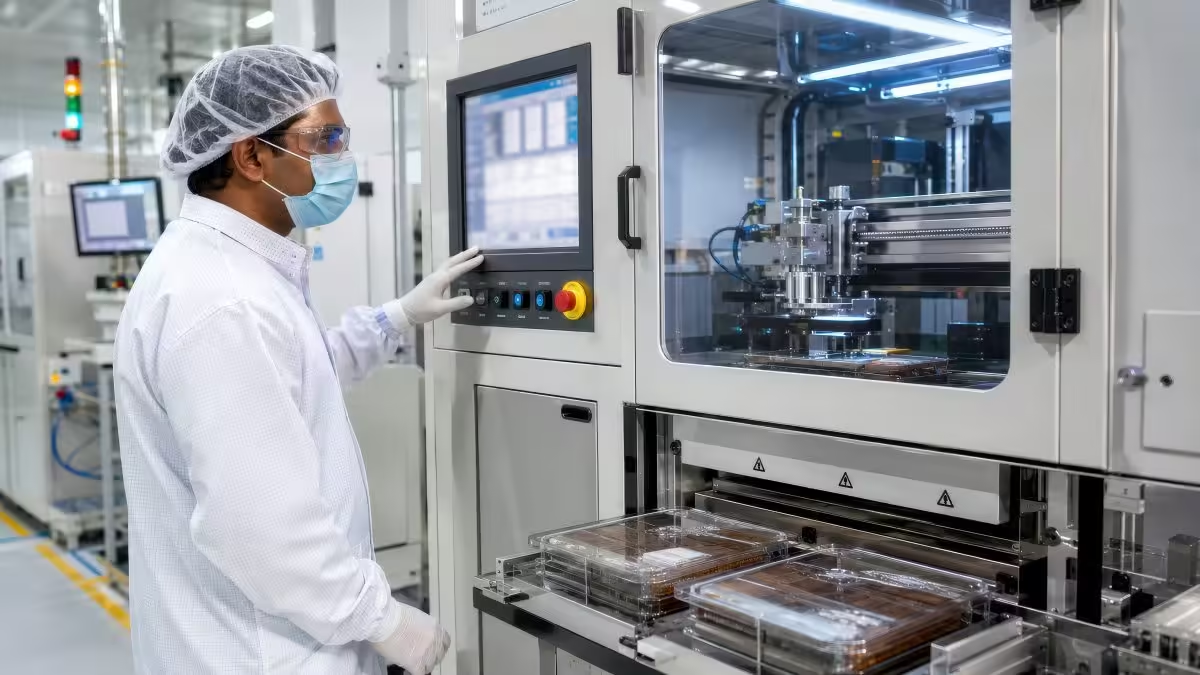
Sahasra’s semiconductor packaging facility, set up under the Ministry of Electronics and Information Technology’s Scheme for Promotion of Manufacturing of Electronic Components and Semiconductors (SPECS), spans 5,295 square meters (57,000 square feet) and has a stated annual packaging capacity of 60 million units. It packages memory chips for microSD cards and flash storage, LED driver ICs, eSIMs, and RFID products. The government described Sahasra as India’s first small and medium enterprise (SME) to begin commercial production of semiconductor chips.
RRP Electronics operates an OSAT facility in Mahape, Navi Mumbai, Maharashtra, serving automotive, industrial, and telecom customers.
The larger OSATs work on a different scale. Tata Electronics’ ₹270 billion (~$3.25 billion) OSAT facility in Assam has an approved capacity of 48 million units a day. CG Power’s ₹76 billion (~$910 million) facility in Sanand, Gujarat, has a planned capacity of 15 million units a day. Kaynes Technology’s ₹33.07 billion (~$395 million) facility, also in Sanand, is designed to handle more than 6.33 million units a day. By comparison, Sahasra’s stated annual capacity of 60 million units translates into an average of about 164,000 units a day.
“The bigger point, however, is that success is not just about money,” Dodia said. “Whether you are setting up a smaller or a larger operation, you need to find an anchor customer.” He also pointed to capacity utilization, experienced personnel, and product qualification as key factors.
Customers before capital
Dodia said a new OSAT should secure at least one customer committed to buying its products over three to five years. This matters even more when the initial investment is low.
Companies such as Sahasra and RRP Electronics have an advantage because they entered the market earlier and already have customers buying their products. “That matters more than simply investing the money,” Dodia said. An investor could spend ₹1 billion (~$11 million) to ₹2 billion (~$21 million) on equipment. But if the equipment sits idle because no customers are lined up, the investment will not deliver the expected returns.
Larger players such as CG Semi and Kaynes Semicon follow the same model, with anchor customers and technology partners. Renesas, for example, is both a technology partner and an anchor customer for CG Semi, whose initial production serves Renesas’s packaging requirements. “Without that arrangement, there is little point in proceeding,” Dodia said.
Dodia said a buyer such as Apple or Samsung might have to work with 10 smaller OSATs, each with capacity tied to a ₹1 billion (~$11 million) to ₹2 billion (~$21 million) investment, to meet its requirements. “This creates additional management work for the customer as well,” he said.
Dodia said capacity utilization matters more than initial capex. Equipment is expensive whether a company invests ₹1 billion (~$11 million) or ₹10 billion (~$105.4 million). Idle equipment ties up money, and the company continues to pay interest. “Therefore, what matters most is whether your products and equipment are being utilized to their fullest potential,” he said.
Investors also need patience. Dodia said returns are typically zero in the first year, and investors should not expect returns in the first two or three years.
Experienced engineers are scarce
“In my view, the workforce, particularly experienced personnel, is the most underestimated requirement,” Dodia said.
Suppliers can provide quotes for equipment and material costs, he said, but experienced personnel is scarce worldwide. Indian OSATs compete for talent with the U.S. and other countries expanding chip manufacturing to reduce dependence on external suppliers.
Dodia expects the pool of experienced personnel to run dry. Much manufacturing knowledge is not documented. Two identical tools from the same vendor can behave differently over time as residue builds up in their process chambers. An experienced engineer can read statistical process control (SPC) charts and find the cause. AI cannot help without the data. “Most of the time, the knowledge exists in someone’s head,” Dodia said.
In an earlier interview with EE Times, Wasi Uddin, senior manager of R&D and training at Kaynes Semicon and a former OSAT and ATMP consultant at MeitY, said the “immediate gap is not materials or equipment; it is the expertise required to operate semiconductor-grade manufacturing facilities.” He said most of this expertise comes from the Philippines and Malaysia, or from Indian engineers who worked abroad and returned. Semiconductor manufacturers also have to compete with the IT sector on engineer salaries, he said.
A long road to qualification
Product qualification is the second hurdle, Dodia said. Qualification cycles often take 12 to 24 months, so a new OSAT cannot supply customers as soon as it installs equipment. A customer may ask for six or 12 consistent batches before it qualifies a supplier. Even then, the OSAT may serve only as a secondary supplier. Material suppliers can spend about 12 months qualifying with an OSAT.
Clusters versus a spread-out map
Dodia said smaller OSATs should ideally operate in clusters. Instead, states compete for semiconductor investment, and plants are spreading across the country. India has approved 12 projects under the India Semiconductor Mission (ISM). Dodia said a chemical supplier serving these plants and companies such as RRP Electronics may need warehouses in eight or 10 locations. Some materials, such as leadframes for certain relatively advanced packages, must come from within a few hundred kilometers of the OSAT because transport can affect them.
Tata has one plant in Dholera, Gujarat, and another in Assam, so its suppliers must manage logistics from west to east. Dodia acknowledged that states have reasons to share in the industry. But he said supply chains will take longer to mature. “Something that could have taken three years may now take five years,” he said.
Sanand in Gujarat shows the alternative. Dodia said Gujarat has three OSATs in Sanand and three more in the surrounding areas. One supplier facility nearby can serve three companies.
Uddin said that OSATs can import materials for the first three to five years while local suppliers build up. “Why is there no leadframe supplier till now in India? Because there was no OSAT, there was no market,” he said.
“Micron, CG Semi, and Kaynes formed a consortium and held monthly supplier meetings so suppliers could see their combined demand,” he said.
Room in legacy packaging
Commodity packaging puts smaller OSATs in competition with suppliers worldwide, Dodia said. Large OSATs, meanwhile, are directing their growth toward advanced packaging. Amkor’s advanced packaging revenue rose to $5.56 billion in 2025, while its mainstream wirebond business stayed flat at $1.15 billion.
Large OSATs also retire some older package lines. In 2022, ASE’s Chung-Li plant in Taiwan decommissioned its punch quad flat no-lead (QFN) line, forcing NXP to withdraw two parts.
Dodia sees an opportunity for smaller OSATs in these discontinued products. “Many products have such well-established applications that demand continues for 10 to 20 years. Automotive is one example,” he said. NXP has committed to supplying several automotive microcontroller families for more than 15 years, while Rohm Semiconductor specifies supply periods of 10 to 20 years for some products, including automotive MOSFETs.
He cautioned against crowding. If five or 10 smaller OSATs all target automotive, they will compete in the same race. “Ideally, they should coordinate their efforts, with one company targeting one segment and another focusing on a different segment,” he said. Some could pursue advanced packaging if they have the right customers, since startups and R&D teams often want newer technologies.
Uddin said the major OSAT players have already split by segment. Micron packages memory. CG Semi focuses on legacy packages such as QFN and thin shrink small outline packages (TSSOP). Kaynes focuses on power packaging, and Alpha and Omega Semiconductor has booked 28% of its capacity. “It will be a competition, that is for sure, but it will not be a throat-cutting kind of a competition,” he said.
Who will buy from smaller OSATs
Dodia said some customers pay a premium for dedicated capacity. Defense customers do not want their products exposed elsewhere and may pay more for a dedicated line. R&D teams and startups need small volumes quickly. When a larger manufacturer receives an order worth millions of dollars, a $10,000 order can wait for months. In all of these cases, time may matter more than unit cost.
Dodia said fabless startups are probably the best customers for new Indian OSATs. Serving them needs a flexible model that supports tens of processes, because their volumes are low and their requirements change fast. Integrated device manufacturers (IDMs) and electronics manufacturing services (EMS) companies could also become customers.
Global companies such as Renesas have two reasons to qualify a smaller Indian OSAT, Dodia said. Incentives could help it offer better prices. A dedicated partner also offers planned capacity for three to five years, without competing against the hundreds of customers that ASE or Amkor serve.
Dodia said India needs a tiered ecosystem, with large OSATs handling high volumes and smaller ones serving customers who need faster turnaround, greater security, or specialized services. Some mature markets abroad already follow this approach. If the ecosystem serves only high-volume customers, startups, defense customers, and R&D teams will not get what they need. “We definitely need both types of OSATs,” he said. Older products and mature technologies can meet many Indian requirements.
Also read:
India’s OSAT-ATMP Build-Out: From Legacy Packages to 2.5D
India’s OSAT Ambitions: Flying High or a Flight Risk?
India’s OSAT Buildout Puts Semiconductor Testing in Focus
CHIP PACKAGING, INDIA, ASSEMBLIES, SEMICONDUCTOR MANUFACTURING, SEMICONDUCTORS
KAYNES SEMICON, MEITY, SAHASRA SEMICONDUCTORS, SMART FAB SYSTEMS
Source: www.eetimes.com