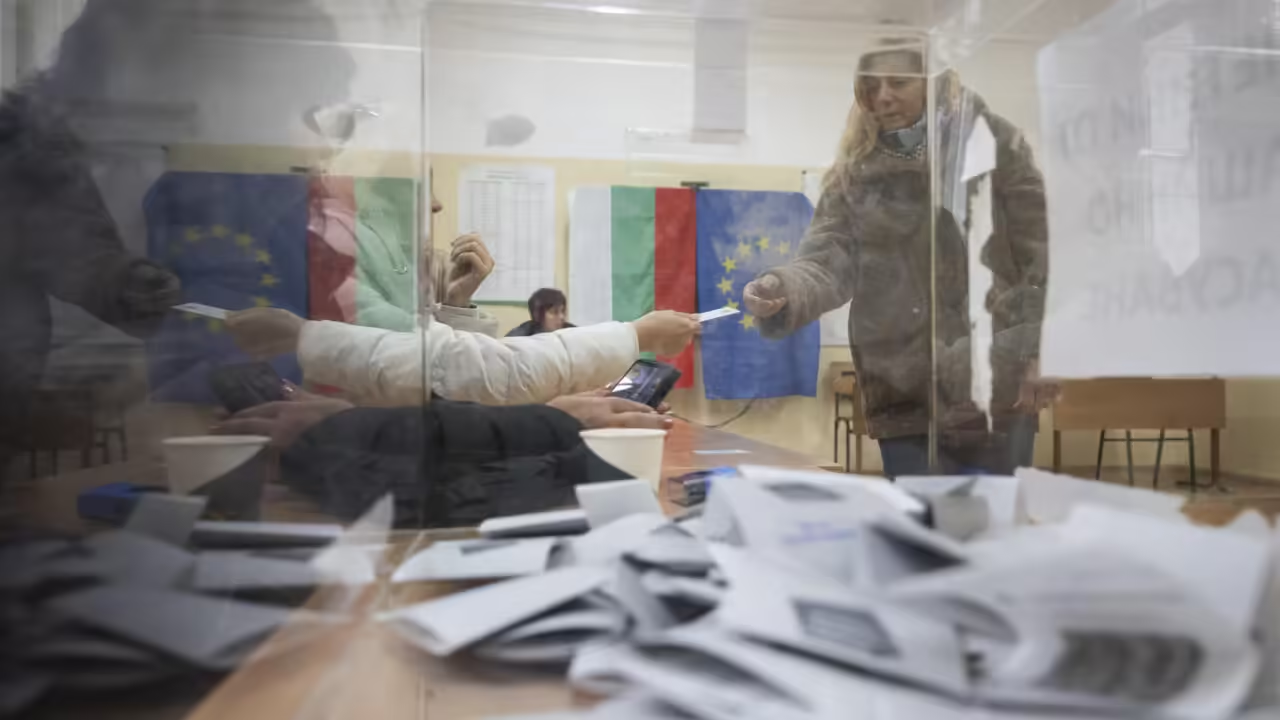

Bulgarians voted Sunday in a presidential runoff between two candidates with contrasting visions on the war in Ukraine, following a series of drone attacks on commercial vessels in the Black Sea.
The race pits President Iliana Iotova, who favours dialogue with Moscow and opposes military aid to Ukraine, against Andrey Gyurov, a banker and former caretaker prime minister backed by the pro-Western opposition, in the race for the largely ceremonial post.
Read moreBulgaria searches for missing crew as drones hit two Black Sea ships
Iotova won 35 percent of the vote in the first round last week, with Gyurov on 32 percent – a much narrower gap than the 20-point lead for Iotova predicted by opinion polls.
The first round recorded turnout of 23 percent, and election officials were expecting higher participation in the runoff.
Political analyst Teodor Slavev told AFP that voters were giving their verdict on “Iotova’s unconvincing response regarding Russian threats in the Black Sea”.
Several vessels were struck in the Black Sea off Bulgaria in October, leaving 21 people missing, in suspected spillover from the Russia-Ukraine war.
Read moreNATO to address drone attacks in the Black Sea after seven missing off Romania
While centre-left Prime Minister Rumen Radev has said the attacks appeared to serve Russian interests and summoned the Russian ambassador, his government insists there is so far no evidence directly linking them to Moscow.
‘Lesser evil’
At a polling station in Sofia, 64-year-old teacher Krassimira Kostova said she voted despite dissatisfaction with both candidates.
“I don’t like either of the two candidates, but I don’t like the return of communism we’ve been seeing in recent years either. That’s why I came to vote,” she said.
Petar Doitchinov, a 67-year-old retired engineer, said he had skipped the first round because he expected a runoff. He said he voted for “the lesser evil”, as neither candidate matched his “vision of democracy”.
In rainy, windy weather across much of the country, turnout stood at 6.1 percent at 11:00am local time (0900 GMT), compared with 5.8 percent at the same time in the first round, according to the Bulgarian electoral commission.
Polls opened at 7:00am and will close at 8:00pm, with exit polls shortly after that expected to give an indication of the winner.
‘Strong Bulgaria’
After voting in Sofia, Iotova, 62, said she wanted “Bulgaria to be strong in a strong Europe” and remaining “sovereign in its decisions”.
A longtime ally of Radev, she supports Bulgaria’s EU and NATO membership while arguing that peace in Ukraine can be achieved only through negotiations.
Gyurov, 50, said after voting in Blagoevgrad that he had voted for a “secure, stable and European Bulgaria”.
In a television debate before the runoff, Gyurov criticised Iotova for not explicitly blaming Russia for the Black Sea attacks.
“Russia must stop its aggression so that the next steps can be taken,” said Gyurov, a former deputy governor of the Bulgarian National Bank.
Iotova maintained that “peace can come only through negotiations”.
Read more‘It is clear that sooner or later we will have European casualties’, Romanian MEP
Radev has also argued that a ceasefire and peace talks offer the best chance of preventing further attacks on commercial shipping in the Black Sea.
He has presented Iotova as a pair of “safe hands”.
A former journalist and member of the European Parliament, Iotova was elected vice-president alongside Radev in 2016 and 2021.
She took over as president this year when Radev stepped down to run in parliamentary elections.
If successful in the runoff, she would become the first woman president in the country of 6.4 million people.
Historically close to Russia, Bulgaria remains deeply divided over its relationship with Moscow.
(FRANCE 24 with AFP)
Source: www.france24.com