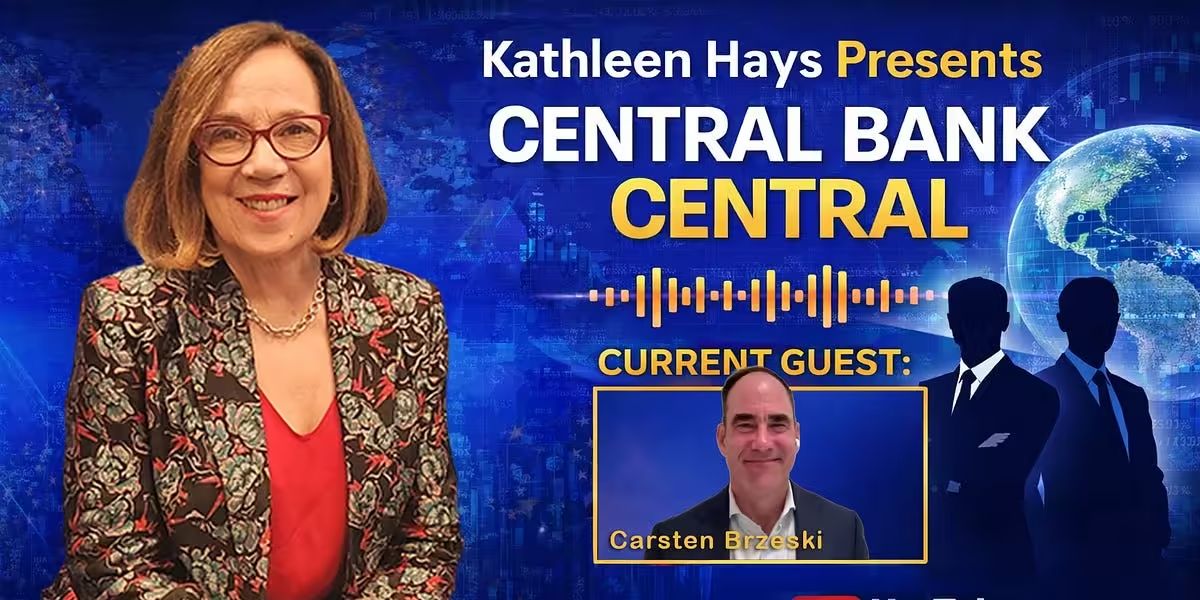

Carsten Brzeski has a long and deep background in all things pertaining to the Eurozone’s economy and the political forces driving it, both as Chief Economist, Eurozone and Global Head of Macro of ING Groupand in previous roles he held at the Dutch Ministry of Finance, the European Commission and more.
So he is more than amply prepared to vet not only the policy outcome of the European Central Bank’s latest meeting but also to weigh in on what may be driving the ECB’s president, Christine Lagarde, to step down in February of next year—the big surprise of the day.
“I think it was really both because the ‘rates on hold’ was expected. So that was not a big surprise headline,” Carsten says. “So the big surprise headline was clearly Lagarde is leaving the ECB. The timing to do this, really only a few hours before a big policy announcement… that is rather special.”
After Lagarde has said at her post-meeting press conference that she wants greater freedom to express personal views, Brzeski questions whether the ECB presidency has truly constrained her: “The ECB is highly independent in Europe.” He also notes that ECB leaders have historically commented on fiscal policy and structural reforms, leaving uncertainty over whether Lagarde’s next move will be into French politics, an international role, or something else.
Cutting to the monetary policy chase: Carsten sees the ECB trying to balance doing an inflation overshoot against a deteriorating growth and fiscal backdrop, making caution more appropriate than aggressive tightening.
“I think it was definitely the right thing to do,” he says. “Why did they do it? And… given that we’ve now had already two rate hikes this year, the last one at the meeting in September, I think the ECB had probably a very heated debate. And that’s also what Christine Lagarde said during the press conference.”
“There are hardly any indirect or second-round effects visible in the European economy,” he adds. With core inflation stable, the ECB can avoid overreacting to a largely energy-driven increase in headline prices. Meanwhile, higher bond yields since September have worsened financing conditions across Europe, effectively doing some of the central bank’s restrictive work.
France is central to Brzeski’s warning about policy risk. Wider French-German bond spreads reflect a domestic fiscal and political crisis, he said, rather than market dysfunction that would justify ECB intervention. The ECB’s Transmission Protection Instrument could buy bonds to preserve even monetary-policy transmission, but only under conditions that France may not meet.
Brzeski believes fiscal dominance is not yet controlling ECB policy, but the risk is growing. “We’re not there yet, but we’re moving into that direction of fiscal dominance.” Persistent debt accumulation could eventually pressure the ECB to tolerate higher inflation rather than tighten forcefully, especially amid elections in France, Spain, Italy, and potentially Germany.
Bottom line: Carsten sees an ECB rate increase at the December meeting if current conditions persist. “The direction of travel… is clear for the next meeting,” he said, describing it as “one of a rate hike.” That expectation depends on inflation remaining elevated, the euro-area economy retaining its unexpected resilience, and energy prices failing to fall sharply.
Will the ECB need to more rate hikes next year? Dive in and hear what he lists as the three main factors that will determine that decision.
Spoiler alert: Carstens says there will be no need for more policy tightening after the first of the year if the jump in Euro-area inflation “remains almost exclusively about energy prices.”
The Lagarde Surprise 00:01:12:23
Hey, Kathleen, thanks for inviting me… So, the big surprise headline was clearly Lagarde is leaving the ECB. And even to some extent even that was not a surprise by the timing of the announcement is a surprise because, you know, there had been rumors already for a long while, some even fueled by herself, that she might stop earlier than her official term will be.
The strangeness of the method and timing of Lagarde’s leaving 00:01:45:15
But I think the timing to do this really only a few hours before a big policy announcement. So that is rather special. And, you know, well, I’m not so much into conspiracy theories, but to me it shows that there must have been some kind of rush because you well, you know this better than I do in terms of communication. I think you could have also just sent out a press release, for example, next week with this announcement, and then would have probably had gotten lesser attention than it did today.
Lagarde wants freedom to express her own preferences 00:02:54:13
You know what? Indeed. Christine said that she wants to speak more freely than as an ECB president. Well, I would slightly contradict this view because in the end, the ECB is highly independent in Europe. And, actually, we have seen so many ECB, well, presidents, officials, also giving comment on all kind of things. So, politically that’s correct…but you know we have had an ECB commenting on fiscal policy on structural reforms etc., etc.. So the big question is and that is something Lagarde did not answer. So what will her personal future look like? You know with the timing you could indeed think, well, is she really willing to mingle herself in French politics? Well, a couple of months ago, there was the rumor that she might want to to join the election campaign.
Lagarde: seeking freedom of expression…and what else? 00:03:49:14
It was unclear whether she would be even considering running for the presidency in France, or whether she would just support some or one of the candidates. That’s unclear, but indeed, it seems to be a pressure for her and a wish to speak out more freely. And then indeed, I think it will not be speaking out freely about what is happening in Italy, or Germany, but what is currently happening in France. So that is something. But then, you know, on doing a little bit of the rumor story here, we also know that in the past, there were rumors that Cristina might become the next chief of the World Economic Forum. So and here I think the jury is also still out. So, we have two options here. We will only hear in a couple of weeks. Probably. What? Wanting to speak more freely again really means. And also why the urge? Because at the end of 2027, she would have had all liberty and all freedom to speak freely again. So why not wait another 12 months or. Well, she said, now she’s going to resign on the 7th of February, so why not wait another nine months before you then are really free again?
Lagarde’s influence 00:05:46:09
…maybe she’s also overestimating her own power and her own role. So, you know, we’ll see. Maybe I’m wrong with the question is only because Christine Lagarde then is able to speak more freely, will this then really still move the people of France? I don’t know. Remains to be seen.
In the past the ECB has stepped outside its mission to give advice 00:06:11:12
And you could also argue that clearly at the ECB at the helm of the ECB, Christina also has actually maybe even more power to interfere with French politics. Remember when we were in the Euro-crisis, the ECB under Mario Draghi was actually sending letters to European governments trying to explain to them what they had to do. So it is not that in the past, you know, the ECB felt bound or restricted in what is communicating. But in the end, this remains a personal decision by Christine Lagarde. And we will maybe in a couple of weeks hear what her next professional steps are.
Monetary Policy…
ECB on hold despite excessive inflation 00:07:31:07
I think was definitely the right thing to do (put policy on hold). Why did they do it? And also given that we’ve now had already two rate hikes this year, the last one at the meeting in September. I think the ECB had probably a very heated debate. And that’s also what Christine Lagarde said during the press conference. So there were they were debating a rate hike as well. And at today’s meeting. And then you have an ECB indeed looking like you mentioned at the start, at a inflation rate that is clearly above target, that is continue to increase. Well, that’s the energy price story. And the ECB also calls it that. The risks to the inflation outlook are tilted to the to the upside, a clear signal that a central bank and the ECB should continue hiking rates.
Stable core inflation reason for pause after two recent rate hikes 00:08:00
But why did they pass? Two things: (1) one thing they said that they are currently there is very little evidence of this higher energy prices really feeding through to the economy. So, there are hardly any indirect or second round effects visible in the European economy. So, core inflation, underlying inflation, remains very stable. So, that is a clear reason for a central bank, particularly after two rate hikes to just take a pause. (2) The other argument is that due to the surge in bond yields that we have seen since the September meeting. Financing conditions in Europe have worsened. So, you could argue that to some extent bond markets have taken over the ECB shop. And that also explains why the ECB now is labeling risks to the growth outlook as being tilted to the downside.
Risks shifting, waiting appropriate 00:09:18:08
So, you are in a situation. Inflation risks, up: growth risks, down. So, you could even call this a bit of stagflation tendencies. And that is where every central bank starts to kind of be a bit more cautious. And we also know and that’s the typical story with the ECB. We know that they prefer taking rate decisions at a time when they have new staff projections. And these staff projections are only available on a quarterly basis. Next time will be will be at the December meeting. So I think this you know a couple of explanations why the ECB thought, you know, yes, they could have done a rate hike, but they rather waited. In my personal view, as you also asked for that. I think that is the right decision to take.
Policy could delay and allow inflation to fall more gradually 00:10:07:00
We now have a policy rate, since September, which is clearly at neutral levels, and I think not more is needed. But I still don’t get that. The ECB would really be willing to slow down the economy just in order to bring inflation down. So, at the current juncture is rather, you know, just wait, allow a little bit for an inflation overshoot, at least for as long as core inflation remains stable.
Options for ECB assistance for France 00:11:13:02
Maybe to start with the reason why everyone is talking about what could the ECB do to to help France is that we’ve seen a huge widening of spreads between French government bond yields and German government bond yields. But that is the French fiscal and political crisis that where they were currently witnessing. And then of course we always get the question. Yeah. Like in the euro debt crisis in the in the early 20 tens. But you know, how about the ECB simply intervening purchasing bonds and then narrowing the spread again. Well. Theoretically that’s a possibility. In practice. The ECB is very cautious in doing so. So now we get technical. What are the options for the ECB to actually do it.
Thoughts of QT but no action 00:11:58:22
So there is one. And that is like in the US a quantitative tightening. So the ECB during the pandemic restarted asset purchases. So they bought government bonds and other assets which are in their books. And for a long while when these assets, the bonds in the ECB books matured, the ECB was simply reinvesting the money. What quantitative tightening means that you are no longer reinvesting the maturing bonds. So but they could do it. Christine Lagarde in the press conference today actually underlined that this is nothing the ECB is currently considering. So ‘QT’ will continue. Then we have the big berserker like we like bazookas in Europe and that is called the Transmission Protection Instrument. Yes, that is another kind of instrument just to allow the ECB to purchase bonds.
TPI is a delicate protocol 00:12:58:06
Well and with this purchasing of bonds, it’s always a kind of a crucial thing because in Europe, according to the treaties monetary financing is forbidden. So even ECB goes into this territory of purchasing bonds of QE. It is always a legally tricky thing. And the ECB has to make sure that it’s really only for pure monetary policy purposes.
But France does not seem compliant with TPI eligibility rules 00:13:24:09
So this is why the Transmission Protection instrument comes in and it says more or less what makes sense that the ECB wants its monetary policy to be felt equally across all European countries. But if now French bond yields are 200 basis points higher than and then German bond yields, well, monetary policy of the ECB is transmitted differently to France than to Germany. And this is where this TPI enters enters the equation. So this TPI would allow and enable the ECB to intervene to shrink these interest rate differences. The spreads to have its own monetary policy being well spread out equally. That’s the theory. Now comes the final point okay. Yeah. So it’s a lot it’s Europe that’s all complicated. So and now but there are conditions attached to tha So the ECB itself has always said that this TPI will only be allowed for countries that are compliant with the European fiscal rules, and they will only use this TPI in a situation that the widening of spread is not warranted by national, political or economic circumstances. Well, here you go. The current widening of France is clearly a national story.
France would need to show some fiscal backbone to get help 00:14:49:01
It is warranted. Bye bye, bye bye. Economic and political reasons. So this is why the ECB is still extremely reluctant to actually use this instrument. Well, long story short, there are instruments that could allow the ECB to intervene in the bond market to intervene in the French situation, but not as long as France is actually not showing any kind of efforts to engage in a austerity measures.
Fiscal dominance? 00:15:52:10
…we’re moving into that direction of fiscal dominance. Clearly. I think so right now. Also, the ECB monitoring policy is hardly being affected by the French situation, also not by higher, debt levels across Europe. But, of course, well, if you think it through, there is a situation thinkable in which there won’t be austerity, for example, but in which government debt will simply continue to increase.
Watching the US contemplating a dangerous path 00:16:29:14
Well, like we’re having in the US. So if this is the case, we might get to a point in which the ECB, at least implicitly, one might have to tolerate higher inflation levels because how know, how do you get out of two high government debt ratios? Well, either by outright austerity or by inflating your debt away. And that can be done by higher growth or by higher inflation. So by higher nominal growth. So which in the European context could mean that fiscal dominance could become an issue, which then would mean that the ECB might be tolerating a higher level of inflation.
Direction of travel is clear: toward a rate hike 00:17:55:19
Yeah, I think Christina sent a very clear message regarding the next meeting. So the fact that they already debated a rate hike at today’s meeting is a clear signal. She also said, I think literally, that the direction of travel that the term she always likes to use is clear for the next meeting. So that is one of a rate hike.
Economic resilience? 00:18:19:04
So if the situation, if the situation does not change drastically and drastically, could mean energy prices come down due to development in the Middle East, or that, for example, the growth outlook worsened significantly. If none of this happens, but we are more or less in a similar situation in which we have you mentioned we have we have economic resilience.
Three parameters War, oil price transmission, and France 00:18:44:14
We’re growing, I would say, at a solid pace. We’re not strongly growing in Europe, but there is this surprise, resilience. So if this remains the case, plus inflation overshooting, they will hike interest rates at the December meeting. If you look beyond that, everything will depend I think on three parameters. (1) One is the war in the Middle East, the level and the duration of of of energy prices. So for for how long will they remain high if they come down due to some kind of relief in the Middle East region, the pressure on the ECB to continue hiking rates fades away. That’s one parameter. (2) The other parameter is the transmission of higher energy prices to the rest of the economy. So if we continue seeing the current picture of underlying core inflation remaining stable, and this remains almost an exclusive energy price shock, there is no need for the ECB to continue hiking rates in 2027. Obviously, if it was the other way around, if we were to see inflation starting to spread and to broaden in the economy, a reason for the ECB to continue hiking rates in 27. (3) And then last but not least, it is the French story. I think if there is no resolution, which I would expect, the ECB hands will also be tied to really hike aggressively.
Story of fiscal dominance- and elections 00:20:17:21
That is the story of fiscal dominance. So then the ECB will be much more cautious and just wait because we will not only have French elections next year, we will also have Spanish elections, we will have Italian elections. And if things go really wrong, we might even get German elections as well. So which is always a very, very vulnerable political situation, a situation in which I cannot see the ECB hiking aggressively.
The price of persistent fiscal excess– 00:21:12:00
I think for France, the economic and fiscal situation is simply not good. We’re seeing a country that is now paying the price for hardly ever having followed the European fiscal rules. So this is a country that I think over the last 27 years, only managed to have a deficit of below 3% of GDP in 3 or 4 years.
The limits of debt-fueled growth 00:21:37:22
So we’re seeing now the limits of what debt fueled growth can achieve. So that is the French lesson. And it’s an either we’re going to get some kind of a gradualist measures or we will continue having this political, you know, uncertainty, very hard to find political majorities, which means it will continue weighing on confidence in the economy and also on growth.
It’s a French problem 00:22:08:06
So that is that is really kind of the, the, the French problem in the rest or in most other European countries. I think the prospects are slightly better. So the peripheral countries of southern European countries have really done their fiscal homework over the last couple of years. Spain, for example, shown stellar economic performance over the last couple of years.
A case for moderate optimism 00:22:30:21
Central Eastern Europe is also doing relatively well. And then we have the Germany that is now gradually leaving stagnation behind thanks to the fiscal stimulus, the big investment programs. So you know what I say, it is really a combination, I think. Well, yes, there are there are good reasons to be cautious, sometimes even skeptical. At the same time, we also have some reasons for well, very, very moderate optimism.
Macro conditions are driving bond yields 00:23:31:08
Yeah. It’s hard to have a conviction call these days. I have to admit we have a house view and the house view is one in which we still see the main explanation. The main driver of the bond yield surge being macro. So this is really for us it’s really the war in the Middle East. Higher oil prices, higher inflation expectations.
The assumed scenario 00:23:57:02
And consequently also this repricing of the central bank reaction function both for the US and in Europe. So if we were and that’s what our assumption is, we don’t have any Intel. But our assumption is that after the midterm elections, there will be some short lived, reescalation followed by some relief in the Middle East, so that oil prices should again move towards $80 – $90 per barrel and in 2027 should be at around $75 to $80 per barrel.
A benign outlook 00:24:29:08
I know this is currently a rather benign scenario, but that’s our base case. So if this is true, it would mean that this entire chain of market pricing will be reversed. So meaning lower all prices means lower inflation expectations means adjusted central bank reaction functions. So only very few rate hikes will be expected. And that means that bond yields should come down in the course of 2027.
Turn over is not just Lagarde 00:25:33:20
Prediction markets. Well maybe they already started to predict who’s going to be the next ECB president. To make things even more complicated, it’s not only the ECB presidency, but it’s also two other vacancies in the executive board. So six people sit on the executive board of the ECB, the president. Then we have the German Isabelle Schnabel, who’s responsible for financial markets, money markets, who also already announced to step down by the end of this year, her term would have ended also only a year from now. So she will step down. But very a key a key figure. And also the chief economist Philip Lane. His term will end next mate. So, we have three key players at the ECB Christine Lagarde, Isabelle Schnabel, Philip Lane who will all have to be replaced. Why is that important? Because this allows governments who are making these nominations to actually agree on a package deal. And we know that in Europe, nationality is also matter. They are all kind of written and unwritten rules.
Surprised, but not unprepared 00:26:41:18
So to answer your question, when it comes to the presidency, I think also over the last couple of weeks, because you know this, the timing of Lagarde announcement was a surprise. The content was not. So we knew that already that we have two candidates, more or less kind of waiting on the sidelines to get into this race. One is the Hernandez De Cos, who is currently also the president of the Bank of International Settlements. He used to be the Spanish central bank governor. And then on the other hand, we have Klaas Knot who is the former governor of the Dutch central bank. So, these are the two names that are currently mentioned most often.
Two excellent choices 00:27:24:20
I think two or both are really very excellent candidates, because they also bring a lot of central bank monetary policy expertise to the table. I don’t dare make any predictions. Who of the two will have better chances to to get the post? Why? Maybe that why will it one of the two and not for example, another Frenchman or a French woman because we already had two French ECB presidents.
The selection process 00:27:53:20
So France is out. Could there be a German? Well, Germany always hoped that they should, with the Bundesbank tradition that they also should get the ECB presidency at some point in time. Well, they do don’t seem to have a very adequate candidate. Plus we have a German president of the European Commission. So that’s also something. So you need to look at the national at the ECB but also then at other European institutions. So which means I think the race is down to de Cos and Knott. And I guess that also at the latest at the we have a European leaders meeting in December. So I assume that this will already be the moment when they announce it.
Carsten Brzeski
Carsten Brzeski is a prominent economist known for his expertise in European macroeconomic issues. He currently serves as the Chief Economist for the Eurozone and Global Head of Macro at ING Research. Brzeski has a strong background in economic policy, having previously worked at ABN Amro, the Dutch Ministry of Finance, and the European Commission. He is recognized for his insights on economic and political developments in Germany and Europe, particularly regarding the European Central Bank’s monetary policy. Additionally, he is a 2019 JFK Memorial Policy Fellow at Harvard University and a member of the Advisory Council on International Affairs for the Dutch government and Parliament.
Source: kathleenhays.substack.com