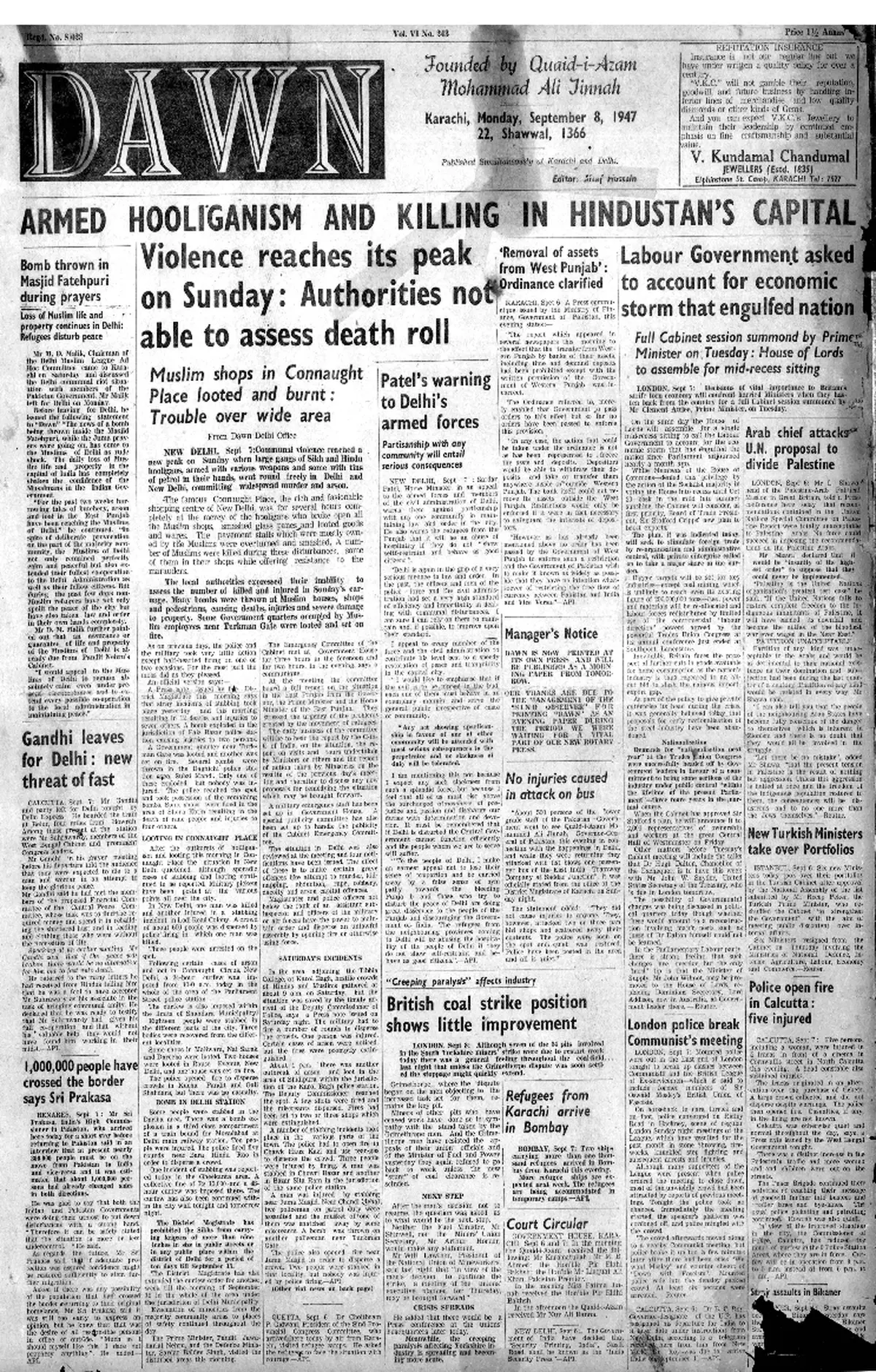

As Pakistan took its first few steps, the massive logistical task of accommodating millions of refugees in the midst of widespread communal violence was a major challenge for the state. The issues of Sept 8-14, 1947, documented these difficult times. In happier news, the Urdu Anjuman met for the first time in Karachi, while in a strange twist of history, the US came to Iran’s defence in the face of Soviet threats.
The great migration
The partition of the subcontinent had resulted in one of the largest — and bloodiest — mass migrations in human history. In the second week of September, the pages of Dawn documented the massive flow of refugees in both directions as communal violence continued, while the newborn state struggled to protect, house and feed millions of people.
In the Sept 8 issue, Mr Sri Prakasa, the Indian High Commissioner in Pakistan, was quoted as saying that “at present, nearly 300,000 people must be on the move from Pakistan to India and vice-versa and it was estimated that about 1,000,000 persons had already changed sides in both directions”.
The refugees coming from India were mainly headed to Karachi, then the federal capital, and Punjab. In the Sept 10 issue, it was noted that “refugees from Hindustan are pouring into Karachi in ever increasing numbers.” However, the outflow in the other direction was equally considerable. In a related report, it was mentioned that “the mad rush of evacuees from Karachi is reaching its zenith. The police had to disperse several times crowds which had assembled at the office of the Bombay Steam Navigation Company to get passages to Hindustan”.
The influx into Punjab was no less intense. In the Sept 11 issue, a report documented that “the total number of Muslim refugees which have arrived from the East Punjab into the West Punjab up-to-date has reached the huge figure of 12 lakhs and almost one half of this number has already been absorbed into the economic life of this province. …”
Food scarcity
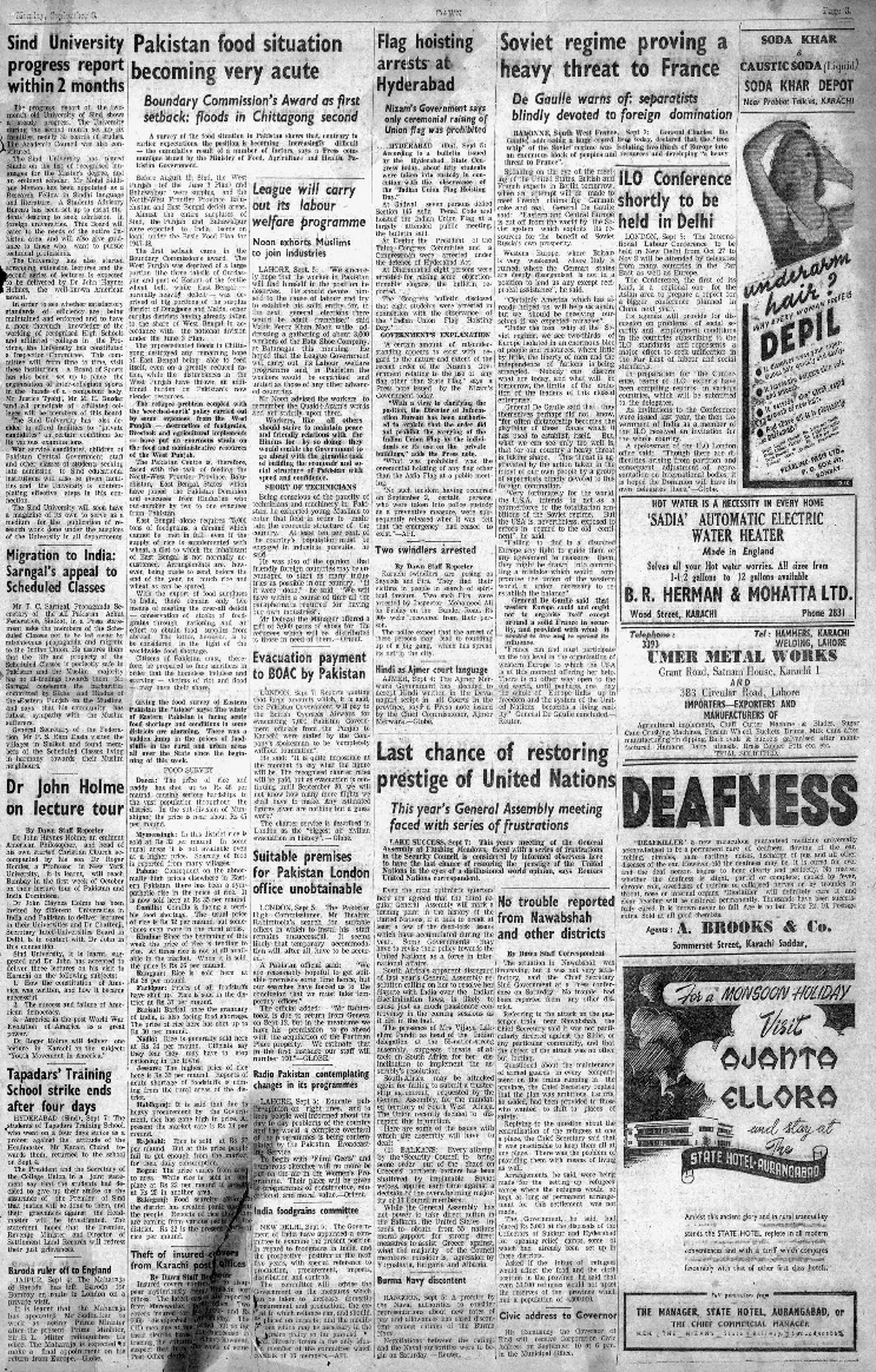
The huge influx of people was amongst the reasons for shortage of food in the early weeks of Pakistan’s existence. As a headline in the Sept 8 issued noted, ‘Pakistan food situation becoming very acute’. Other factors behind the scarcity were export to India — now another country — as well as floods.
But as the report put it, the “refugee problem coupled with the ‘scorched-earth’ policy carried out by some evacuees from the West Punjab — destruction of foodgrains, livestock and agricultural implements — have put an enormous strain on the food and administrative resources of the West Punjab.”
Though those were exceptionally tough times, as the young state had to arrange food for a large population in war-like conditions, today, decades after the establishment of Pakistan, a much more experienced state is still unable to properly feed its people, particularly children. Millions of children suffering from stunting and wasting due to malnutrition point to this depressing reality.
Delhi in flames
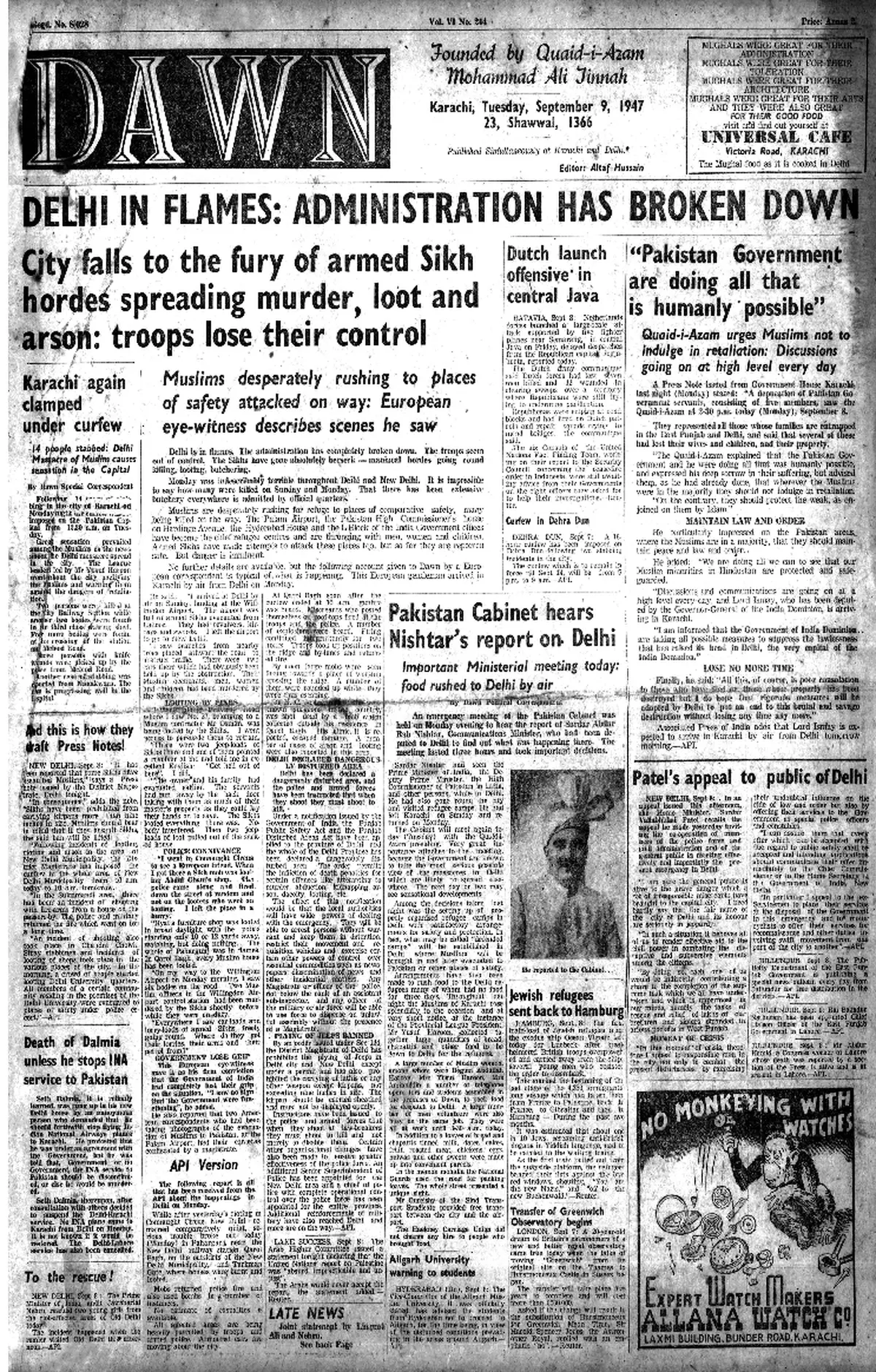
While there was communal violence across the subcontinent in the run-up to Independence and the weeks and months thereafter, in the week under review, New Delhi, the Indian capital, experienced particularly brutal violence. ‘Delhi in flames’ the banner headline in the Sept 9 issue read.
“Delhi is in flames. The administration has completely broken down. The troops seem out of control”, the report said, detailing a nightmare scenario. “Monday [Sept 8] was indescribably terrible throughout Delhi and New Delhi. It is impossible to say how many were killed on Sunday and Monday. That there has been extensive butchery everywhere is admitted by official quarters”.
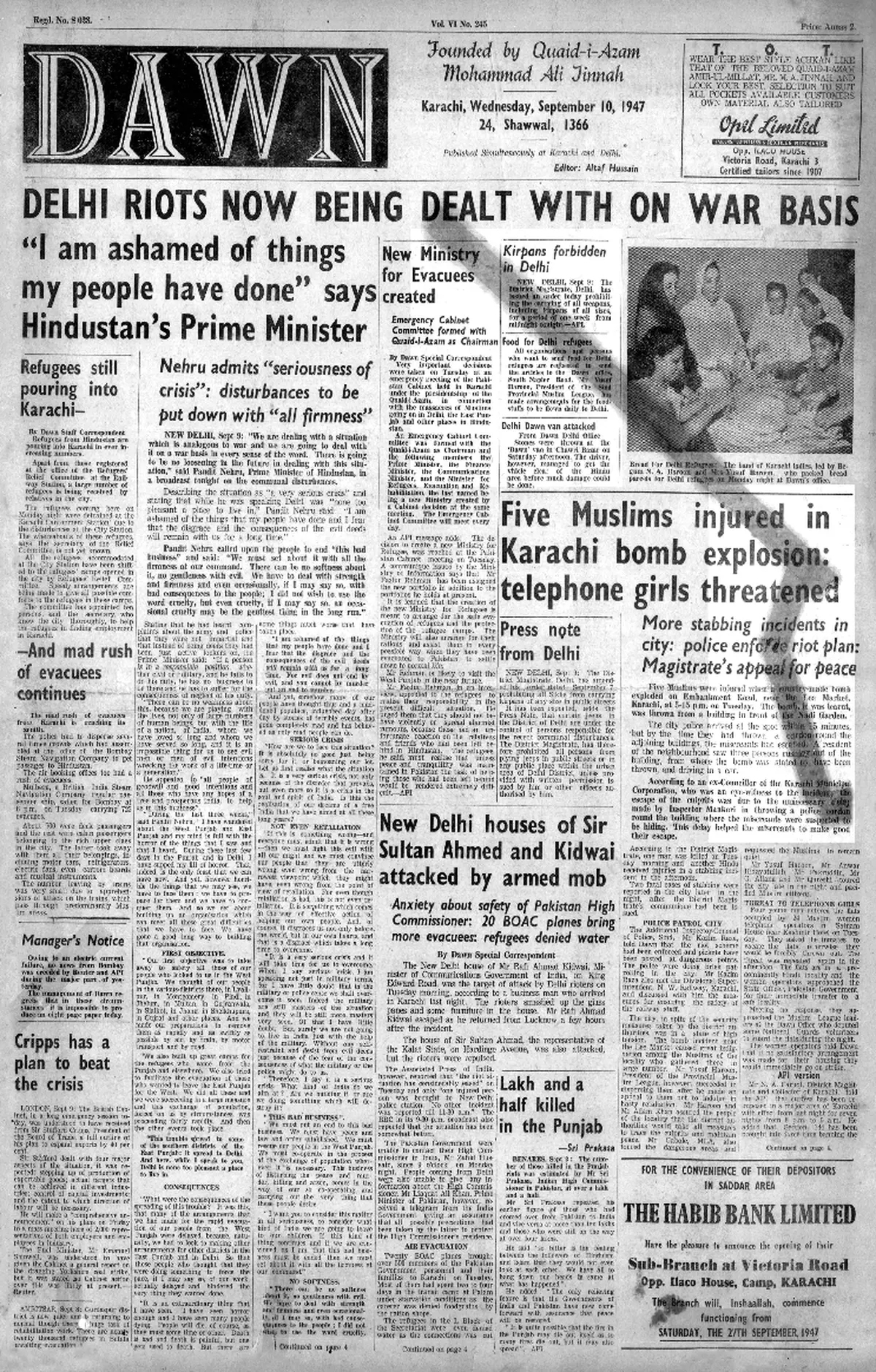
Freedom was supposed to be a moment of joy; the end of nearly a century of foreign bondage. But as these horrific accounts illustrate, that joy would be short-lived, as savagery was unleashed. Those who witnessed with their own eyes this madness have nearly all met their Maker, or are in the twilight of their lives. Yet the wounds of that period have yet to heal, as the continuing toxicity marking relations between Pakistan and India shows.
Urdu Anjuman formed
Though many amongst the elite pay only lip service to Urdu, the national language is key to preserving the culture and civilisation of the subcontinent’s Muslims. That’s not to take anything away from other languages spoken in Pakistan, which are all important and deserve respect and support. But Urdu and Pakistan are joined at the hip, and as the issue of Sept 9 noted, the formation of the Urdu Anjuman was a major event in the nation’s cultural history.
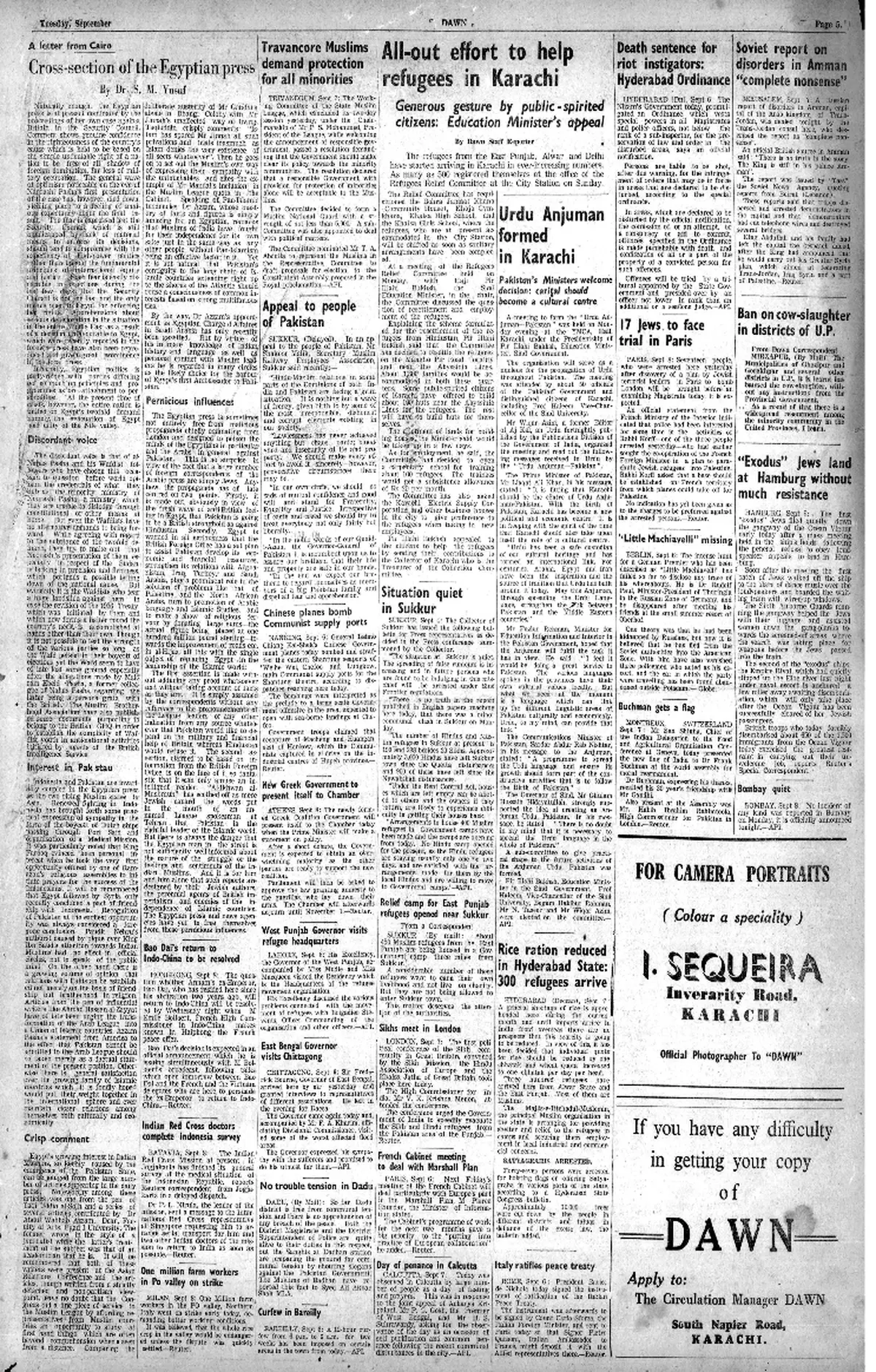
The initial meeting was held in Karachi’s YMCA Hall on Sept 8 “under the Presidentship of Pir Illahi Bakhsh”, Sind’s education minister. “The organisation will serve as a nucleus for the propagation of Urdu throughout Pakistan,” the report said.
In a message, Prime Minister Liaquat Ali Khan said: “It is fitting that Karachi should be the centre of the Urdu Anjuman-Pakistan. … Urdu has been a safe custodian of our cultural heritage and has formed an international link.”
US support for Iran
The truth can sometimes really be stranger than fiction. Today the US and Israel are locked in battle with Iran, and chances of fresh aggression against the Islamic Republic remain. However, in 1947, as the Iranians, then ruled by Mohammad Reza Shah, who was deposed by 1979’s Islamic Revolution, experienced tensions in their relations with the Soviet Union, guess who (rhetorically) came to Tehran’s defence: the US.
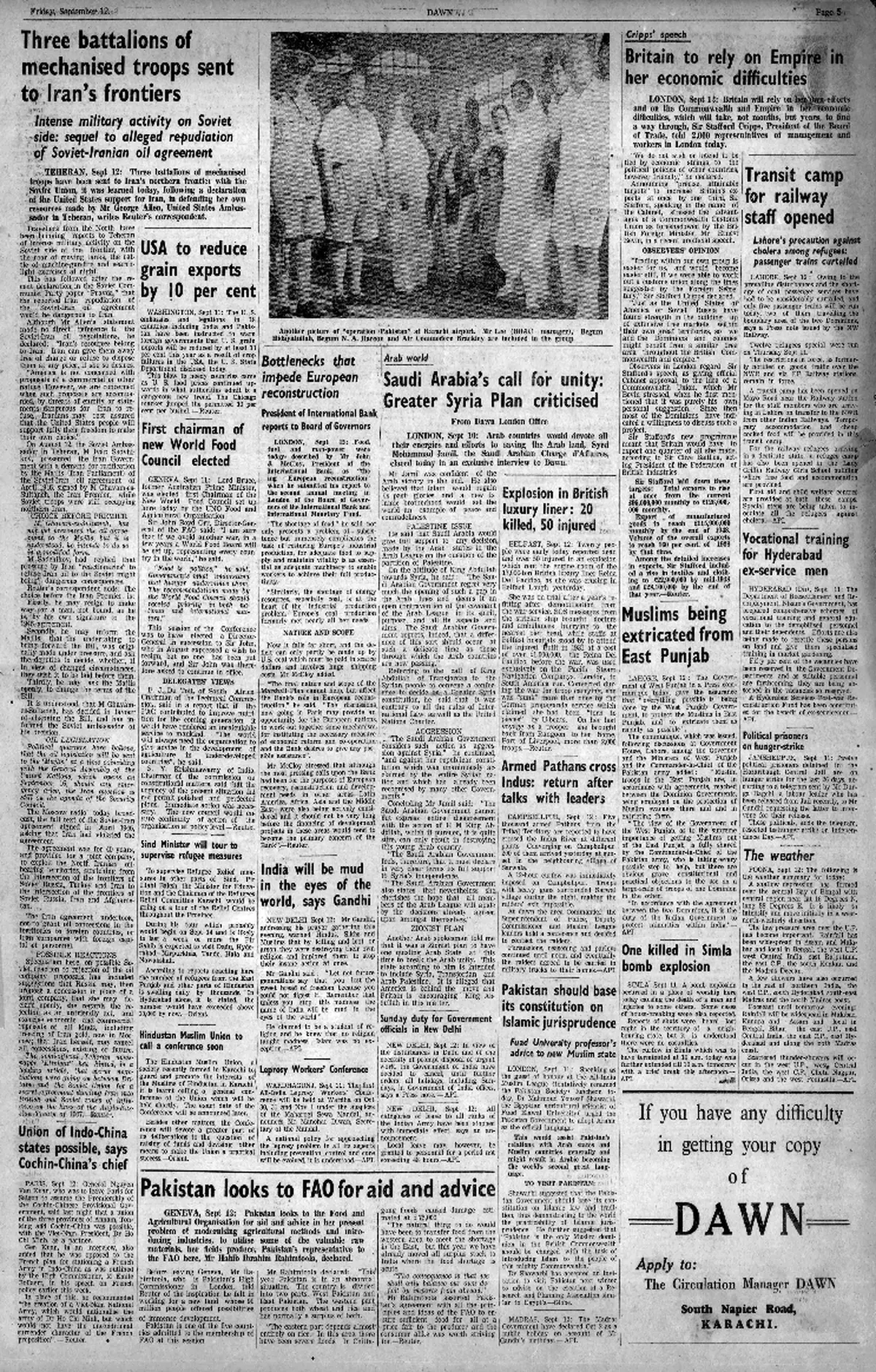
As mentioned in the Sept 12 issue, the Iranians had reportedly repudiated the Soviet-Iran oil agreement, which didn’t go down well in Moscow. The kerfuffle caused the American ambassador in what was then called Teheran to make an impassioned plea for Iranian sovereignty. Of course we all know how, over the decades, the US has meticulously respected the sovereignty of states, and refused to meddle in their internal affairs (wink, wink).
Mr George Allen, the US Ambassador in Teheran, was quoted as saying that “Iran’s resources belong to Iran. Iran can give them away free of charge or refuse to dispose them at any price. … Iranians may rest assured that the United States people will support fully their freedom to make their own choice.”
You can’t make this stuff up.
With the advantage of hindsight, one has the opportunity to study the historical cycles in a nation’s life. Thanks to this newspaper’s unique, extensive archive of back issues, one can examine the major political, economic and social trends that have shaped Pakistan and the world over the last seven decades and counting. Cliched as it may sound, history repeats itself, and we — as a state and as a polity — largely refuse to learn from it.
Through this platform, we will look back at the ‘big’ stories that made it to the front pages of Dawn, as well as significant developments tucked away in the inside pages, from the birth of Pakistan onwards, and try to put them in perspective. We will study the critical issues of the week, starting from Aug 14, 1947 and examine the major themes and issues that made it to the paper.
Source: www.dawn.com