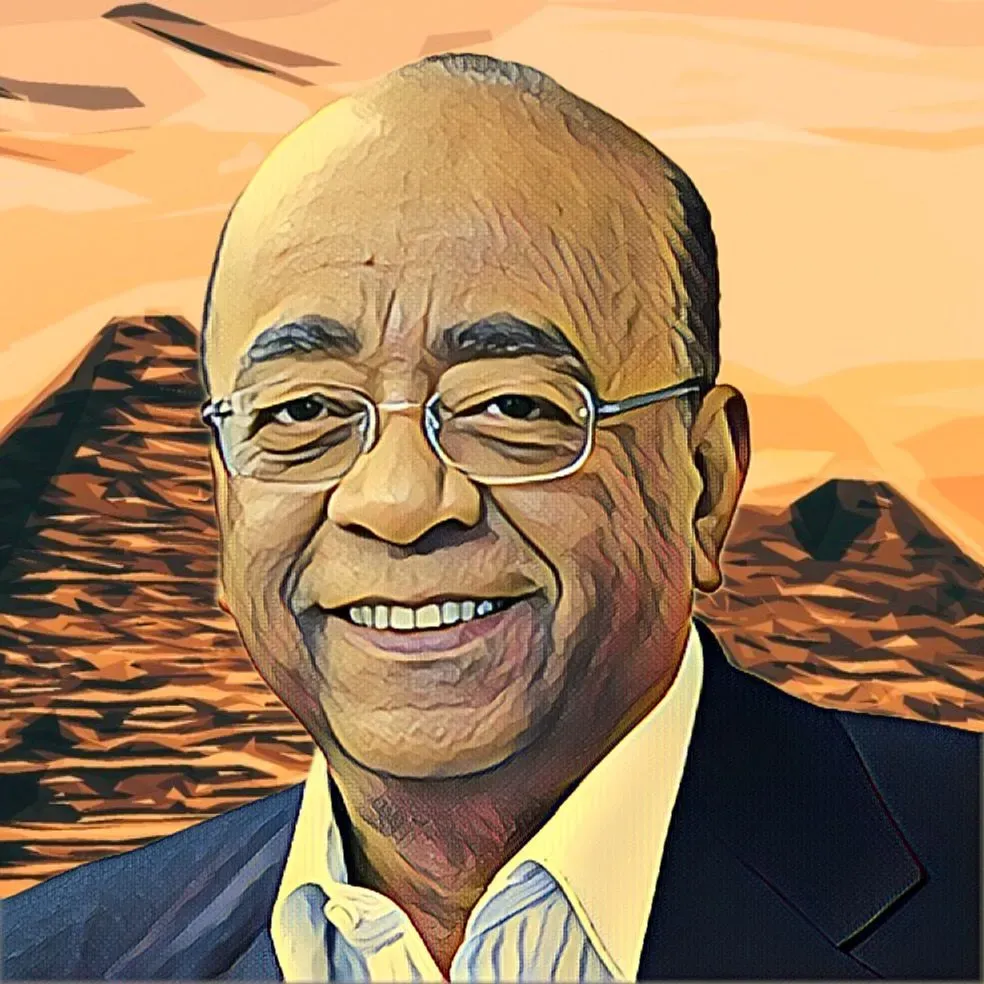

Sudanese-British billionaire Mo Ibrahim says African leaders are copying the rise of strongmen elsewhere in the world, as his foundation’s latest governance index showed security, rights and political participation sliding across the continent over the past decade.
The 2026 Ibrahim Index of African Governance, released on Saturday, Oct. 31, at an event at the American University in Cairo, found that overall governance in 23 African countries was worse in 2025 than in 2016. Thirty countries improved and one was unchanged. The countries that slipped are home to just over half of Africa’s population.
“It is a strange era,” Ibrahim, 80, said in an interview, adding that “we can see this phenomenon of the rise of strongmen everywhere.” He went on: “If you’re an African leader and you see all those strong people rising everywhere, you say, why not me too?”
He pointed to recent elections in Tanzania, where security forces were accused of killing thousands of protesters, and in Uganda, where opposition leader Bobi Wine was hunted and attacked. “It’s just disgraceful,” he said. Leaders, he said, believe “I can get away with it.”
Gains in the economy, losses in rights
The index, which covers all 54 African countries and draws on 319 variables from 59 data sets, gave the continent an average overall governance score of 50.1 out of 100 in 2025, up 0.8 points from 49.3 in 2016. All of that progress came from two of the index’s four categories.
Foundations for Economic Opportunity, which tracks areas such as infrastructure, public administration and the business environment, rose 3.7 points to 51.1. Human Development, covering health, education and social protection, gained 2.5 points to 53.2. Infrastructure improved in 52 countries, every one except Nigeria and Gambia.
Security and Rule of Law fell 1.7 points to 47.8 and worsened in 34 countries. Participation, Rights and Inclusion dropped 1.0 point to 48.5 and declined in 31 countries. Twenty-five countries managed to grow their economies while security and the rule of law deteriorated.
“The 2026 IIAG results highlight Africa’s resilience in a challenging global environment,” Ibrahim said in a statement. “They also show that many countries manage to achieve economic and human development despite deterioration in security and rule of law. But this is not a sustainable trade-off.”
Seychelles on top, South Africa slipping
Seychelles ranked first with a score of 78.6 and posted the biggest improvement of any country over the decade, gaining 8.3 points. Mauritius was second at 75.0, followed by Cabo Verde, Botswana and South Africa. Namibia, Morocco, Senegal, Ghana and Kenya made up the rest of the top 10.
Morocco entered the top 10 in place of Tunisia, tying Senegal for seventh after a 6.4-point gain over the decade. South Africa held fifth place with a score of 66.6, but the index marked it as a country in “increasing deterioration,” meaning its decline has sped up in recent years.
Burkina Faso suffered the steepest fall, losing 6.9 points. Nigeria, Africa’s most populous country, was next, dropping 5.2 points to 44.2 and ranking 38th. Sudan, Tunisia, Comoros, Mali, Guinea-Bissau, Niger and Guinea followed. Seven of the 10 biggest decliners had at least one coup during the decade.
Aid cuts and a new generation
Ibrahim also criticized the United States for what he called a transactional kind of diplomacy that is weakening the international order and the rule of law. He described the abrupt shutdown of the U.S. Agency for International Development last year as “brutal.”
“Of course, it is a prerogative of US to give aid or not,” he said. “But please give notice.” He said Africa had to face reality. “We need to depend more on ourselves. And we need to work with all partners who are willing to work with Africa, whether it is Europe, whether China or India or whoever.”
He said he takes hope from Africa’s young people. About 60% of Africans are under 25. “They are much better informed, much better educated than the past generation,” he said. “We wasted Africa, our generation, I must admit that. We really wasted some opportunities.”
Ibrahim, born in Sudan and trained as an engineer, made his fortune from Celtel, a mobile phone company he founded in 1998 that grew into one of Africa’s largest operators. He sold it in 2005 to Kuwait’s MTC, now Zain, for $3.4 billion. He is worth about $1.3 billion.
He set up the Mo Ibrahim Foundation in 2006 to track and promote good governance in Africa. The foundation has published the index since 2007 and awards the Ibrahim Prize for Achievement in African Leadership to former heads of state who govern well and leave office when their terms end.
Source: www.billionaires.africa