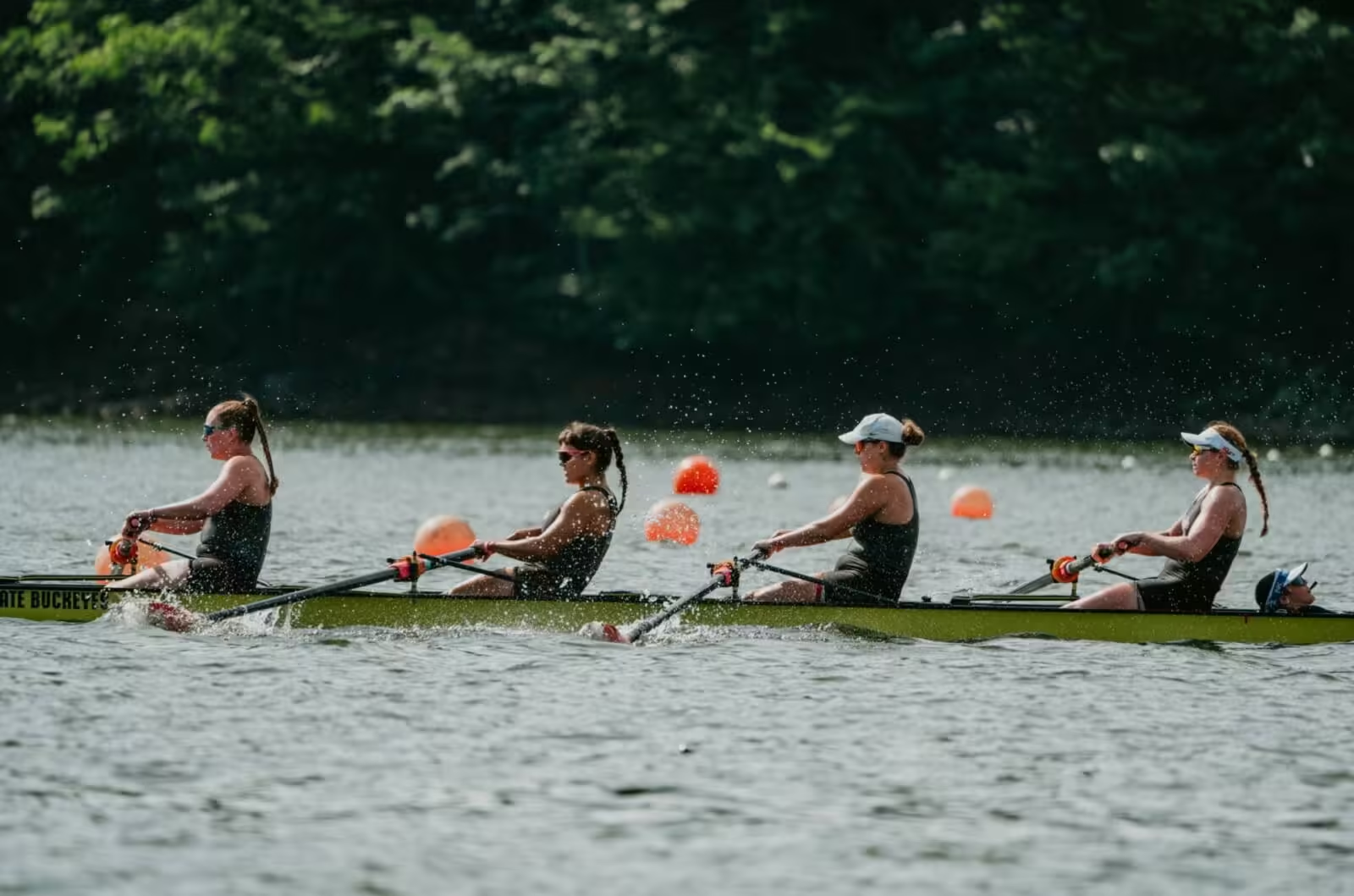

Ohio State women’s rowing team on May 31, 2026 at the NCAA rowing championship. Credit: Courtesy of Ohio State Athletics.
Traditionally, eight rowers sit in the same racing boat, pulling through the same water to accomplish the same goal: moving the boat as fast as possible.
Yet, the athletes powering the boat are anything but identical.
Differences in height, strength and technique can change how each rower transfers force through an oar and into the water. On Ohio State’s rowing team, coaches are using engineering and collecting data to account for those differences.
The Buckeyes use Peach PowerLine, a telemetry system, which tracks each stroke and gives coaches detailed data on how a rower applies force while moving the boat.
With adjustable equipment and individualized performance data, the Buckeyes can measure details once originally left to a coach’s eye or a rower’s feel.
Emilia Fritz, a former Ohio State rower and current assistant coach and data optimization engineer, said collecting those numbers is only the beginning.
“How personalized you could make a rowing boat is something that people probably would overlook,” Fritz said. “The goal is to make the experience super individualized for every athlete.”
The ability to individualize the rowing experience is important to sophomore rower and engineering physics major Katerina Dohnalová, who said rowing introduced her to some of the same principles she now studies in the classroom.
“I was first learning physics through rowing, and now I found out it’s something I am interested in,” Dohnalová said.
Dohnalová began rowing at 11-years-old and recalls coaches telling her that the team had more success when everyone worked together. Years later, she now recognizes the physics behind her former coach’s message.
When rowers apply force in the same direction simultaneously, their efforts combine to move the shell more efficiently through the water, a physics principle Dohnalová said she sees play out with every stroke.
However, that synchronization does not mean every athlete needs the same setup.
“There’s a lot of things you can do when rigging the boat in different ways,” Fritz said. “So if you’re in a seat, you can change. Let it be 20 variables. So once you get into changing that, there’s so many possibilities, and we want to find the best rigging for every athlete.”
“I feel like the details are really important,” Giulia Zaffanella, Ohio State rower and second-year in mechanical engineering said.
Zaffanella said she can feel when the boat is not performing properly, but the data collected can help identify equipment or technique adjustments that could improve performance.
“The more it is personalized, the more you will be efficient,” Zaffanella said.
Fritz said that understanding the process makes feedback from the rowing team just as important as the collected data.
“We always try to use the data in a way we don’t make decisions solely based off the data, because we know that data can be wrong sometimes,” Fritz said.
Dohnalová pointed to the ergometer, an indoor rowing machine used to measure an athlete’s performance, as an example of the limitations of data.
“The ergs don’t float,” Dohnalová said.
While ergometer measures an athlete’s strength and performance on land, they cannot fully replicate the conditions of rowing on water.
Dohnalová said factors such as water resistance, balance and synchronization between teammates affect how efficiently a boat moves, meaning strong individual results do not always translate to a faster boat.
“Rowing is something that for a long time was just something that was seen from the coach or felt from the rowers,” Dohnalová said. “Now, we are learning how to translate it into data on the paper.”
Source: www.thelantern.com