
Two Australians are unaccounted-for after Spain’s deadly rail disaster, with authorities working to confirm their wellbeing.
A statement from the Department of Foreign Affairs and Trade says consular assistance is being provided to the family of two Australians in connection with the collision.
“Our heartfelt condolences are with the families and loved ones of those killed, with those injured and all affected by the train collision in Spain,” a spokesperson said.
The crash in central Spain on Wednesday killed at least 69 people.
The crash has become one of Europe’s deadliest train disasters this century. (AP: Manu Fernandez)
Transport Minister Oscar Puente said the security system on a stretch of track stopped working due to a computer malfunction, causing all trains on that stretch to stop.
Minutes after the order to stop was given, a train from state operator Renfe was told by central command it could run again without speed restrictions, leading it to collide with a train operated by the private Spanish company Iryo.
“The sequence of malfunctions, instructions, and actions eventually led to the collision, in the absence of the necessary mitigating barriers,” according to Reuters, citing a preliminary report by the Independent Authority for the Technical Investigation of Accidents and Incidents (AITAT).
It estimated the Renfe train was travelling at a speed of between 160 and 200km/h when the collision occurred.
AITAT said it would not be able to confirm the exact speed of the train until it extracted information from the train’s black box.
On Thursday, local time, Spanish media reproduced short audio clips of the controller ordering the train engineer to start moving.
Mr Puente said that the train should never have been told to start moving again since a “stop signal” was still active on that line. And if it had, at least it should have been told to go at reduced speed.
The control centre “had more than enough time to verify the error, and they did not fix it” he added.
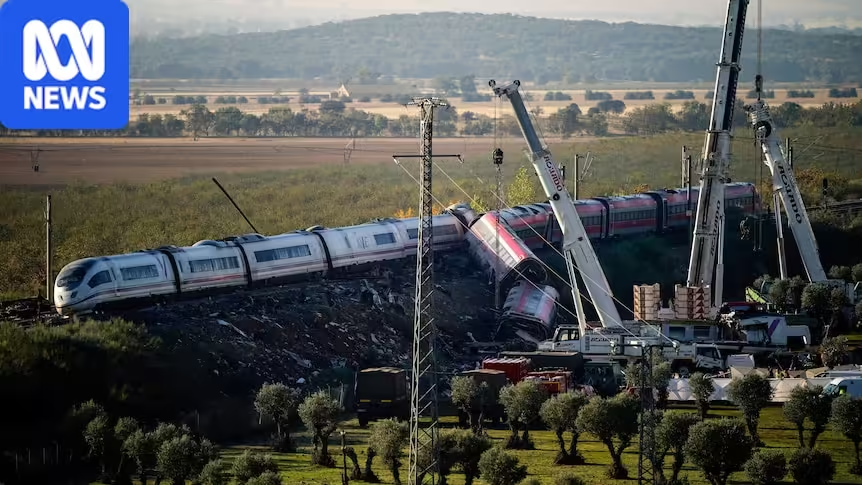
The Renfe train was told it could start running again and then collided with the stationary Iryo train. (ABC News: Ryan Boyle)
There were more than 500 passengers on the two trains, according to a regional governor.
Spain’s Civil Guard said it had received reports of 64 people missing in what was already Spain’s deadliest train accident since 2013, according to reporting by Reuters.
Authorities have carried out 49 autopsies so far and identified five people, three women and two men, Esther Padilla, spokesperson for the Castilla-La Mancha regional government, said on state television network TVE.
“Testing is proceeding slowly, although families will be contacted throughout the day so that they can come and collect their results,” Mr Padilla said.
It’s unclear how many of the missing were among the bodies still to be identified.
The resulting collision has become one of Europe’s deadliest train disasters. Spain has since begun three days of mourning.
Prime Minister Pedro Sanchez, who faces a general election on November 29, pledged to establish the cause of the crash.
“We are working day and night not only to support the victims’ families, but also to establish every last detail of this tragedy and strengthen safety measures to ensure it never happens again,” he said.
The computer system failure saw six trains stopped on just over 60km of track between Madrid and Seville. (AP: Juanma Jiménez/Europa Press)
The crash follows another collision between two high-speed trains in January, which killed 46 people.
In its wake Spain’s government faced heavy criticism over the management of the country’s railways.
The investigation into the January incident is ongoing.
The January crash was the first fatal incident on Spain’s dedicated high-speed rail lines since 1992. According to European Union data, rail fatality rates in Europe have decreased over the last decade.
Between 2022 and 2024, Spain recorded some of the lowest fatalities per million train kilometres in Europe.
Source: www.abc.net.au