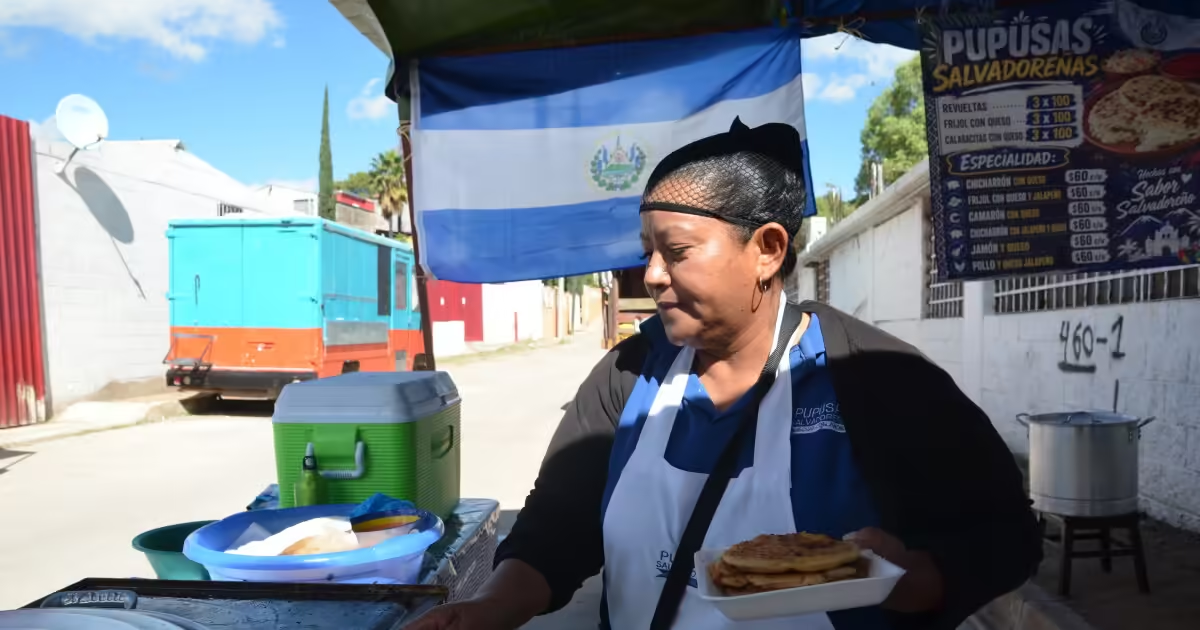

It’s midmorning in the Mexican border city of Nogales, Sonora, and a street lined with stalls for the annual Día de Muertos festival is shaking off sleep. But tucked around a corner, Yessica Minero’s pupusa stall is a hub of activity.
Pupusas — traditional Salvadoran stuffed tortillas — sizzle on the grill as Yessica greets her regulars.
“They’re receiving pupusas very well,” Minero said about Nogales, a city of carne asada, flour tortillas and tacos. As we talk, an ambulance driver leans out his window to ask her to save one for him.
A year ago, Minero and her husband were running out of hope. The cook says they fled El Salvador after gang members threatened her. The couple had arrived at the border in January 2025 for an appointment to seek asylum in the United States. It was a harrowing journey on foot through Mexico. At one point, they were kidnapped.
Minero and her husband ended up being a little over an hour late. Their appointment would have been one of the last before President Donald Trump shut down the process on his first day in office, effectively cancelling tens of thousands of asylum appointments at the border — including the one that had been rescheduled for Minero and her husband.
U.S. courts have been working through cases over the legality of Trump’s decision to end asylum appointments. That’s led to limbo at the border, where some denied entry almost two years ago remain.
In that time, some asylum seekers have given up their claims and moved to other parts of the country to find work. Others, like Minero, are digging in and building a life in border communities.
“To be away from your family, your country, it’s really hard,” Minero said. “But the work distracts us. It’s like therapy.”
Minero has permits from the city to operate her pupusa stand. She and her husband are still in the process of trying to get legal refugee status in Mexico. They’ve been waiting for more than a year.
Asylum petitions in Mexico are supposed to be decided within less than two months, according to the country’s refugee laws. But lawyers say these cases have been taking much longer to resolve.
‘Implicit deportation’
In Nogales, lawyer Rafael Cheé counsels migrants at the Kino Border Initiative shelter. Many of his clients recently got permission to work, but their cases to gain permanent residency in Mexico are still processing — some more than a year after being filed. Some of his clients have decided to give up on the process completely and leave Mexico.
“Organizations are defining a new concept they call ‘implicit deportation,’ because the authorities are effectively achieving deportation, even though they aren’t explicitly seizing or detaining individuals and sending them back to their home countries,” Cheé said. “Instead, due to the various barriers these individuals encounter, they ultimately decide that leaving is their best option.”

Across the border in the United States, legal challenges to Trump’s asylum ban continue. An appeals court in Washington, D.C., decided earlier this year to block the ban, saying people have the right to seek asylum at the border.
But as that suit and others shake out in the U.S. justice system, asylum seekers are “feeling stranded,” said Peter Habib, a lawyer with the Center for Gender and Refugee Studies, which is challenging Trump’s decision to shut down asylum access in another lawsuit.
“It’s a complete betrayal,” Habib said. “Folks have a right to seek asylum in the United States, and this policy of blanket preventing them from accessing it whatsoever doesn’t comport with the statute.”
Dimming hopes
For some asylum seekers, hope is wearing thin and options feel fewer and fewer with each passing day.
Diego is one of the migrants in Nogales who has been feeling stranded. He came from Ecuador to seek asylum in the United States almost two years ago, and now spends most days at the Kino Border Initiative migrant shelter. He has relied on this shelter, just steps from the U.S.-Mexico border, since his appointment to seek asylum in the United States was cancelled when Trump took office.
“Days and months pass, then a year, in the same situation and you start to think, ‘What am I doing here?’” Diego said.

Diego, a civil engineer in his 60s, fled Ecuador after he says gang members assaulted him in his home after demanding money. KJZZ is only using his first name to protect his safety.
Just a few months ago, Diego finally got a card from the Mexican government allowing him to work in Mexico while they process his application for refugee status. He’d been waiting for the work permit for over a year.
But even with the temporary work permit, he keeps getting turned down from jobs. He doesn’t know if it’s his age or that he’s a foreigner, or something else entirely.
“I don’t see progress, so I feel really depressed,” Diego said.
He still has to pay rent, and his sister in Arizona is no longer able to help financially.
He’s been alone at the border and separated from his teenage son, who lives in the United States. He misses his dog, Blacky, who he sent by plane to his sister in Arizona before he made the journey to Mexico.
He’s thinking seriously about going back to Ecuador.
“If I die, I die,” he said. “But what can I do? To die here, like this, as time passes by without any money, that’s not a life.”
-
At least eight Iranians were loaded onto a plane Sunday morning in Mesa, Arizona, for a deportation flight headed to the country of Georgia, then on to Pakistan, according to Ali Rahnama, an attorney with the Iranian American Legal Defense Fund who filed emergency motions on behalf of some of the Iranian detainees. The flight was canceled without explanation, he said.
-
The 2026 Midterm Election Voter Poll surveyed more than 10,000 Asian American, Black, Latino, Native American and white voters between Oct. 19 — when early voting began — and Election Day — including in 50 of the most competitive House districts.
-
ICE and other armed federal personnel are not legally allowed to be at polling sites. But for months, rights groups worried a federal deployment might still happen — especially after Homeland Security Secretary Markwayne Mullin said ICE agents may go to polls for specific threats.
-
Lawyers for the state are telling a federal judge it’s none of the business of the Trump administration who gets reduced tuition at Arizona’s public universities.
-
The Trump administration has deported thousands of immigrants to countries other than their own under a process known as third country removals. For one woman, that process from arrest to deportation took less than a week.
Source: www.kjzz.org