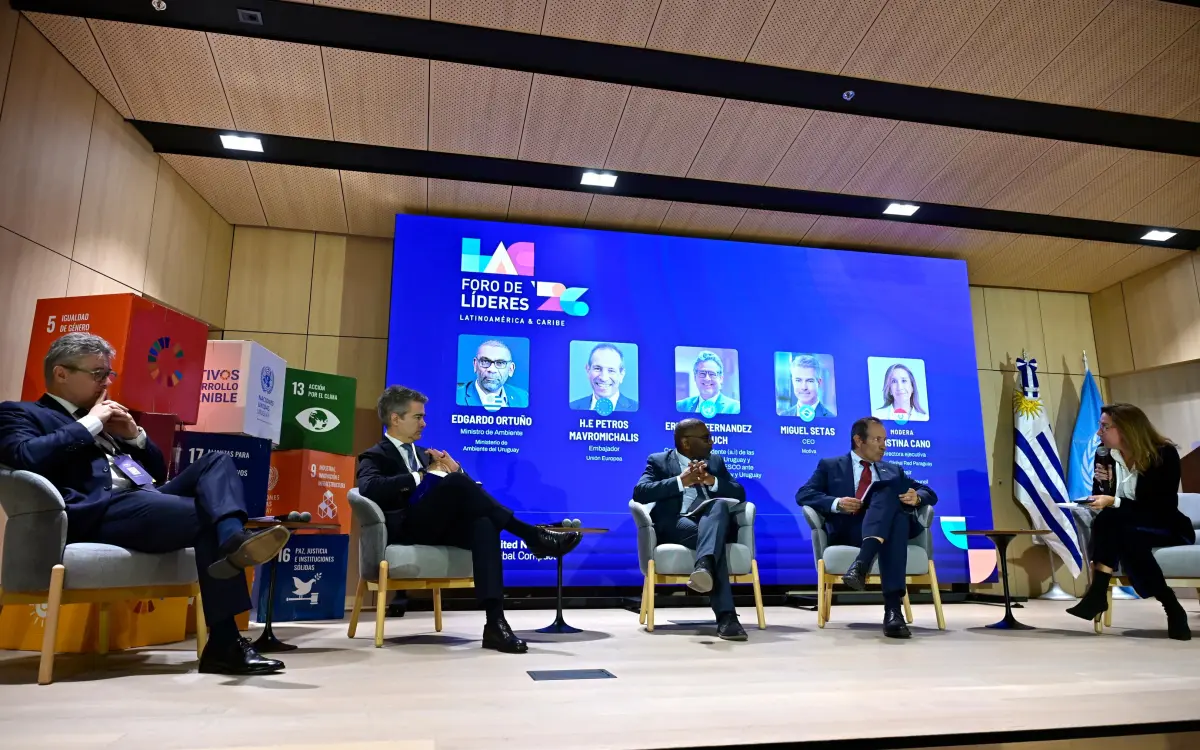

The sustainability as an engine of economic growth, investment opportunities linked to the energy transitionthe development of new business and the need to strengthen international cooperation were some of the main topics addressed during the Forum of Global Compact Leaders of Latin America and the Caribbeanheld in Uruguay. The meeting brought together representatives of the public sector, international organizations and companies to analyze the environmental challenges of the region and move towards concrete solutions that allow combining economic profitability with sustainable development.
Among the participants were the minister of Environment, Edgardo Ortuño; the ambassador of the European Union in Uruguay, Petros Mavromichalis; the CEO of Motivates Brazil, Miguel Setas; and the resident coordinator of United Nations in Uruguay, Ernesto Fernandezamong others, who presented their perspectives on the opportunities and challenges facing Latin America and the Caribbean.
Ortuño highlighted that the sustainable development represents an opportunity to boost economic growth, generate new value chains and promote investments that contribute to facing environmental challenges.
“There are enormous economic opportunities for growth, progress towards development, development of new consumption patterns and also new production patterns in the commitment to sustainable development,” he stated. In his opinion, this process opens spaces to develop sustainable businesses that contribute both to business profitability and to environmental protection.
Ortuño warned about the dimension of the triple environmental crisis that the planet is going through, characterized by the loss of biodiversity, pollution and climate change. In this context, he stressed that it is essential to strengthen international cooperation and promote the participation of the private sector in the search for solutions.
He pointed out that the international markets They increasingly demand information about the “environmental traceability” of products and the “natural conditions” in which economic activities are carried out.
Edgardo Ortuño. Photo: Leonardo Mainé.
As an example, he mentioned the transformation of the Uruguayan energy matrixwhich made it possible to mobilize more than US$7 billion in investments over a decade, destined for the development of sources such as wind, solar and biomass energy. As indicated, Uruguay reached levels close to 99% of electricity supply through renewable sources, which represents a platform to promote a second energy transition.
Among the opportunities of this new stage he identified the expansion of electric mobility, the development of charging infrastructure and innovation linked to recycling and reuse of batteries.
He also highlighted the economic potential of waste management and the circular economy. In particular, he mentioned the work carried out by the Ministry of Environment with business chambers, commerce and supermarkets to recover packaging and transform them into raw materials for new industrial processes.
“These are concrete examples where a public policy orientation can, if done in an articulated manner, give rise to private ventures that contribute to the environment, but that have a concrete economic result, profitability,” he said.
For his part, Mavromichalis focused on the commercial and cooperation opportunities offered by the agreement between the Mercosur and the European Unionespecially for Latin American companies interested in accessing the European market, made up of approximately 450 million consumers.
The diplomat pointed out that the commercial part of the interim agreement has already entered into force, although different levels of ratification are still pending. Among them he mentioned the approval of the European Parliamentwhich he hopes will be finalized during the next year, and the procedures corresponding to the global agreement.
Beyond the strictly commercial aspects, Mavromichalis highlighted that the understanding contemplates possibilities of cooperation in areas related to the environment, sustainability and labor rights.

Petros Mavromichalis. Photo: Leonardo Mainé.
In relation to the first results, the ambassador pointed out that during the first six months of the agreement the Uruguayan exports toward Europa increased 12%, while European exports towards Uruguay they grew 6%.
“The first steps have been taken to take advantage of the opportunities offered by the agreement,” he stated.
In any case, he considered it necessary to deepen the dissemination of the benefits of understanding, particularly among companies and the different economic actors, to facilitate the use of new commercial possibilities.
Meanwhile, Setas proposed that sustainability must be part of the economic strategy of companies and demonstrate concrete financial results to obtain the support of the investors.
In this context, he mentioned that Motiva manages about 5,000 kilometers of highways in Brazilin addition to railway operations and land transportation, and has a stock market valuation close to US$5 billion.
Setas pointed out that the company incorporated objectives linked to decarbonization, the transition to clean energy and social development, and maintained that “investors want to have evidence that sustainability means development and value creation.”
Additionally, he mentioned an example of how sustainable investments can generate new sources of income. He argued that Motivates takes advantage of the electrical capacity available at night in its facilities to offer charging services to electric buses Saint Paul.
The businessman also highlighted the importance of strengthening alliances between companies and public organizations. As an example, he mentioned a coalition for the decarbonization of the land transport in Brazilmade up of more than a hundred companies and entities.

Fernández, Setas, Ortuño and Mavromichalis. Photo: Leonardo Mainé.
Fernández, meanwhile, warned about the difficulties that international cooperation currently faces due to the reduction of resources allocated to development.
As indicated, official development assistance decreased 23% between 2024 and 2025, in a context of questions about multilateralism and greater financial constraints.
Faced with this scenario, he maintained that it is necessary to modify the traditional cooperation approach and move towards mechanisms capable of mobilizing private investments for development projects. sustainable development.
In that sense, he explained that United Nations seeks to play a catalyzing role in investments, promoting mechanisms through which initial cooperation resources allow private capital to be attracted to economically viable projects.
As an example, he mentioned the Renewable Energy Innovation Fund (REIF) of Uruguay, which uses resources from a United Nations fund to mobilize business financing.
Finally, the director of Corporate Affairs of Salus, Laura Kostachishighlighted the importance of incorporating sustainability as part of the business strategy and establishing mechanisms that allow measuring environmental progress. In that sense, he recalled that in 2020 Salus became the first mass consumption company in Uruguay in obtaining B Company certification, while in 2024 it presented its first impact report and is currently launching the second. As he explained, these tools make it possible to identify opportunities for improvement, establish specific objectives and communicate the company’s results with greater transparency.

Laura Kotsachis. Photo: Nahuel Amón.
Kostachis maintained that one of the main changes was to integrate environmental criteria into business decisions, through a work team that involves different areas of the company. “The sustainability It is transversal in the company and it is a strategy,” he stated. Currently, he explained, aspects such as the carbon footprint and the materials used are considered when evaluating new projects and packaging.
On the other hand, he highlighted the conservation and environmental education work carried out by Salus in its nature reserve, where there are more than 1,000 species, of which 55 are priorities for conservation.
The event also featured a panel made up of Gabriel Cimaspresident of Global Compact Uruguay Network; Ana Paula Carracedopresident of Red Brazil Global Compact; Patricia Malantipresident of Gloabl Pact Red Argentina y Fernando Navapresident of Global Compact Mexico Networkwhere they discussed and debated the commitment of sustainability in the companiesnew practices related to the field and communicating its value inside and outside companies to obtain better results as a whole.
Impact of AI on sustainability and employment
The artificial intelligence and its impact on sustainability, business efficiency and the future of the employment were other topics addressed during the Global Compact Leaders Forum of Latin America and the Caribbean. The Director of Corporate Affairs and Sustainability of LATAM Airlines, Juan Tohahighlighted that artificial intelligence makes it possible to improve the operational efficiency of airlines, reduce costs and advance environmental objectives. In that sense, he maintained that technology constitutes a tool to strengthen the company’s activities and expand accessibility to air transportation.
“Behind aviation there is an activity that enables essential rights of people,” he stated, noting that connectivity facilitates access to transportation services. health, education and economic opportunities.
The executive explained that LATAM uses artificial intelligence to optimize aircraft loading, fuel consumption and navigation parameters, with the aim of reducing emissions. He also mentioned its application in environmental management, where it allows identifying possible non-compliance among the approximately 19,000 standards that the company must observe.
In terms of circular economy, he highlighted that technology allows the amount of food transported to be adjusted according to the consumption patterns of passengers, reducing waste. The airline, he added, aims to reduce waste sent to landfills by 75% by the end of 2027.
For his part, the vice-rector of the Catholic University of Uruguay (UCU), Gustavo Monzónwarned that the expansion of artificial intelligence poses challenges that transcend technological innovation and force us to review educational models, human capabilities and the social consequences of its adoption.
“The artificial intelligence “It is here to stay, we are not going to go back,” he stated. However, he considered that the main challenge is to develop critical thinking skills to evaluate the results generated by these tools.
In this scenario, he raised the need to train leaders capable of facing technological changes and protecting the most affected sectors. He even considered that this transformation could lead to reconsidering the institutions that support social well-being.
“Maybe we will have to rethink the welfare state and the institutions that gave prosperity policy y economic”, he concluded.
Source: www.elpais.com.uy