

AI Stock Falls Despite Business Growth, Is It Just a Price Adjustment? Actions linked to artificial intelligence have been going through several weeks of fallsamid growing doubts about the pace of investment in data centers and the future profitability of the sector. This Monday, November 9, a good part of the big technology companies began to recover ground, with Amazon, Alphabet, Microsoft and Meta recording progress to the 12:30 cutoff in New York. Nvidia, on the other hand, remained lowerwhile its board investigated reports about a possible espionage attempt directed against its CEOJensen Huang. This recovery contrasts with the stock market punishment of recent weeks, which has reduced the valuations of several companies whose businesses continue to show significant growth.
Expected Earnings Rise as Valuations Fall
That difference between the behavior of stocks and the evolution of their businesses is best understood by reviewing how much the market is paying for future earnings. According to LSEG data as of October 31, the expected earnings per share for the next twelve months of Alphabet, Amazon, Meta and Microsoft passed, on average, from US$16.5 to US$20.2 during the last yearwhile his forward price/earnings multiple fell from 27 to 21 times. This means that although earnings expectations continue to improve, investors are willing to pay less for each dollar of expected benefitwhich helps explain part of the stock market correction.
Moving from the average to individual ratings, Amazon and Microsoft appear at the top of the comparison, with multiples of 24.7 and 22.5 timesrespectively. Alphabet and Meta are located somewhat lower, at 18.9 and 18.0 timeswhile Nvidia and Oracle present the lowest valuations of the group, 11.2 and 10.8 times. However, a lower valuation does not necessarily mean that a stock is cheap, since the growth expectations and risks of each business also influence. To better understand these differences, it is important to review how their results are evolving and how much they are investing to sustain them.
The growth of technology requires greater investments
The expansion of cloud services and the growing demand for infrastructure for artificial intelligence continue to be reflected in the results of large technology companies. Alphabet increased its operating profit by 30% year-on-yearwhile Microsoft registered an advance of 21% and Amazon of about 61%. This growth is also observed in Nvidia, whose revenue increased by 106% in its latest published quarter, driven primarily by demand for data center chips. Meta, for its part, managed to increase its sales by 26%although his operating profit fell 37%affected by an extraordinary legal charge. Beyond these differences, the results show businesses that continue to expand, but they also raise an important question about how much money these companies need to invest to maintain that growth and how much of their profits ends up being converted into available cash.
To sustain this expansion, large technology companies are allocating more and more resources to the construction of data centers, the purchase of chips and the development of infrastructure. Only between July and September, Amazon, Alphabet, Microsoft and Meta together allocated nearly US$202 billion to purchases of fixed assets in cash, more than double that in the same period of the previous year. During that quarter, the four companies generated approximately US$175.5 billion in operating cash flowhence His investments exceeded the cash produced by his businesses. Although not all of this spending corresponds directly to artificial intelligence, the difference helps understand why the market is paying more attention to how much money is available after financing its growth.
Cash flow and artificial intelligence: the challenge of recovering investment
This greater investment effort is clearly observed in Alphabet, which during the third quarter generated $42.3 billion in operating cash flow, but spent $51.4 billion on capital investmentsleaving a negative free cash flow close to US$9.1 billion. Although during the period it made a payment of US$5.2 billion for a European fine, even without that disbursement the free flow would have been negative. Although the company maintains positive cash generation when considering the last twelve months, the quarterly result shows how new investments can absorb more cash than is produced by a business that remains profitable.
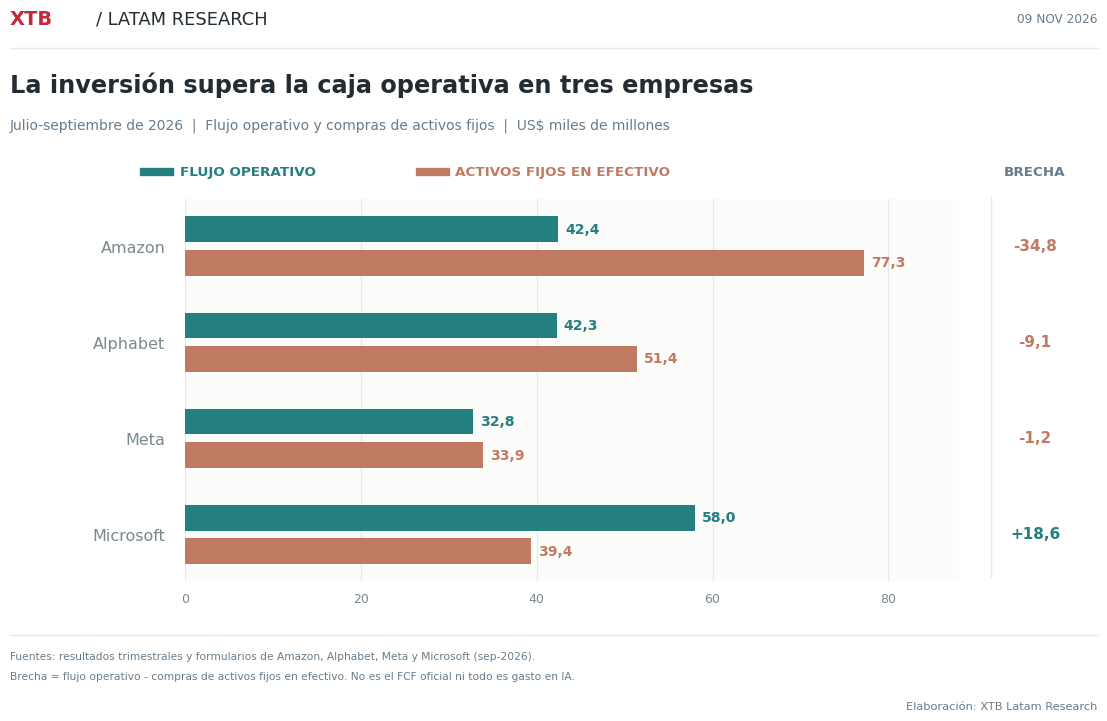
Investments in infrastructure for artificial intelligence require large disbursements in the presentwhile a good part of the expected returns depends on how demand evolves over the next few years. The immediate impact on cash is not the same between companies, since Microsoft still generates more operating cash than it spends on fixed assetswhile Amazon, Alphabet and Meta recorded the opposite scenario during the last quarter. This does not mean that they have stopped being profitable, but rather that they are committing an important part of their resources to sustain growth whose return is still uncertain. In this context, the stock market correction could reflect something more than an adjustment of multiples, with a market that begins to demand greater evidence that current investments will ultimately be justified with income and cash generation in the coming years.
“This report is provided for general information and educational purposes only. Any opinion, analysis, price or other content does not constitute investment advice or recommendation under Belize law. Past performance is not necessarily indicative of future results, and any person acting on this information does so at his or her own risk. products with leverage and carry a high level of risk. Make sure you understand the associated risks.”
Source: www.xtb.com