
Amna Nawaz:
Well, Tuesday’s election results weren’t just closely watched here at home. American elections in many ways become global events. And this Democratic wave has led to an extraordinary outpouring.
Nick Schifrin gauges that reaction, beginning with Iran.
Nick Schifrin:
On the darkened streets of Iran overnight, the regime put President Donald Trump in jail. This fake lockup followed Democrats locking down Election Day victories. Iranian leaders resisted a preelection agreement and believe they helped hand President Trump electoral defeat.
Iran’s chief negotiator relished the rebuke and said it should end the war. But Iran’s supreme leader, warned divided American government will not lead to American concessions, a sentiment echoed on the streets of Tehran.
Ali Akbar Mashayekhi, Iranian Demonstrator (through interpreter):
It’s always the same cycle, negotiations, then war, then back to negotiations, then war again. We’re not afraid of war. If they want to fight, we will fight back.
Nick Schifrin:
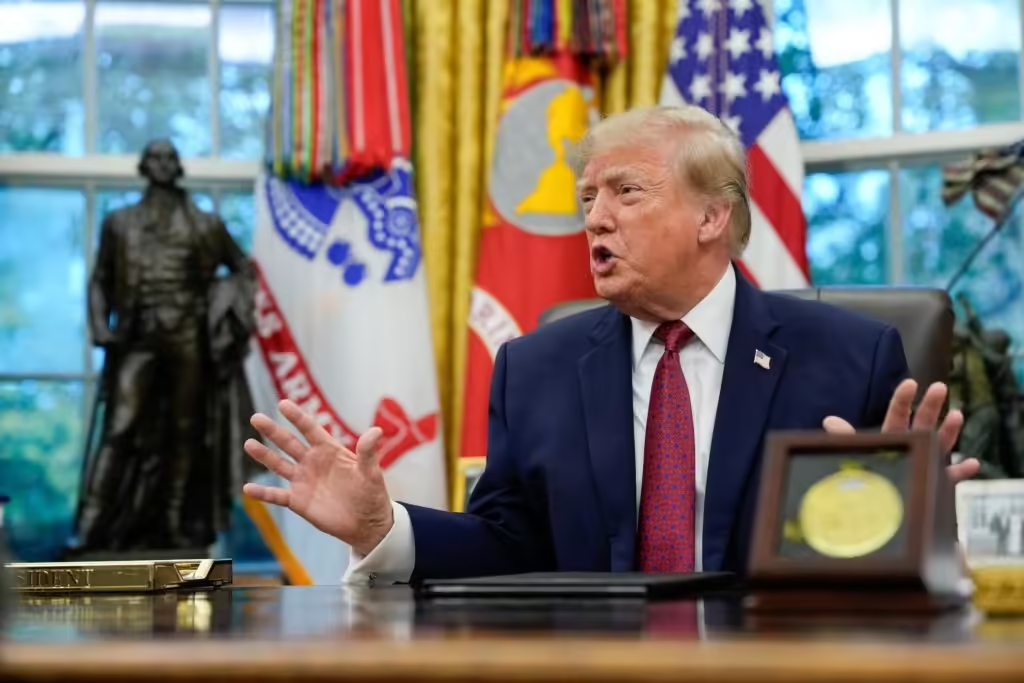
Trump agreed with his vice president that the war in Iran, now entering its ninth month, triggered a blue tsunami.
President Donald Trump:
It’s largely true because it drove the gasoline up a little bit short term.
Nick Schifrin:
But the war has only brought Iran closer to its allies, including Russia. Today, Russian President Vladimir Putin welcomed Iran’s National Security Council Chief Mohsen Rezaei. Iranian weapon designs have helped Russia target Ukraine.
And so it was again today when Russian drones and missiles hit Kyiv. Ukrainian officials tell “PBS News Hour” they are skeptical the new Congress can shift U.S. policy. But some European leaders hope a new Democratic Congress can make a difference.
Kaja Kallas, High Representative for Foreign Affairs, European Commission:
I hope that the new Congress and the new Senate will continue supporting Ukraine and also putting more pressure on Russia.
Man:
Today, democracy won in America.
Nick Schifrin:
Across Europe, some officials publicly breathe a sigh of relief and described Democrats as kindred spirits. And in the Global South, some leaders said the midterms could result in a reset.
Cyril Ramaphosa, South African President:
I do think that this is going to introduce a new era in world relations, really.
Nick Schifrin:
But one country’s current leaders do not welcome that new era.
President Donald Trump:
We have already agreed that, by the end of this year, we won’t be paying Israel.
Nick Schifrin:
On FOX News earlier this week, President Trump announced the U.S. would stop giving Israel grants to buy American jets and weapons. Israel will now have to use its own money.
Abdul El-Sayed, Michigan Senator-Elect:
I think the fact that we’re fighting the war in Iran is a function of what the prime minister of Israel wanted.
Nick Schifrin:
And this election produced what may prove the most hostile U.S. Congress to Israel in history. Democrats now face a choice, whether to go further and try to block weapons sales to Israel and whether to end funding for the war in Iran.
Amna Nawaz:
And Nick is here with me now.
Nick, let’s begin with that war in Iran. Where are negotiations to end it?
Nick Schifrin:
A senior regional and senior American official both tell me that, before the elections, the two sides were close to a deal that would have returned them to the memorandum of understanding earlier this year. One official, in fact, Amna, told me it was 80 percent there.
And that deal would have included an agreement for Iran to downblend its highly enriched uranium. Now, before the June 2025 strikes, the U.N.’s nuclear agency reported Iran had nearly 1,000 pounds of 60 percent enriched uranium, a small step away from weapons-grade. Iran’s agreeing to downblend its stockpile would be a significant concession on their part.
It would also mean the U.S. would accept some Iranian-enriched uranium, at least for now, Amna. The agreement would also include the U.S. is lifting sanctions and unfreezing some Iranian assets, and it would have reopened the strait without any kind of tolls, according to these officials.
Now, Vice President Vance during this time even wrote a letter to the man we just showed was in Moscow today, the head of Iran’s supreme National Security Council, Mohsen Rezaei. Now, simultaneously is all that, Amna, a senior U.S. official told me President Trump told regional allies that the U.S. would start bombing Iran again with a short, intense campaign.
And then he said, well, that campaign was postponed, but he has not said that was canceled. And, today, the president said this still could come soon. Today, in the Oval Office, the president said — quote — “And now we will make a decision. Do we want to go further and certify it? By certifying it, meaning it will never happen again. I think it will take 25 years to rebuild the country.”
He concluded, “I would rather not destroy the rest of the country if possible, but maybe I will have to. You will know soon enough.”
Amna Nawaz:
So the big question is how, if at all, do these midterm election results play into all of this?
Nick Schifrin:
So, interestingly, regional officials tell me that they are worried that actually it will take Iran’s calculus and change it. The regime has used rallies this week to celebrate the Democrats’ win. And regional and U.S. officials tell me Iran has been gloating in private and public it didn’t give the president the deal he wanted, and therefore helped deliver that Republican defeat.
And these regional officials fear Iran will now drive a harder bargain now that it feels like it in some ways won the midterm elections. Now, on the U.S. side, we saw this extraordinary post on X by Vice President Vance, right?
He listed the war and the U.S. relationship with Israel as among the top reasons pollsters believe the Republicans lost the election. He went on to say — quote — “The reason we lost is the war” — unquote.
U.S. officials tell me he and Steve Witkoff are pushing for a deal to be done by President — between President Trump and Iran, whereas, on the other side, some military and civilian defense officials alongside Israeli Prime Minister Benjamin Netanyahu are pushing to resume this intense campaign.
The third option the president has, Amna, do nothing, as in keep this economic pressure going, and see how far that can get.
Amna Nawaz:
We will see which option he chooses.
Nick Schifrin, thank you very much.
Nick Schifrin:
Thank you.
Source: www.pbs.org