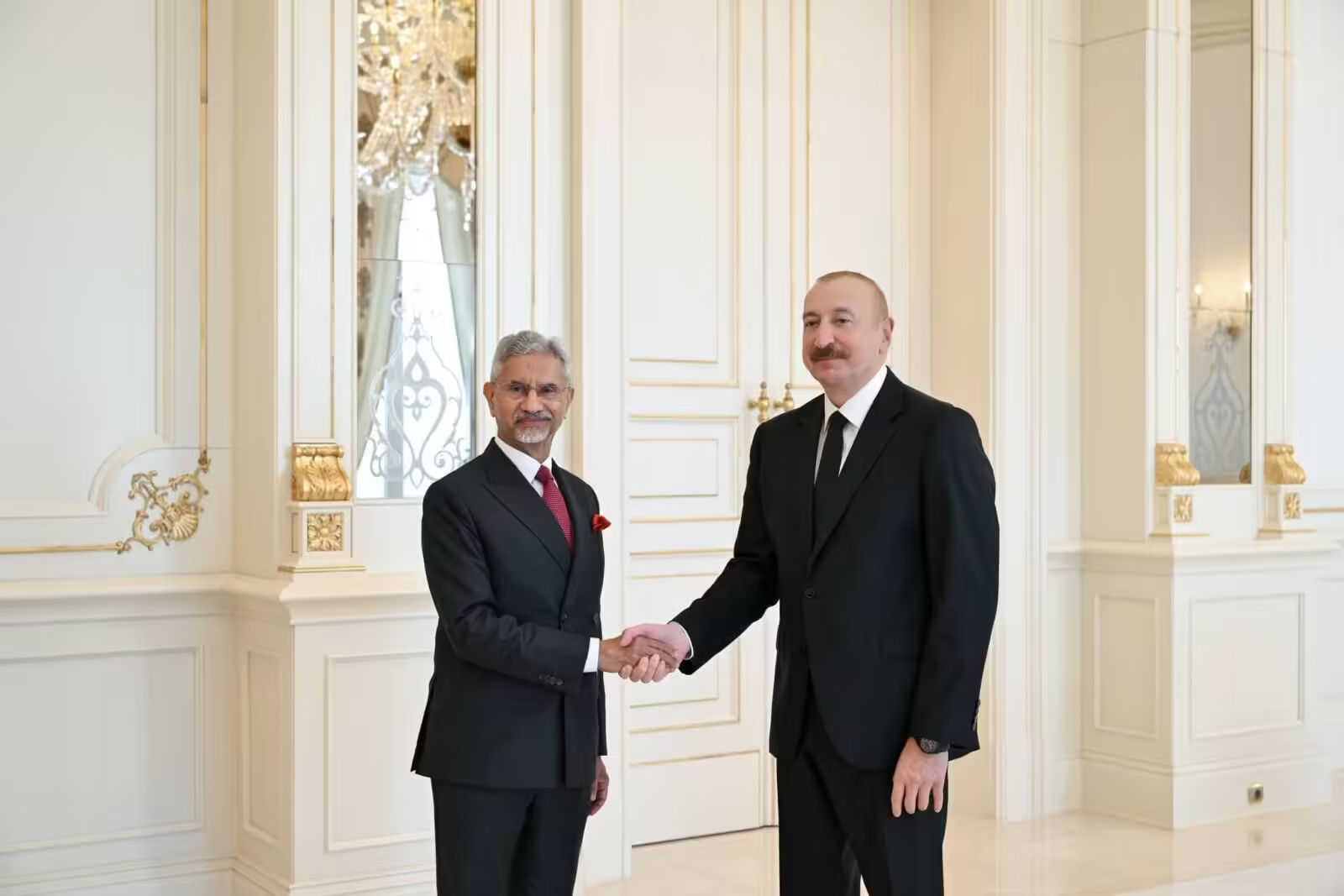

Image Source: Getty Images
India-Azerbaijan relations appear poised for cautious re-engagement after a period of open friction. Connectivity and trade underpin the shift, even as both countries navigate changing dynamics in the South Caucasus and mounting tensions among major powers that have weighed heavily on the Global South.
Building on the 1 September meeting between Prime Minister Narendra Modi and President Ilham Aliyev on the sidelines of the Shanghai Cooperation Organisation (SCO) Summit in Bishkek, Kyrgyzstan, External Affairs Minister (EAM) Dr Subrahmanyam Jaishankar visited Azerbaijan on 23 October, his first trip to the country in eight years. Underscoring continued efforts to strengthen bilateral ties, Jaishankar held high-level talks in Baku with Aliyev and Foreign Minister Jeyhun Bayramov. Both sides reaffirmed their shared interest in deepening ties and expanding cooperation in trade, energy, connectivity, and tourism, and discussed key regional and global developments. This bilateral reset unfolds against the backdrop of the Armenia-Azerbaijan peace agreement, which India welcomed, and Yerevan’s decision to establish diplomatic relations with Pakistan.
The Foundations of the Relationship
The relationship is rooted in a long history of cultural and economic exchange dating back to the ancient Silk Route. This shared heritage is vividly reflected in Baku’s 18th-century Ateshgah fire temple, where Devanagari and Gurmukhi inscriptions bear witness to longstanding trade connections. Jaishankar’s visit to the temple further highlighted the enduring importance of these historical ties.
India was among the first countries to recognise Azerbaijan in December 1991, following the dissolution of the Soviet Union, and the two nations formalised their economic partnership in 1998 with an agreement on economic and technical cooperation. Bilateral trade grew substantially, rising from US$50 million in 2005 to US$1.882 billion in 2022. At US$1.435 billion in 2023India was Azerbaijan’s seventh-largest trading partner. Although trade declined to US$966 million in 2024 and US$401 million in 2025, renewed diplomatic engagement is helping to restore momentum, with bilateral trade reaching US$600 million in the first nine months of 2026.
More than 2,000 Indian companies operate in Azerbaijan, providing a strong foundation for expanding commercial cooperation and deepening this longstanding partnership. ONGC Videsh Limited (OVL), for instance, has strengthened its energy presence in the country, investing more than US$1.2 billion in the Azeri-Chirag-Gunashli (ACG) oil and gas fields and the Baku-Tbilisi-Ceyhan (BTC) pipeline. This commitment continued in 2024, when a US$60 million investment raised OVL’s stake to 2.925 percent in ACG and 3.097 percent in the BTC pipeline. During Jaishankar’s visit, both sides agreed to deepen cooperation in the oil and energy sector and extend it to other high-potential areas, such as tourism, trade, and investment.
Connectivity as the Bridge
The International North-South Transport Corridor (INSTC), ratified by 13 countries, links the South Caucasus, Russia, and Central Asia with the Arabian Sea. India and Azerbaijan share a strong interest in the corridor, which can play a vital role in strengthening regional connectivity and expanding trade. Both countries participate in the INSTC’s western route, which connects India’s Jawaharlal Nehru Port to Iran’s Bandar Abbas and Chabahar ports, then runs to Azerbaijan along the western coast of the Caspian Sea, and finally on to Russia and Europe. Spanning approximately 5,100 kilometres, this route could cut transit times by around 40 percent and transportation costs by about 30 percent, offering meaningful benefits to regional commerce and cooperation. With land acquisition largely complete and surveying and initial stabilisation work underway, the 164-kilometer Rasht-Astara railway line is expected to be completed within the next three years, reducing transit times and costs along this important route. Iran has also completed the 730-kilometre strategic Chabahar-Zahedan railway linewhich is expected to facilitate India’s access to Central Asia, Afghanistan, and eastern Russia.
Azerbaijan’s role in facilitating the evacuation of Indian nationalsincluding students, from Iran during the West Asia conflict earlier this year further reflects the depth of the partnership.
Azerbaijan is also emerging as a pivotal link between the East-West and North-South corridors, at the point where the Middle Corridor intersects the INSTC’s western route. This strategic position offers India an opportunity to secure more reliable and resilient access to European markets, reinforcing India’s connectivity as its global economic and geopolitical influence grows. Baku also aligns closely with New Delhi’s Eurasian ambitions and its Connect Central Asia policy. Azerbaijan’s formal participation in the Central Asian consultative framework in Tashkent in November 2025 widened the C5 grouping of Kazakhstan, Kyrgyzstan, Tajikistan, Turkmenistan, and Uzbekistan into a C6, creating new scope for regional cooperation.
During Jaishankar’s visit, the two sides discussed increasing weekly flights from 14 to 42. Air India and Azerbaijan Airlines have also established a codeshare partnership. Azerbaijan’s role in facilitating the evacuation of Indian nationalsincluding students, from Iran during the West Asia conflict earlier this year further reflects the depth of the partnership.
Divergences to Manage
India and Azerbaijan must still navigate each other’s ties with third countries, from Baku’s support for Pakistan to New Delhi’s defence cooperation with Armenia. India has welcomed the peace agreement between Baku and Yerevan and hopes it will lay the foundation for lasting stability. The Armenia partnership has gained significance amid Eurasia’s evolving geopolitical landscape, especially since the 2023 Nagorno-Karabakh conflict, though it has also drawn concern in Baku. India’s defence exports to Armenia were meant to preserve the regional balance of power, not to intensify tensions, and they arguably helped create conditions conducive to the subsequent peace process.
Greater sensitivity from Baku to India’s domestic concerns and security interests would help strengthen bilateral trust. To realise the relationship’s full potential, India and Azerbaijan should treat each other as long-term partners, with ties built on mutual respect and not hostage to their relationships with third countries.
India has maintained a neutral position on the Nagorno-Karabakh conflict, and New Delhi can use its diplomatic influence to support durable peace between Yerevan and Baku. A stable South Caucasus could spur economic growth, underpinned by reliable and resilient connectivity. Azerbaijan, however, has backed Islamabad’s position on Kashmir. Greater sensitivity from Baku to India’s domestic concerns and security interests would help strengthen bilateral trust. To realise the relationship’s full potential, India and Azerbaijan should treat each other as long-term partners, with ties built on mutual respect and not hostage to their relationships with third countries.
The Road Ahead
The renewed momentum in bilateral ties now needs to translate into reliable connectivity, expanded trade, and sustained high-level political engagement. Beyond these, India and Azerbaijan have considerable scope to deepen cooperation in strategic sectors, counterterrorism, and regional security across a contested Eurasia.
In an international environment marked by conflict, both countries can contribute constructively to peace in the South Caucasus and across Eurasia. Doing so will require a more institutionalised relationship and regular consultations, including on the “different viewpoints on different issues” that Bayramov acknowledged at a joint press briefing with Jaishankar.
Ayjaz Wani is a Fellow with the Strategic Studies Programme at the Observer Research Foundation.
The views expressed above belong to the author(s). ORF research and analyses now available on Telegram! Click here to access our curated content — blogs, longforms and interviews.
Source: www.orfonline.org