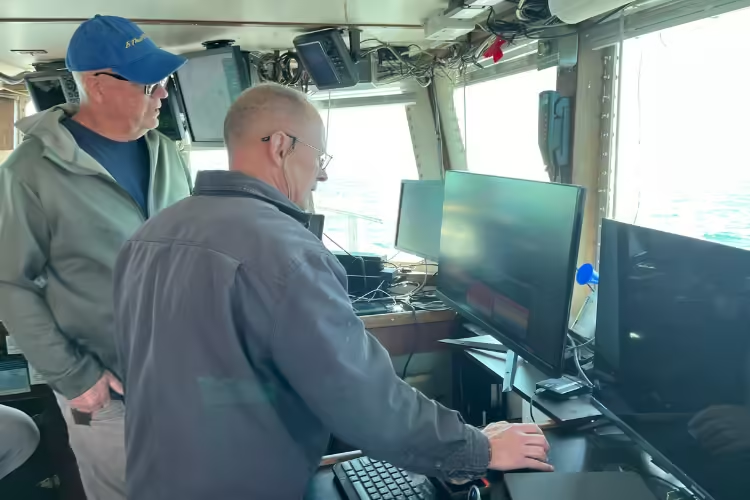

The ocean is a three-dimensional world. Life moves vertically and horizontally through the water, often across large areas and at depths scientists cannot easily observe. Active acoustic technology gives researchers a tool to sample what’s hidden under the surface, gathering information that nets and other sampling gear cannot capture.
The use of sound to study the ocean is not new. After the Titanic sank in 1912, scientists and engineers began developing ways to use sound to detect shipwrecks and other objects beneath the surface. Fishermen soon found another use: Early underwater sounders could reveal where fish were. By the 1920s and 1930s, fishermen in Europe were using sounders to direct their fishing efforts.
What began as a practical fishing tool is now an important part of fisheries science. Today, our researchers use active acoustics to survey large areas of the ocean and study the distribution of fish and other organisms. The technology extends the reach of fisheries surveys and complements other forms of data collection, such as biological sampling. The resulting insights provide fisheries managers with the information needed to sustainably manage fish populations that support our nation’s seafood industries and the coastal economies that depend on them.
Dr. Michael Jech, a research fishery biologist at the Northeast Fisheries Science Center, has spent nearly three decades advancing the use of underwater acoustics. Since joining the center’s emerging acoustic program in 1998, his contributions to the field have helped refine techniques and expand their applications in fisheries research. “The trick is in the interpretation of the electronic signals,” Dr. Jech explains. “That challenge has shaped much of my career.”
Dr. Jech’s work helped launch acoustics from a specialized technology toward a broader tool for observing fish, plankton, and marine ecosystems. As the former chair of the international Working Group on Fisheries Acoustics, Science, and Technology, his work continues to connect Northeast fisheries research with the international acoustics community. For more than 50 years, the working group has brought together fisheries and plankton acoustics researchers from across the globe to advance methods, technology, and applications for active acoustic technology. Their most recent meeting convened researchers from 26 countries representing all inhabited continents.
What Is Active Acoustic Technology?
Active acoustic technology is a form of remote sampling that uses echosounders to send pulses of sound into the water column. When the sound waves encounter fish, plankton, the seafloor, or other objects, some of the sound is echoed back. Scientists use the returning sound waves—known as backscatter—to create echograms showing where organisms and underwater objects are located and how much acoustic energy they reflect.
An active acoustic signal contains more than echoes. It can also include reverberation, background noise, animal vocalizations, and sounds produced by human activities. For fisheries science, researchers focus on the echoes because they reveal information about the abundance and distribution of fish and other organisms. Other acoustic approaches can also provide valuable information about the ocean. Passive acoustic technologies record sounds that animals and human activities produce, rather than transmitting sound pulses. Researchers use these recordings to study animal vocalizations, biological activity, and human-generated noise. Both approaches help scientists study the underwater environment, but they address different questions.
Sound travels much farther and faster underwater than it does through air, so acoustic tools allow scientists to cover large areas relatively quickly. This is particularly useful for pelagic species, which live in the middle of the water column and may not be regularly caught by surveys designed for seafloor sampling. Active acoustic data can help map pelagic fish schools and improve abundance estimates used in fisheries stock assessments.
Challenges and Opportunities
An acoustic echo does not identify what species produced it. Fish reflect sound based on factors such as their size, orientation, physiology, and anatomy. A gas-filled swim bladder can produce a strong echo, while species without one can produce weaker backscatter. Different frequencies can also reveal various parts of the food web or ecosystem. Higher frequencies can indicate smaller organisms such as zooplankton and krill, while fish like Atlantic mackerel reflect lower frequencies. Because multiple species can produce similar echoes, it’s difficult to identify species using acoustics alone.
This is why interpretation is central to fisheries acoustics—and Dr. Jech’s work. Combining multiple types of data and expertise across disciplines is key to refining interpretation. Scientists combine acoustic data with net tows, cameras, and other tools to determine what is in the water and connect those observations to recorded backscatter.
Since 1998, Dr. Jech and his team at the Center have collected active acoustic data during fisheries surveys—including the Northeast Multispecies Bottom Trawl Survey—and other research activities. The annual survey yields data that informs the Atlantic herring stock assessment in the Gulf of Maine and Georges Bank, offshore of Massachusetts. Trawl samples can help identify the species responsible for an acoustic echo, while biological measurements (i.e., size and age), environmental conditions, and information about fish behavior provide additional context. Combining these data sources gives scientists more confidence in interpreting what an echosounder detects.
Identifying the source of an acoustic echo remains a major challenge in the field. “The goal is near real-time classification at the lowest possible taxonomic level,” explains Dr. Jech. His research has explored ways to extract more information from active acoustic echos, including using newer broadband and multifrequency systems. Much of the field’s earlier work relied on a single-sound frequency. “It’s like seeing in just black and white, versus in color,” says Jech. “With more frequencies, researchers can see more detail in the acoustic echo and begin to distinguish among different types of organisms.”
Echosounders also have physical limitations. Animals near the seafloor or ocean surface can be difficult to detect. Bottom-associated fish can also be difficult to distinguish from the seafloor, creating acoustic “dead zones.” These challenges are one reason cooperative research and international collaboration are important to advancing active acoustic science.
NOAA’s Active Acoustic Strategic Initiative
The science center established the Active Acoustic Strategic Initiative in 2023 to strengthen and coordinate the use of active acoustic technologies across NOAA Fisheries. The initiative brings together researchers to improve how acoustic data is collected, processed, shared, and interpreted.
Researchers are exploring new ways to process and interpret growing volumes of acoustic data. Partners are developing cloud-based and open-source tools that can combine acoustic observations with information from trawls, underwater cameras, environmental sensors, and emerging technologies such as environmental DNA. They are also exploring using machine learning and mathematical models of how organisms scatter sound to help improve echo classification.
With the vast amounts of data our surveys collect, speeding up the processing time is increasingly important for timely use in fisheries stock assessments. By streamlining data collection and analysis, we can equip scientists and decision-makers with more precise data to improve our stock assessment models. New approaches developed by Jech and his colleagues have dramatically reduced the time needed to process acoustic data. The time to process active acoustic data from Atlantic herring has dropped from roughly 24 hours to about 2 hours, with new automated approaches reducing processing time to 8 minutes.
Faster processing does not replace the biological sampling needed to interpret the data. But, it can give scientists a much quicker way to examine large volumes of information and identify patterns to investigate more closely. Acoustic methods can help scientists better estimate the abundance of commercially important species such as Atlantic herring, mackerel, and squid that can be underrepresented in bottom-trawl surveys. In turn, better estimates can strengthen stock assessments and support sustainable fisheries management and the U.S. seafood industry.
“The National Strategic Initiatives provide an opportunity to simultaneously leverage multiple advanced technologies toward achieving the Science Center’s missions. The success from advancing active acoustics has had direct impacts on the other initiatives, in particular the advancement of uncrewed systems. The implementation of both these tools together have expanded our monitoring capabilities and research activities.” — Dr. Conor McManus, lead for the science center’s Marine Development and Advanced Technology Program
Researchers are also exploring mounting echosounders on uncrewed surface and underwater vehicles, moorings, and other platforms. Smaller, uncrewed systems could make it possible to collect observations in areas or at times when using a large research vessel is difficult or costly. This would expand the reach of fisheries surveys while reducing the resources required to complete them.
Atlantic Mackerel Initiative
Atlantic mackerel is a highly sought-after species in Northeast commercial and recreational fisheries. As a highly mobile pelagic fish, mackerel can be difficult to study with traditional surveys because they move across large areas and are not reliably sampled by survey gear. To address these challenges, we are using an integrated approach that incorporates active acoustic data into mackerel monitoring. Through the industry-driven Atlantic Mackerel Cooperative Research Initiative, fishermen and scientists are working together to address uncertainties in mackerel population dynamics and biomass estimates. More than 50 fishing vessels are contributing to the research.
Active acoustics is a key part of the initiative. Researchers will collect acoustic data alongside trawl catches and biological samples to develop methods for identifying mackerel backscatter and estimating biomass. Other components of the initiative will examine mackerel spawning, movement between U.S. and Canadian waters, and the environmental conditions that influence where mackerel are found. Complementary survey methods can fill in what active acoustics cannot show on their own:
- Acoustic tags—a form of passive acoustics—can provide information about fish movement
- Otolith chemistry can help researchers understand where fish originated
- Egg surveys provide information about spawning
- Oceanographic measurements can help scientists examine how temperature, currents, prey, and other conditions affect mackerel distribution
International Collaboration and Looking Ahead
Through the International Council for the Exploration of the Sea’s Working Group on Fisheries Acoustic Science and Technology, Dr. Jech collaborates with researchers from countries like Scotland that have used active acoustics to study mackerel and other species for decades. Comparing methods, sharing data, and combining expertise can help U.S. scientists evaluate approaches that may be useful in our own waters. Together, these observations can give scientists a better understanding of a highly mobile fish that is important to fishermen, seafood businesses, consumers and ecosystems.
In 2023, the International Council for the Exploration of the Sea marked the 50th anniversary of its fisheries acoustics symposia in Portland, Maine. The meeting reflected a shift in the field: from focusing primarily on acoustic instrumentation and individual fish stocks toward using echosounders as powerful data-collection tools for ecosystem science. Where most ICES working groups run for about 3 years, this working group has brought together fisheries and plankton acoustics researchers over decades.
“Dr. Jech’s work with the international acoustics community has helped build a strong foundation for the cooperative research the Mackerel Initiative is doing today,” reflects Dr. Anna Mercer, chief of the Center’s Cooperative Research Branch and lead of the Atlantic Mackerel Cooperative Research Initiative. “His collaboration with researchers around the world, and his understanding of how acoustic methods have been applied to species like mackerel and herring, gives us a valuable connection to decades of research. That foundation allows us to build on what we already know, rather than starting from scratch.”
The field has changed considerably since fishermen first noticed echoes could direct their fishing efforts. Researchers now collect data at multiple frequencies, combine acoustic observations with other biological and environmental information, and explore using autonomous platforms and new approaches to processing large datasets.
Dr. Jech’s work has helped shape how we use active acoustic data today and how the technology will continue to evolve. The next generation of acoustic scientists will build on that foundation of innovation and collaboration. The volume of acoustic data is expanding, and technology is making it possible to analyze that data faster. Scientists are gaining new insights to guide research and the monitoring needed to support sustainable fisheries management.
Source: www.fisheries.noaa.gov