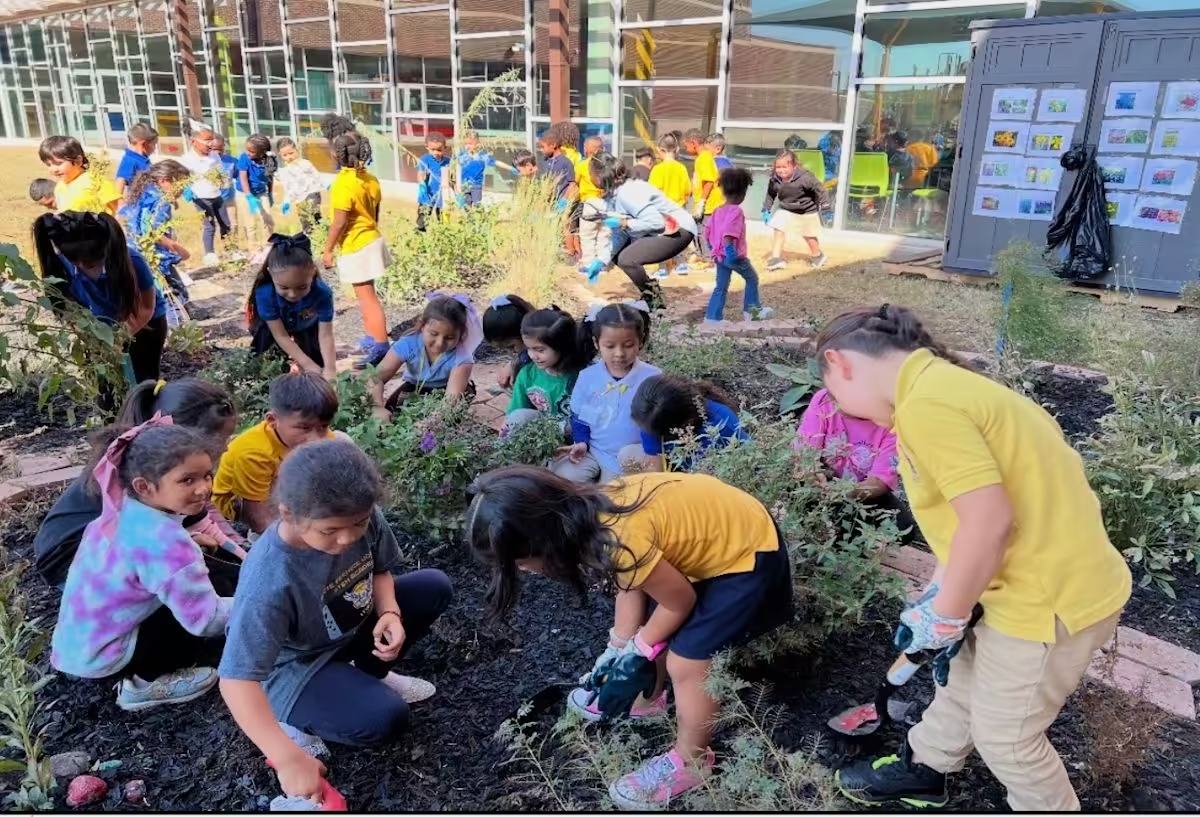

Nestled in the courtyard of Eddie Bernice Johnson STEM Academy is a small garden shaped like a butterfly.

The garden is lined with stones that students painted with orange and white dots to resemble the spots on monarch butterflies’ wings, and here and there, tufts of native plants with orange blooms poke through the mulch. It is late October, and the perennials look withered, but first-grade teacher Astrid Cruz said the plants are entering fall dormancy and will revive in early spring.
The monarch butterfly garden began in 2023 with an invitation from the National Wildlife Federation’s Monarch Heroes program, which works to restore the habitat for the declining monarch population. When Cruz heard about it, she wrote a grant and received $500 to purchase native plants.
She also obtained caterpillars through the Dallas ISD Environmental Education Center and found another generous partner in Ace Hardware, which donated supplies. With the supplies at hand, parents and children came together one weekend to build the butterfly garden.
“We didn’t expect it to be so big,” said Esmerelda Longoria, a bilingual kindergarten teacher who, along with fellow bilingual teacher Lesly Calderon, joined Cruz in maintaining the garden.
In March, the monarch butterfly garden doubles as a classroom and science lab, a place where children can watch a butterfly metamorphose from larva to adult. But students do more than just observe; they also dig with little shovels and plant flowers, learning about pollination and the environment in the process.
“The kids explore other garden residents like ladybugs and worms, whose tunnels help water reach plant roots,” Cruz said.

The garden also teaches care for the environment.
“If students spot litter, they know it can be dangerous for wildlife, and so they’re ready to pick it up,” Longoria said.
But what students look most forward to is releasing the butterflies. In the spring, eight classes of pre-K 3 and 4 come together to watch the monarch butterflies take flight. Some monarchs flit about the garden, perching on petals or leaves and showing students that caring for a habitat can make a real difference.
“After a butterfly emerges, we wait 24 to 48 hours for its wings to dry before releasing it, since wet wings keep it from flying,” Cruz said.

The work of maintaining the garden continues long after the butterflies are released and school lets out. Teachers and staff clean the garden, water it, add mulch, and replace plants. While native flowers can make it through local winters, keeping the garden watered during holidays is a challenge. Cruz said she applied for a Heart of Teaching Grant to install an automatic, solar-powered watering system and is awaiting the final decision.
Other ideas are percolating in Cruz’s mind, including ordering a kit to track the monarch butterflies.
“That way, the kids can track any butterfly, even if it’s not a monarch,” Cruz said.
The school has completed the first step toward becoming a National Wildlife Federation certified Eco-School, Cruz said.
For Cruz, Calderon, and Longoria even planting one small seed can grow into something much bigger: empathy for nature’s most vulnerable creatures. And when students are outside, learning together, the simplest discoveries become a source of wonder.
“When we see students engaged and happy, we realize it’s worth it,” Longoria said. “Anything they do for nature is important because they’re learning to make a difference, no matter how small.”
Source: thehub.dallasisd.org