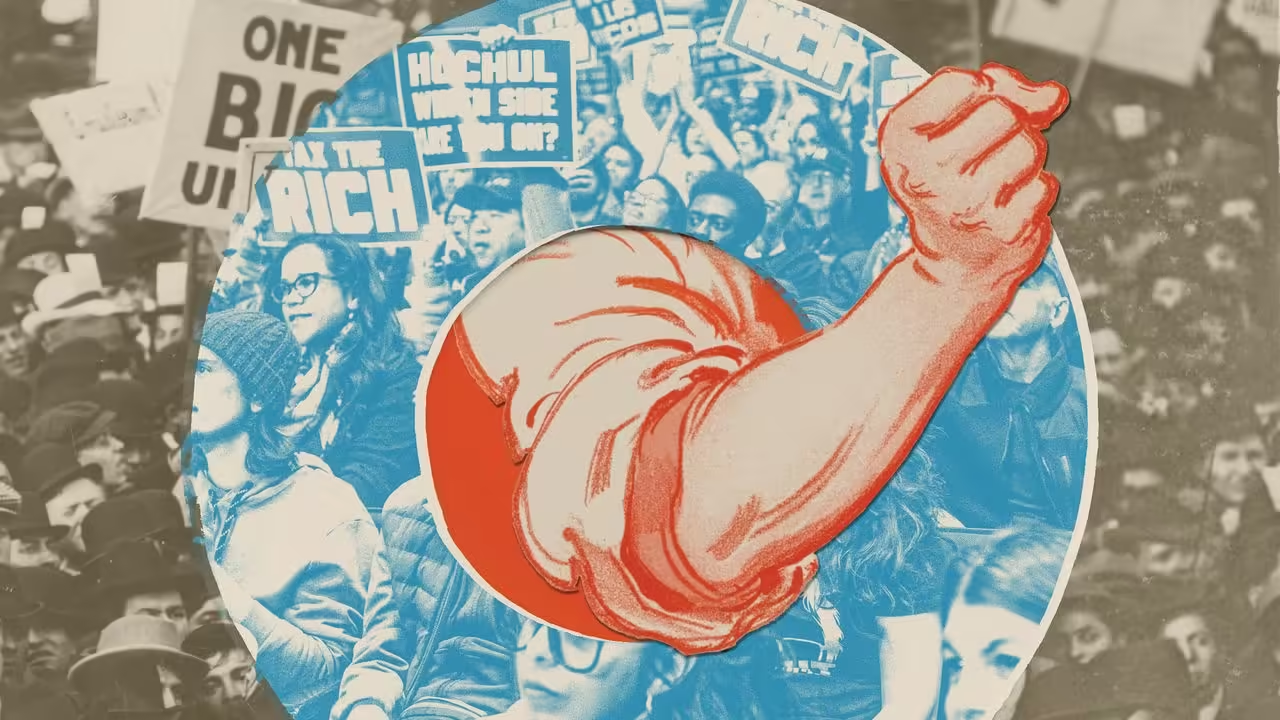

It was American socialism’s best year ever. In 1912, the Socialist Party of America tallied a hundred and twenty thousand members, and newsstands groaned under the weight of some three hundred socialist papers and magazines, including the Kansas-based Appeal to Reasonwhich had three-quarters of a million subscribers and was committed to the belief that “socialism is not just a theory—it is a destiny.” Socialists were winning elections, carried to victory by voters furious at trusts and corporations and millionaires and oligarchs, whose monopoly on political power rested on a two-party system indifferent to labor’s demands and on a breathtakingly conservative Supreme Court. (In 1895, the Court declared a federal income tax to be unconstitutional; in 1905, it said the same of a law limiting the number of hours in a workday.) Year by year, socialists had gained strength. In 1910, the Milwaukee newspaperman Victor Berger, who had founded the Socialist Party with the Indiana railroad-union leader Eugene V. Debs, in 1901, became the first socialist elected to Congress: he vowed to abolish the Senate. In 1911, a socialist mayor was elected in Schenectady, New York. “We know that we cannot abolish the capitalist system in Schenectady,” he said at his inauguration. But “we can and will demonstrate to all the spirit of socialism and the application of socialist principles insofar as possible with the handicap of laws framed to establish and sustain capitalism.” (He pledged to lower trolley fares.) In 1912, Debs ran as the Socialist Party candidate for President and called for an end to “wage slavery.” Across a great striving land of fields of wheat and corn, and factories of steel and automobiles, and mines of coal and copper and iron, more than a thousand socialists held office, including fifty-six mayors (of cities as different as Berkeley, California, and Flint, Michigan), a hundred and sixty city councilmen, and a hundred and forty-five aldermen. A machinist became the mayor of St. Marys, Ohio; a railroad brakeman the mayor of New Castle, Pennsylvania. “But, comrades, it is not merely our physical growth, it is not merely our large strength upon which we congratulate ourselves,” the chairman of the Socialist Party Convention, held in Indianapolis that year, declared. “It is the fact that the Socialist Party has, at all times, remained true to its trust and carried the banner of international socialism aloft in this country.” Socialism’s moment, it seemed, had arrived.
At that convention, the Party adopted a platform that began by denouncing capitalism as a system that produced, among other evils, an “extortionate cost of living”: “Under this system the working class is exposed to poisonous conditions, to frightful and needless perils to life and limb, is walled around with court decisions, injunctions and unjust laws, and is preyed upon incessantly for the benefit of the controlling oligarchy of wealth.” The platform called for the collective ownership of everything from the railroads and the telegraph lines to mines, forests, oil wells, banks, and the currency system. It called for a shortened workday, a workweek no longer than five and a half days, a minimum wage, old-age pensions, workers’ insurance, unemployment insurance, and the abolition of child labor. It also called for a graduated federal income tax, female suffrage, and the abolition of the Senate, the Presidential veto, and the Electoral College—and, since each of the items on this last list would require amending the Constitution, for a constitutional convention.
“The socialist moment is here,” Nathan J. Robinson, the editor of the socialist magazine Current Affairsannounced this past summer, pointing to the swelling membership of the Democratic Socialists of America and to socialists’ newfound prominence: Zohran Mamdani on the cover of Time. Is it 1912 all over again?
This year, the banner of socialism is being carried by the D.S.A., whose hundred and thirty thousand members already include two U.S. representatives, Alexandria Ocasio-Cortez and Rashida Tlaib; there are hundreds of D.S.A.-backed state and local officeholders across the country. (Bernie Sanders is a longtime socialist, but he is not a member of the D.S.A.) The D.S.A. is not a political party, but it does have a platform. Sort of. In 2017, its National Political Committee decided to replace its “priorities resolution” with a platform. Promised for 2019, it was postponed to 2021, given the D.S.A.’s “ideological diversity.” A new platform, which the D.S.A. prefers to call a “program,” was released this summer. It has much in common with the Socialist Party platform of 1912.
Source: www.newyorker.com