
Controversy is going on at many petrol pumps in Karnataka regarding mixing of ethanol in petrol more than the prescribed quantity of 20 percent. The Karnataka government, which conducts lab testing of petrol samples, is attacking oil companies and the Center for blending up to 31 percent ethanol, while companies like Indian Oil and Bharat Petroleum have denied the allegations. The central government has also talked about 20 percent ethanol blending only. Karnataka Chief Minister DK Shivakumar said on Sunday that processing units are also involved in this game. Today on Monday, his minister Rizwan Arshad is going to release a detailed report, in which he will tell with evidence how and where more ethanol blending is done in petrol.
Before the Karnataka government releases the report, we are trying to explain to you how and where ethanol is mixed in the petrol you fill in your car and bike. Understand whether the petrol pump employee mixes ethanol in petrol or this work is done in the refinery.
Where and who mixes ethanol in petrol?
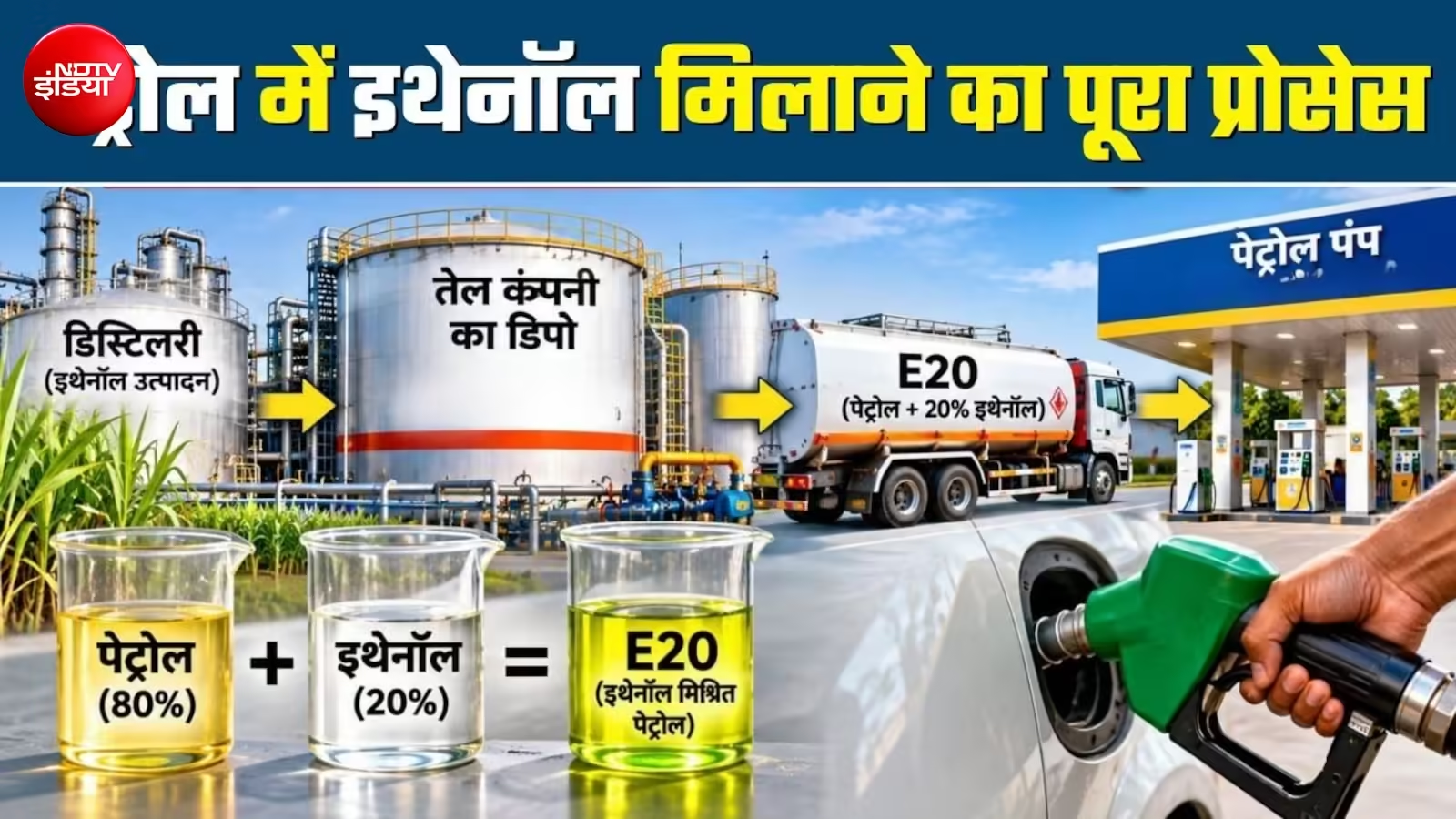
In the country, the work of mixing ethanol is generally done in the depots of oil marketing companies. Companies like Indian Oil, Bharat Petroleum and Hindustan Petroleum reduce this. There is no process of adding ethanol to petrol on a manual basis. According to a release from PIB, for this, a controlled and fixed proportion mixing system is used at the refinery and depot level. Here ethanol is mixed in petrol and after this the prepared fuel is transported to different petrol pumps across the country.
Ethanol reaches the depot from the distillery
Ethanol is supplied for mixing in petrol by distilleries i.e. ethanol manufacturing units. The reply given by the Petroleum Ministry in this regard in the Parliament According to this, ethanol is supplied to public sector oil marketing companies i.e. Indian Oil, Bharat Petroleum and Hindustan Petroleum mainly from private distilleries. Companies mix it with petrol at their depots and then send it to the market through their retail sales network.

Separate infrastructure for storage and blending
In this system of companies like Indian Oil, Bharat Petroleum and Hindustan Petroleum, there is separate infrastructure for storage and preparation of mixture. According to Indian Oil, oil companies have been investing in increasing the capacity of their terminals and depots for ethanol blending. Railways are also used to transport ethanol and ethanol mixed petrol over long distances.
How is it decided how much ethanol to add?
The most important part of this process is safe proportional blending i.e. preparing the mixture of petrol and ethanol in fixed proportions. According to the Petroleum Ministry, the system of automatic calibration and proportioning is used in refineries and depots.
In simple language it means that the quantity of both the liquids is controlled by ensuring the accuracy of the measuring instruments. As per the current system, 800 ML petrol and 200 ML ethanol is mixed in 1 litre. The fuel is prepared as per prescribed standards and quality checking process.
In-line blending and splash blending
Technologies for blending ethanol include in-line blending and splash blending. In in-line blending, measured quantity of ethanol is added to the petrol passing through the pipe. In splash blending, ethanol is mixed with base petrol directly into the tanker or delivery truck.
The study report of ICRIER i.e. Indian Council for Research on International Economic Relations i.e. ICRIER explains the difference between these two methods. However, it is not that the same method is used at every depot in the country.

E20: Who decides, how much ethanol will be mixed?
On the basis of standards, the central government decides what percentage of ethanol can be mixed in petrol. The Center does this to reduce the country’s oil import bill. From time to time the government makes changes in it according to the standards.
At present E20 petrol is approved, in which the share of ethanol is about 20 percent. To understand this with a simple example, 100 liters of finished fuel contains about 20 liters of ethanol and the rest petrol. Acceptable limits are also fixed in the quality standard.
According to the clarification of the Petroleum Ministry dated November 8, 2026, the prescribed acceptable amount of ethanol for E20 is 19 to 21 percent and this fuel should conform to the Indian Standard IS 17021.
In this, the government said that the quantity of ethanol was found within the prescribed limit in 893 samples taken from 27 states and union territories. This result is for the samples tested; This should not be understood as separate testing of every liter of petrol sold in the country.
Why is it important to protect yourself from water?
It is very important to protect the supply of ethanol blended fuel from water. Total Energies According to the SOP, ethanol storage tanks must be cleaned and any water and sediment present in them must be removed before use. Due to this, there is no risk of oil contamination and rust.
Indian Oil has improved its marketing discipline. guidelines It is also mentioned that there is a provision to check the quantity of water and ethanol. According to them, after removing water from the tank, the quantity of ethanol is checked again. If it is not within the prescribed limit, then the sale of petrol is banned and the concerned officer is informed. Therefore, quality control is not limited only to manufacturing of blended E20 petrol, but also continues during storage and sale.
What is the responsibility of petrol pump?
In the current system, petrol pumps get pre-prepared ethanol mixed petrol. The responsibility of the dealer is to sell the right quality petrol, whereas the responsibility of the oil company is to prepare the right mixture as per the prescribed government instructions. The guidelines of Indian Oil also clarify both the responsibilities separately.
In this way, from the ethanol made in the distillery to the petrol reaching the vehicle tank, it passes through many stages – supply, storage, ethanol blending, quality control, distribution, selling. Ethanol blending can be checked from the distillery to the depot and then to the petrol pump.
Sources: NDTV Research (Business Desk), PIB, Sansad.in, IOCL, totalenergies
Read also | Ruckus over E20 in India, then how did Brazil do wonders with E100 in cars?
Source: ndtv.in