
Love cuts deeper than politics.
Or at least it should.
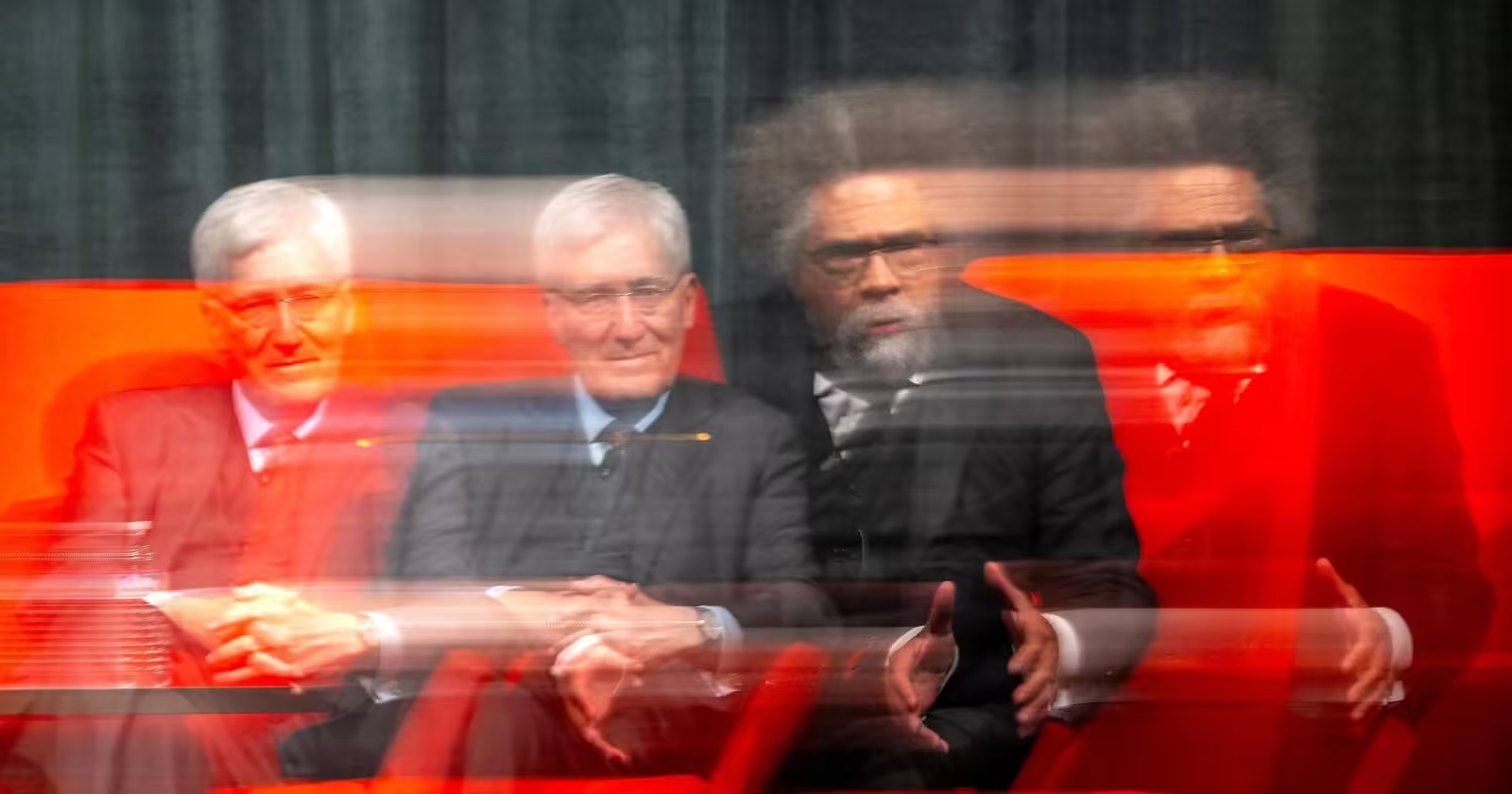
On Friday, inside Whitworth’s Cowles auditorium, roughly 800 people witnessed two intellectual giants at the peak of their prowess – one a leftist author and philosopher, the other a legal scholar and conservative philosopher – talk about integrity, tribalism, idolatry, and the importance of forming friendships with people who have deferring opinions.
The conversation between Dr. Robert George and Cornel West comes just after what some have dubbed a “blue tsunami” swept across the United States during this year’s midterm elections.
While the event was well-timed, George and West spent very little, if any, time discussing policies or politics.
They were more focused on preserving freedom of speech, rejecting partisanship and reinforcing the importance of civic virtue and living as truth seekers.
Born in Morgantown, West Virginia, as the grandson of immigrant coal miners, George is a legal scholar, political philosopher and public intellectual who currently holds the McCormick Chair of Jurisprudence and is the director of the James Madison Program in American Ideals and Institutions at Princeton University.
He is a Roman Catholic natural law theorist who is known, among other things, as a prominent opponent to same-sex marriage and abortion. In 2008, President George W. Bush awarded him the Presidential Citizens Medal.
Born in Tulsa, Oklahoma, as the grandson of a Baptist pastor, West is a philosopher, theologian, political activist, social critic and public intellectual who’s currently the Dietrich Bonhoeffer Chair at Union Theological Seminary in New York and Professor Emeritus at Princeton. He’s taught at numerous colleges, including Princeton, Harvard, Yale, Dartmouth, Pepperdine, and the University of Paris in Saint-Denis.
He’s also a longtime member of the Democratic Socialists of America. His philosophy is known to center around race, gender and class struggle. In 2024, he was an independent candidate during the U.S. presidential election.
On paper, the two couldn’t be any more different.
One is a leading thinker in the conservative movement. The other is a socialist.
Yet, they speak with such an openness and genuine care for one another that can only come after 20 long years of friendship. They riff off one another like dove-tailing instruments in an orchestra.
“What sustains the friendship?” George asked. “Well, the brother’s so lovable, I mean, how can you not love him? Cornell and I have been teaching together, writing together, lecturing together, praying together, singing together, now for more than 20 years, and it has been the greatest blessing of my academic career, and really one of the greatest blessings of my personal life. We’re interested in all the same topics. We’re interested in all the same authors, living and dead. We share a deep commitment to the pursuit of the truth.”
George said he and West both attempt to discipline themselves against falling so deeply in love with their own opinions that they can’t see or believe anything else.
The importance of the freedom of speech, thought and expression are paramount to the pair of them. But what really bridges the divide between the two is their unwavering faith in the same God. While they sometimes debate and struggle over how to interpret teachings from the Bible, they have a shared Christian conviction that overrides everything else.
“It takes courage to cultivate thinking for yourself,” West said. “It takes courage to try to love others without asking for anybody’s permission as to who we love. People come to me all the time, ‘How do you spend all that time with Brother Robbie? You know how conservative he is?’ I said ‘I’m a Jesus-loving, free Black man.’ I don’t ask for your permission as to who I love. I’m free. I’ve been commanded by a Palestinian Jew named Jesus. That’s the authority, and that love flows over and we have such a magnificent time together, intellectually and spiritually.”
When people ask if there are some questions the two avoid asking to not blow up their friendship, George said there’s nothing that divides them that they aren’t comfortable with exploring and learning more about.
West said he has a profound respect for George because he possesses integrity. He described integrity as “wholeness, soundness and freshness” that flows from a person, so that they not only say what they mean, but also mean what they say.
“Brother Trump is made in the image of the same loving and living God that I am,” West said. “He has dignity. He has a sanctity that the world didn’t give him and the world can’t take away. But he chooses to be a gangster. That’s a choice. And a gangster is what? Say anything. Do anything. Think there’s no accountability, no responsibility, no answerability whatsoever.”
West recited a quote from Irish poet William Butler Yeats when he said, “it takes more courage to examine the dark corners of your own soul than it does for a soldier to fight on a battlefield.”
How do we push back against our own envy, greed and hatred? West asked.
By learning how to die in order to learn how to live well.
“Baptism is knowing how to go down in death with Jesus Christ in order to emerge with new vitality and vibrance and energy,” West said.
Integrity, West said, is a virtue that’s missing in much of society today. He said the young people in the audience must be aware of the culture that encourages a “joyless quest for insatiable pleasures.”
“You can get any kind of pleasure you want,” West said. “Any kind of titillation, stimulation, distraction you want, and your heart is still empty and your soul is still vacuous because there’s no joy there. Joy cuts deeper.”
As a Christian, George said he’s called to be a truthteller. But in order to do that, one must wrestle against some natural human tendencies.
One of those tendencies is to wrap emotions so tightly around convictions and beliefs that a person is fast tracked towards the path of becoming an ideologue or a dogmatist. When someone is unable to recognize their own fallibility, then they’ll never be challenged and as a result, never changed.
“Here’s the thing: Unless we allow ourselves to be challenged by a serious intellectual sparring partner, we will persist forever in whatever those false beliefs are in our head,” George said.
Both West and George insist they do not follow partisan lines. When Obama was president, West was harsher on the 44th president than George was. With Trump currently serving as president, George said he’s harsher on the president than West is.
They warn all people – Black or White, rich or poor, young or old – against the temptation of tribalism, which “creates the ideological partisanship that turns people into dogmatists.”
Standing firm with one’s conscience is a hard thing to do, George said. It can lead to ostracization by the same group one begs to be a part of. But a person of conscience, he said, must be willing to pay the price and remove themselves from echo chambers that only exist to reinforce preconceived notions.
“In America, we think we just have problems to solve,” West said. “No. We’re in a fog, and we’re infected by the fog, which means that oftentimes we’re infected by the very thing we’re trying to resist. That’s why you get the cycles of hate, cycles of domination, cycles of violence … The very folk who come up in power to solve it, they get corrupt. Absolute power corrupts absolutely, says Lord Acton. But we should add the lack of power corrupts, too. Obsession with power corrupts too. That’s who we are as a species. We are wretched.”
Hatred, greed, envy, resentment and “the fog”, as West calls it, will never be fully eliminated, but “waves of awakening” can strike and allow a person to see beyond the narrow confines of their own opinions.
“How do you wake?” He asked. “If you’re waking in a dogmatic way, you’re just putting others asleep. If you’re waking the Socratic way, which we’re talking about, then it allows for a variety of voices to be heard.”
The pair agree that a liberal arts education and studying great writers, like Shakespeare, St. Augustine, William Faulkner, Toni Morrison, James Baldwin, and Herman Melville, teaches much about the human condition. But so does living without blinders on.
George pointed to the 10th Federalist paper when James Madison asked, “What caused all the other republics to fail?”
Madison’s answer was “factionalization.”
George then went on to compare today’s state of democracy to the election of 1800 when Thomas Jefferson and John Adams ran against each other. The result, after much strife, was the nation’s first peaceful transition of power.
“The bitter election that destroyed the friendship between Adams and Jefferson would later be restored after both men were out of political office in their old age,” George said. “But it destroyed that relationship and almost destroyed the country. The bitterness, the animosity, the hostility that’s the tendency of citizens to treat each other as enemies, not as civic friends who happen to disagree. That’s what we are experiencing today. It’s exactly what they were experiencing in 1800.”
He argues that what preserves a republic is civic virtue. Structural constraints on power, such as checks and balances, were designed to be auxiliary protections. Civic virtue can be described as an idea that says members of a society should put the needs of their society before their own desires.
“If people are going to be virtuous, they have to be educated into virtue by the non-governmental institutions of civil society,” George said.
Along with hundreds of other students, professors and members of the community at the Cowles Auditorium on Friday night, City Council President Betsy Wilkerson said she had a lot of mental digesting to do after witnessing such a thought-provoking conversation.
She said civic discourse really resonated with her as she usually thinks of it as being able to talk to others with differentiating opinions without being cussed out. Wilkerson said West and George made her realize it’s not always whether someone is wrong or right on a topic, it’s whether or not they have integrity and a keen ability to not only avoid tribalism, but admit one’s own fallibility.
Beyond that, the message that wealth and riches means nothing without joy resonated deeply with Wilkerson.
Even if one’s life is “perfect,” if there’s no joy, what does it matter?
“What do you want on your tombstone?” she said. “That I was a trillionaire and nobody else cared, or that in real life, I was the best friend a person could ever have, or the best grandmother, or the best human.”
Source: www.spokesman.com