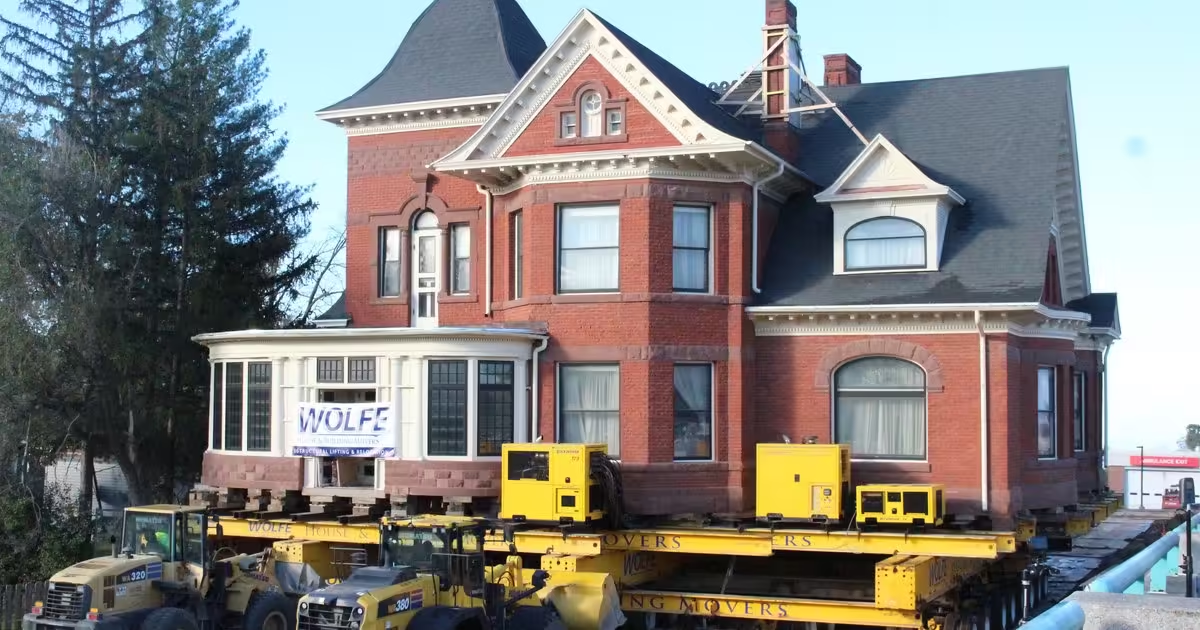

In assessing if a landmark should retain its historic status, the NPS examines seven aspects of historic integrity: setting, location, workmanship, design, materials, feeling and association.
“They don’t love to see a historic property being moved from its original setting,” Dolberg said of the parks service. “But I think you could argue that its original setting had long since gone.”
She pointed out that the 160-acre farm that surrounded Fairview has been replaced by the hospital and blocks of single-family homes.
Sothan said the decades of change will be considered when the National Parks Service determines if Fairview will still be a National Historic Landmark.
“You drive there, you don’t get a sense of the farm anymore,” Sothan said. “It’s very much in the heart of Lincoln. So, its historical setting, its historical association, has already been, to use a term, compromised. And when William and Mary donated this to Bryan Health —wasn’t by that name at that time — I don’t think they were under any illusion that it would change. They gave this land to be used for the establishment of a hospital.”
There’s also a century of history that’s built up since the Bryans vacated Fairview. While the original owners lived in the home for less than 20 years, it served for more than twice as long — roughly four decades — as a dormitory for the health campus.
“Frankly, by the time it was listed in the 1960s to the National Register of Historic Places and made a National Historic Landmark, that change had already occurred,” Sothan said.
To protect and preserve
While lots of paperwork is due before it is confirmed that Fairview keeps its National Historic Landmark status, the National Parks Service only has jurisdiction over the title itself. Unless a project is using federal funding — which Bryan Health is not — state and federal authorities have little formal recourse if the landmark itself is damaged.
“So many times, people say, ‘oh, it’s on the National Register, it’ll be protected,’ or ‘it’s a National Historic Landmark, that means it’s protected,’ and at the end of the day, those designations largely are honorary.” Sothan said. “A person could, in theory, list a building to the National Register of Historic Places, get that confirmed by the National Park Service — and the next day, as long as they have a local permit for its demolition, they could demolish that property and there is no one at the state level or at the federal level that’s going to say, ‘no, you cannot do this.’”
The local level is a different story. The HPC has more authority over a property — if it is designated as a local landmark.
“In this case, Fairview isn’t a local landmark,” Dolberg said.
Dolberg said Bryan Health voluntarily presented to the city’s Historic Preservation Commission, though they were not required to.
“Really, it was Brian’s property to do with as they wished,” Dolberg said. “They wanted to be very transparent about it and work with HPC to just make sure that the public and the people who interact with this part of our built environment had a say in it and weren’t blindsided by this project.”
She added that Bryan Health is willing to work with the city to designate Fairview a local landmark once the move is fully completed and the building’s basement restored.
“We like the idea of being able to have more input on this National Historic Landmark,” Dolberg said. “And they’re amenable to that.”
Moves in Lincoln
Source: nebraskapublicmedia.org