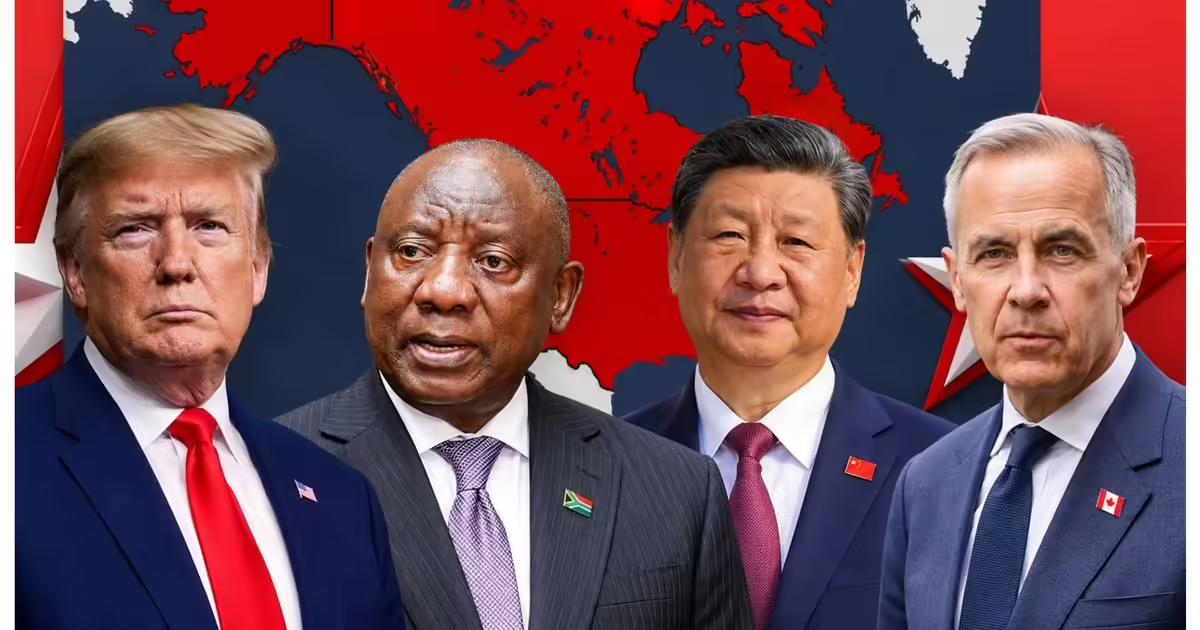

South Africa, in particular, is still grappling with Washington’s recent announcement of plans to remove it from the African Growth and Opportunity Act (AGOA), a setback that even its trade relationships with China and Europe may not be enough to offset.
The country’s automotive industry, which produces more vehicles than any other country in Africa and is AGOA’s largest user, is already struggling with the 25% tariffs Washington imposed on vehicles and components in 2025.
The withdrawal would do more than impose additional duties of around 2.5% on affected passenger vehicles, as it could weaken South Africa’s competitiveness against rivals in Japan, the UK, the EU and South Korea, which have secured better US tariff deals.
According to NAACAM, South Africa’s automotive exports to the US fell by 29% to R20.43 billion ($1.14 billion) in 2025, while the component manufacturing sector recorded 15 company closures and more than 7,500 gross job losses over three years.
Canada faces similar pressure as US tariffs threaten thousands of jobs
Canada, meanwhile, has faced similar pressure since April 2025, when Washington imposed tariffs on Canadian-built vehicles, disrupting an automotive industry heavily dependent on American buyers.
More than 90% of Canadian-made vehicles are exported to the US, leaving an industry supporting 125,000 direct jobs and more than 500,000 jobs across the wider sector exposed to American trade restrictions.
In January 2026, General Motors announced plans to cut 500 jobs at its Oshawa plant, potentially affecting 1,200 supply chain workers, while Stellantis’s decision to shift planned Jeep production to the US left 3,000 Brampton workers facing uncertainty.
Why China may not rescue South Africa and Canada’s car industries
With their automotive industries under pressure, both countries are counting on Europe and China to come to their rescue from US trade restrictions.
Europe already offers South Africa some relief, with automotive exports to the EU and UK reaching R182.8 billion ($10 billion) in 2025, accounting for 62.8% of its total automotive export value, compared with just R20.43 billion ($1.14 billion) exported to the US.
Canada also enjoys preferential access to the European market through its trade agreement with the EU, but the region remains a much smaller automotive export destination than the US.
As a result, Prime Minister Mark Carney is also turning to China for further relief, securing an agreement in January 2026 to allow 49,000 Chinese electric vehicles into the country annually, hoping to attract investment and strengthen domestic manufacturing.
“For Canada to build its own competitive EV sector, we will need to learn from innovative partners, access their supply chains, and increase local demand,” Carney said during his visit to Beijing.
However, the strategy raises questions about whether China can provide the relief both countries need, particularly when Beijing is already a major competitor in their domestic automotive markets.
In 2025, South Africa earned $1.14 billion from automotive exports to the US, while Canada exported $47.36 billion worth of automotive products to the American market, compared with just $322.86 million to China.
The figures show how difficult it could be to replace lost American sales, while cheaper Chinese electric vehicles could increase competition for domestic manufacturers and put more jobs at risk.
“China now has a foothold in the Canadian market and will use it to their full advantage at the expense of Canadian workers,” Ontario Premier Doug Ford warned.
South Africa, meanwhile, continues to negotiate with Washington while exploring alternative markets.
“The exclusion from AGOA is indeed a negative for us,” President Cyril Ramaphosa acknowledged during a televised address.
Like Canadian Prime Minister Mark Carney, Ramaphosa stressed the need to reduce dependence on the US despite hopes of a favourable trade agreement.
“Diversification has now become the order of the day,” he said.
Source: africa.businessinsider.com