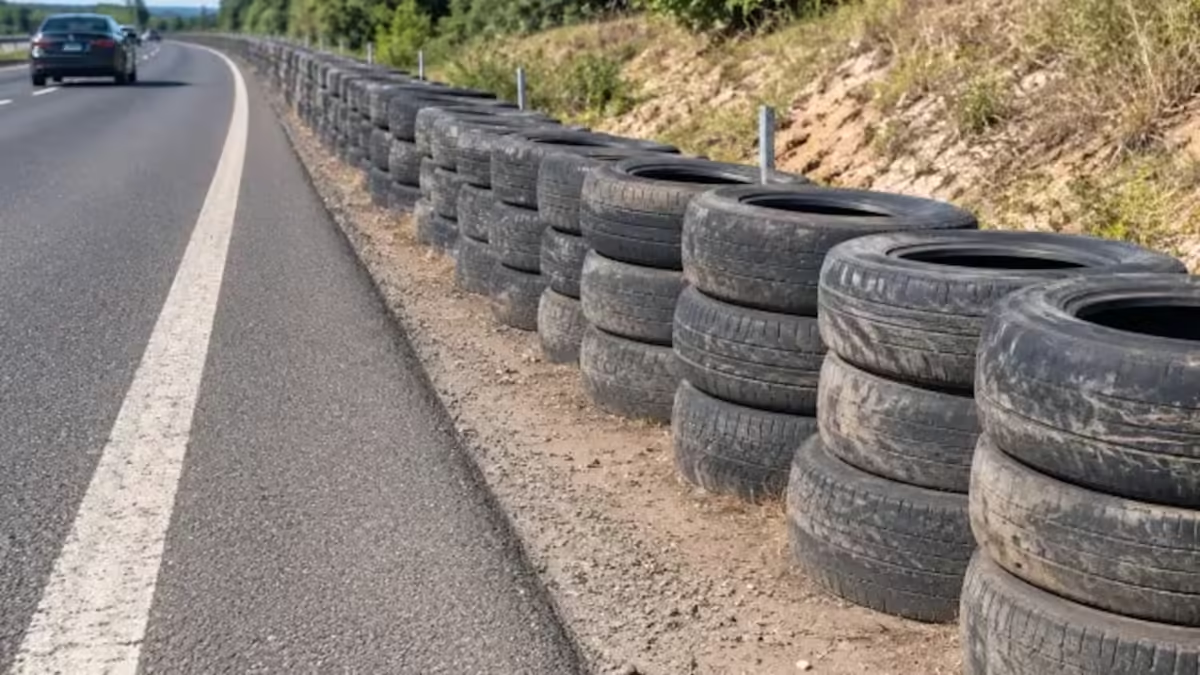

Discarding used tires poses a problem for the environment. In 1990, the Oregon Department of Transportation (ODOT) found a way to give them a second life and, in addition, avoid disposing of this waste. Their inspiration may have come from professional racing.
While they were in the process of repairing a road, the embankment was quite unstable. If more soil had been added, the weight would also have increased and, therefore, it would have become even more unstable. This is where the tires took on an important role that was not expected at first.
This is how tires were used in the United States to stabilize a road in Oregon
The exact location of this invention was on the Coos Bay-Roseburg Highway, about 40 kilometers west of Roseburg, in Oregon. To date, there has been no known use of used tires to stabilize a road. In fact, a report was prepared under the title “Experimental project: use of shredded used tires as lightweight fill’.
In this experiment, 5,800 tons of tires were used, which could amount to 580,000 tires. All of this material was transported by truck from different locations. Once on site, they were placed in 90-centimeter stacks and each one was compacted with a D-8 excavator. Now, all of this work was only possible with funding behind it.
The Oregon Department of Environmental Quality launched financial assistance. The cost of that material was $30 per ton. The DEQ offered a subsidy of $20 per ton, so the cost of the material was reduced to $10. In addition, $8.33 per ton had to be added for its placement and compaction. In total, the final cost was $18.33 per ton.
Source: www.marca.com