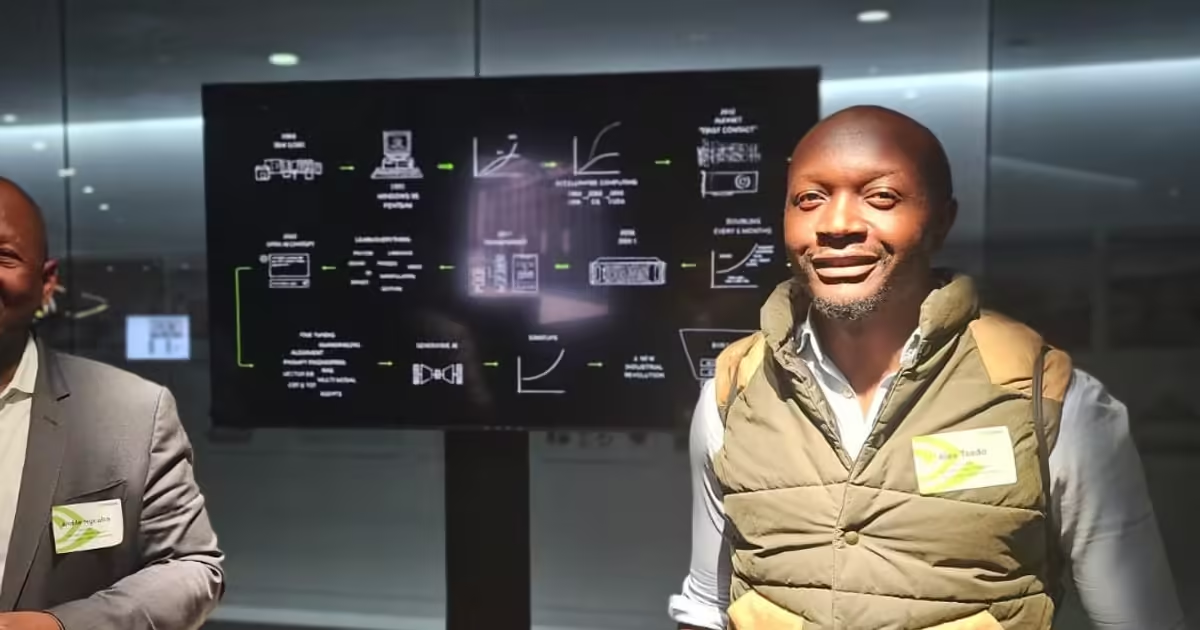

When Alexander Tsado worked at Nvidia as an engineer, the company was already at the centre of a technology revolution. As the world’s first $5 trillion company, it had become one of the biggest beneficiaries of the global race to build artificial intelligence. But while the rest of the world was rushing to secure the computing power needed to shape that future, Tsado kept noticing something uncomfortable. Africa was barely part of the conversation.
The United States had moved early. President Donald Trump announced plans for up to $500 billion in private-sector investment to build AI infrastructure, hoping to keep the country ahead of its global rivals in a technology increasingly tied to economic power.
The ambitions have since grown. Five of the world’s largest AI data centre companies, including Amazon and Google, are on track to spend $900 billion on AI in 2026, roughly as much as they spent in the previous three years combined.
China, on the other hand, is preparing to spend about $295 billion over the next five years building data centres across the country to support its domestic AI industry. Several other Asian economies are also advancing their ambitions.
Africa, meanwhile, has yet to make comparable investments, leaving many of its governments and businesses on the margins of a race that could shape the global economy.
For Tsado, this was more than an observation about where the money was going. He had begun to see the consequences in his own work. He remembers two prominent African businessmen who approached Nvidia hoping to explore opportunities but received no response. Eventually, he decided to contact the company’s CEO himself, hoping someone would pay attention.
The CEO replied within 10 minutes and arranged for the sales team to follow up. It was a small victory, perhaps, but it left Tsado thinking about a much larger problem. There was no real structure within the company to serve a market that was only beginning to show interest in AI.
“There was a structural problem,” he said. “There was nothing set up to serve our continent, even if our continent got interested.”
At the time, Tsado was a product manager working on cloud computing at Nvidia. Between 2016 and 2020, he was involved in setting up some of the company’s early cloud GPU infrastructure for Amazon Web Services.
He was close enough to the technology to understand where the industry was heading. But he was also beginning to question whether the infrastructure being built elsewhere would ever adequately serve African businesses. He eventually left Nvidia to start Udu Technologies, a startup that offers GPU cloud, compute hardware and AI advisory for businesses and institutions in the United States, Africa, the Caribbean and beyond.
The problem with waiting for Africa to catch up
Tsado grew up in Benin City before leaving Nigeria for university in New York. His experience in the global technology industry gave him a close look at how much money other regions were putting into AI research.
According to him, governments and companies in these markets spent years buying GPUs and experimenting with the technology before they could point to clear financial returns. African investors and governments, on the other hand, tend to wait until an idea has proved itself before committing money. That difference, he argues, is part of why the continent is falling behind.
“Other regions of the world spent money on research for two to four years,” he said. “Hundreds of millions of dollars they spent on research buying GPUs without seeing the projected returns in the future.”
He believes Africa has been too cautious, even when the technology is already working elsewhere. Since starting Udu, he has spent much of his time trying to convince business leaders that AI is not just another technology trend to watch from a distance.
The company wants to shorten that adoption period from 10 years to two or three. Its focus is what Tsado calls homegrown AI: helping African organisations use their own data to build solutions that address their specific needs.
“It’s not something you copy and paste and it will work well,” he said. “You bring your data, your understanding of your data, you merge it with a big machine called the GPU, and you start to get an AI model or insights that come out of that.”
Making the technology easier to access
One of the biggest challenges is cost. Powerful computing infrastructure is expensive, and the electricity required to run it adds another layer of difficulty.
Udu’s answer is to make access smaller and more flexible. Its cloud platform allows AI developers to use GPUs for less than $1 an hour. It also offers computing credits starting at $50 and $100, which can be distributed to startups through venture capital firms and accelerators.
Tsado compares the approach to how telecommunications companies made mobile services accessible through small-value recharge cards.
“If you think about telecommunications and recharge cards, they had to reduce the price of recharge cards to a very small amount. That’s what we’re doing with Udu Technologies.”
The idea is to give startups access to computing power before they become established enough to qualify for the large cloud credits offered by global providers.
Udu is also working with governments and institutions. Tsado says the company helped drive a project involving GPU deployments in six African countries, referenced in a recent UNDP report. Each country came with different electricity costs, infrastructure conditions and levels of technical expertise.
The work involved more than installing equipment. Udu also had to train local teams so they could manage the infrastructure and eventually expand its capacity.
In Nigeria, the company is also involved in implementing the AI Scaling Hub alongside partners including Lagos Business School and Data Science Nigeria.
Tsado says Udu has built software that allows institutions to manage access to the computing resources rather than relying on manual processes.
The business case for AI
Getting businesses to spend money on AI is another challenge. Many have experimented with tools such as ChatGPT and Claude, but Tsado believes they are often doing so without a clear plan for what the technology should achieve.
He points to banks as an example. Large banks process billions of transactions, and reconciling those transactions can take hours on traditional computer systems. Using GPUs, he argues, some of those processes could be completed in about 30 minutes.
That means less time spent running servers, lower electricity and diesel costs, and potentially less physical space needed for computing equipment.
He also believes African companies should stop measuring their progress against the amount Google or other global technology giants spend.
The immediate opportunity, he says, is to become more efficient than competitors in their own markets. Even older GPUs, he argues, can reduce certain processes from six hours to 30 minutes.
“You don’t have to compete with Google,” he said. “How do you increase from where you are now by 10%, by 50%, by 2X?”
Who pays for the infrastructure?
For Tsado, AI infrastructure should not be treated as something only governments or technology companies need to fund. Businesses have to start paying for it themselves.
He compares computing power to electricity. Companies already budget for power because they understand that their operations depend on it. AI, he believes, will become just as necessary.
“GPUs is electricity. We just don’t know it yet,” he said.
Based on Udu’s calculations, businesses should eventually spend between 5% and 10% of their revenue on AI, including staff training, software, tools and hardware. He estimates that many African businesses currently spend far less.
Governments still have a role, particularly in funding research and making infrastructure available. But Tsado thinks announcing AI strategies without putting money behind them will achieve little.
He also wants African countries to share resources. Udu has deployed GPUs in six countries, he says, but getting governments to share access across borders has proved difficult.
“Many of our countries are too small,” he said. “We’re going to need to share resources.”
There is another part of the AI conversation that concerns him: Africa’s data.
Across the continent, organisations are collecting local language data and building datasets that could help train AI models. But Tsado worries that too little attention is being paid to turning that data into products and technology that Africans own.
He compares the situation to exporting crude oil without building the capacity to refine it.
“GPUs are the refinery of the future,” he said. “Just like Dangote has built a refinery to process our crude oil, Udu is building the refinery of the future to process our data at home.”
Building beyond the first GPU clusters
Tsado believes AI could also create jobs in a continent where millions of young people are looking for work. He argues that many African businesses are too small to afford services such as legal advice, marketing support or business coaching. AI could make some of those services cheaper and easier to access.
If businesses become more productive and grow, he argues, they will have more reason to hire.
For Udu, the next few years will be about turning that opportunity into larger infrastructure projects. Tsado says the company expects to work with about five partners to deploy their first GPU clusters, with each project valued at between $1 million and $2 million.
He expects the size of those projects to grow significantly over time, with Udu targeting deals worth more than $100 million within three to five years.
The company has also raised funding from venture capital firms, corporate investors linked to the telecommunications sector and angel investors.
Udu is building for a market that Tsado believes has spent too long waiting for AI to prove itself. He wants African companies to start building with it instead.
Source: africa.businessinsider.com