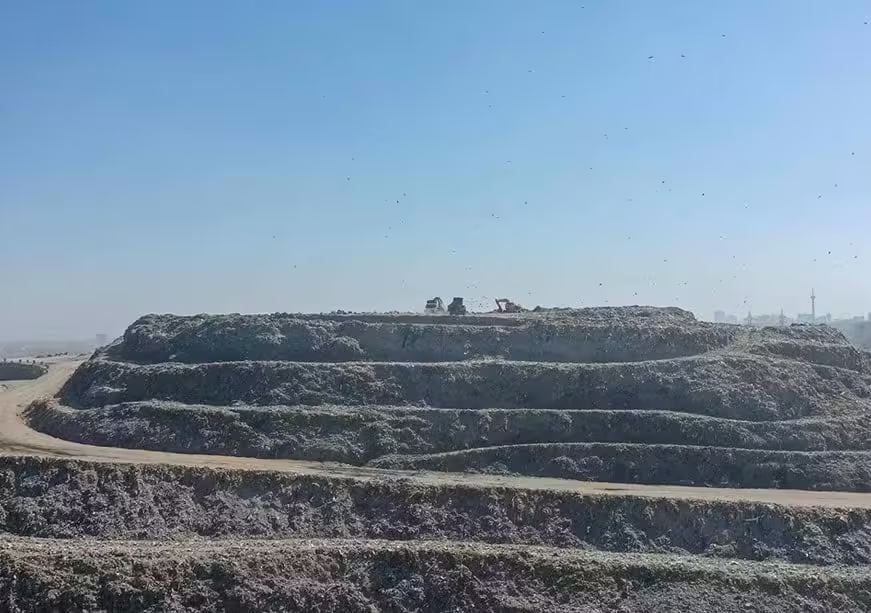

India is confronted with towering landfills and deteriorating air quality, and the link between them is irrefutable: landfills and the unchecked burning of municipal solid waste are significant contributors to greenhouse gas emissions. Policymakers have increasingly turned to large waste-to-energy (WtE) plants as an answer to both waste disposal and energy supply. The logic is appealing, but the approach has proved a silver bullet on neither count. This article argues that a waste system succeeds or fails by what happens at its beginning, not its end. Segregation at source is the decisive variable, and strategies imposed from above without fixing the fundamentals are unlikely to work.
Landfills are a symptom of the mounting problems of waste mismanagement, and nothing illustrates this better than New Delhi. Dumpsites such as Bhalswa repeatedly ignite as trapped gases accumulateand even when they do not burn, they passively release greenhouse gases. Municipalities spend heavily on collecting, hauling, and dumping waste, yet what arrives at the site is mixed, unsorted refuse. Whatever escapes the trucks is left on the streets or burnt in the open.
Segregation is a necessary condition for most WtE technologies; it determines whether a plant can functionally convert waste into energy or will end up causing even more pollution and health risks. The Solid Waste Management Rules (2026) introduce four-step segregation, in place of the simple wet-and-dry split of the previous iteration, recognising the importance of source segregation. What remains unchanged from the Solid Waste Management Rules of 2016 is that mass incineration at WtE plants is permitted only for segregated, non-recyclable waste with a calorific value of at least 1,500 kcal/kg. This is because this is the minimum calorific value required to generate energy efficiently without releasing toxic air emissions. Indian municipal waste, dominated by wet organic matter, rarely meets that threshold, particularly when unsegregated. Burning damp, mixed refuse yields poor energy recovery and, more dangerously, sends materials into the furnace that should never be there. Batteries and electronic waste, which often find their way into landfills and municipal solid waste incinerators (MSWIs), release heavy metals and other pollutants into the air and soil.
Okhla, in Delhi, illustrates the consequences. A 2024 New York Times investigation reported emissions at the plant exceeding permitted limits by a factor of eight to ten, alongside the burning of precisely such materials. The investigation spanned five years, 2019-23, and revealed extreme heavy metal and chemical contamination in the air, soil, and leftover incinerator ash. The specific pollutants are listed in the table below:
| Pollutant | Exceedance Level | Reference Standard / Context | Primary Cause / Impact |
| Cadmium | Up to 19x higher | U.S. Environmental Protection Agency (EPA) safe threshold |
Toxic heavy metal leakage from burned electronic/industrial waste.
|
| Manganese | Up to 11x higher | Standard safety limits |
Heavy metal contamination impacting the surrounding air and soil.
|
| Dioxins | Up to 10x higher | Indian legal regulatory limits | Incomplete combustion of mixed plastics and organics at low temperatures. |
| Arsenic | Up to 10x higher | Permissible safety limits | Highly toxic carcinogen released into the surrounding residential ecosystem. |
| Lead | Up to 4x higher | Permissible safety limits |
Heavy metal emission, posing a severe risk to cognitive and physical health.
|
| Cobalt | Up to 3x higher | Standard safety limits | Elevated metallic residue found in the vicinity of the plant. |
| Particulate Matter (PM2.5) & Hydrogen Chloride (HCl) | Regularly breached specified limits | Indian Solid Waste Management Rules limits | Stack emissions violating continuous automated tracking parameters, contributing to hazardous AQI levels. |
Source: Compiled from The New York Times and The Times of India
The Timarpur facility, built in the 1980s on the same site, failed for related reasons. Contractors were paid by tonnage, so they were rewarded for delivering volume rather than quality, and inert waste filled the incinerator. In both cases, a centrally conceived project met waste that the upstream system was not prepared to handle, regardless of how sophisticated the technology was.
Top-down approaches follow a familiar pattern. An authority selects a capital-intensive facility, contracts a private operator for infrastructure and technology, and assumes that segregated waste will arrive in usable form. It rarely does, and several factors explain why. First, incentives are misaligned. Payment by volume rewards quantity, not the quality that determines whether a plant can generate energy without releasing toxic emissions.
What suits Sweden, where a largely dry, high-calorific waste stream is supported by advanced segregation and recycling systems, does not transfer automatically to India, where wet waste predominates and an army of informal workers sort truckloads of mixed refuse by hand every day.
Second, such strategies tend to ignore local waste composition. What suits Sweden, where a largely dry, high-calorific waste stream is supported by advanced segregation and recycling systems, does not transfer automatically to India, where wet waste predominates and an army of informal workers sort truckloads of mixed refuse by hand every day.
Third, top-down approaches sideline those who already sort waste. Informal workers lose access to material, and with it their source of income, while their practical knowledge of waste composition goes unused. Funding design compounds the problem. When public support rewards a plant’s output but not the quality of the waste it receives or its compliance with emission norms, the stages that make good output possible remain unfunded.
Fixing the Fundamentals
To say that the investments that support segregation are modest in comparison to top-down solutions like MSWIs would be understating things. Clearly labelled, separate bins in homes, institutions, and streets, combined with sustained public encouragement to use them, may do more for collection efficiency than added expenditure on door-to-door services. Decentralised composting can treat India’s large organic fraction at neighbourhood scale, as a resource rather than a burden.
For recyclables, India could look to Germany’s Deposit systemunder which a small refundable deposit is charged on each glass or plastic bottle at purchase and reimbursed when the bottle is returned to a retail store. It changes sorting behaviour through a price signal rather than exhortation, and it keeps containers out of landfills and open fires. Deposit Refund Schemes of this sort are at various stages of trial and implementation in different Indian states, but they will need to be adapted to local conditions.
The German system is designed for specific packaging streams and cannot be transplanted wholesale onto India’s wider municipal waste management problem without accounting for infrastructure and collection costs and the impact on the livelihoods of informal waste workers. Single-use sachets of snacks and tobacco, individually trivial, accumulate into a collective burden and lie scattered everywhere, from riversides to mountaintops. In India’s cities, they litter street corners, clog stormwater drains, and aggravate monsoon flooding. Producers should be held more accountable for collecting this packaging, with real consequences for non-compliance. Citizens, for their part, need accessible disposal points; low-cost municipal investment here can support a gradual shift in civic habit.
Where these foundations exist, the results are evident, even where some issues may persist. Indore’s bio-CNG plant operates under a public-private agreement that obliges the municipality to supply waste that is 90 percent segregated. It treats roughly 550 of the 700 tonnes of organic waste the city generates each day, and its biogas displaces diesel in the public bus fleet. Segregation was written into the contract rather than assumed. Cooperatives such as SWaCH in Pune, and the collaboration between informal collectors, NGOs, and the municipality in Bengaluru, show that informal workers can be integrated into decentralised collectionstrengthening it in the process. The 2026 Rules replace the flat tipping fee, historically tied to the tonnage delivered, with segregation-linked payment, but much remains to be done on implementation.
Large-scale WtE plants may yet contribute to India’s energy transition, but only once the basics of waste management are firmly in place. Changing how the country handles waste requires well-organised systems, backed by research, oversight, and targeted investment in segregation and collection.
Institutional accountability remains a critical area for improvement. The Central Pollution Control Board (CPCB) must move beyond fines that exist only on paper and enforce automatic, non-discretionary environmental compensation penalties directly against municipal commissioners, backed by independent third-party audits of compliance with the 2026 Rules. Enforcement should also extend to Extended Bulk Waste Generator Responsibility (EBWGR)as outlined in the same Rules.
Large-scale WtE plants may yet contribute to India’s energy transition, but only once the basics of waste management are firmly in place. Changing how the country handles waste requires well-organised systems, backed by research, oversight, and targeted investment in segregation and collection.
Krishna Vohra is a Junior Fellow with the Centre for Economy and Growth at the Observer Research Foundation.
The views expressed above belong to the author(s). ORF research and analyses now available on Telegram! Click here to access our curated content — blogs, longforms and interviews.
Source: www.orfonline.org